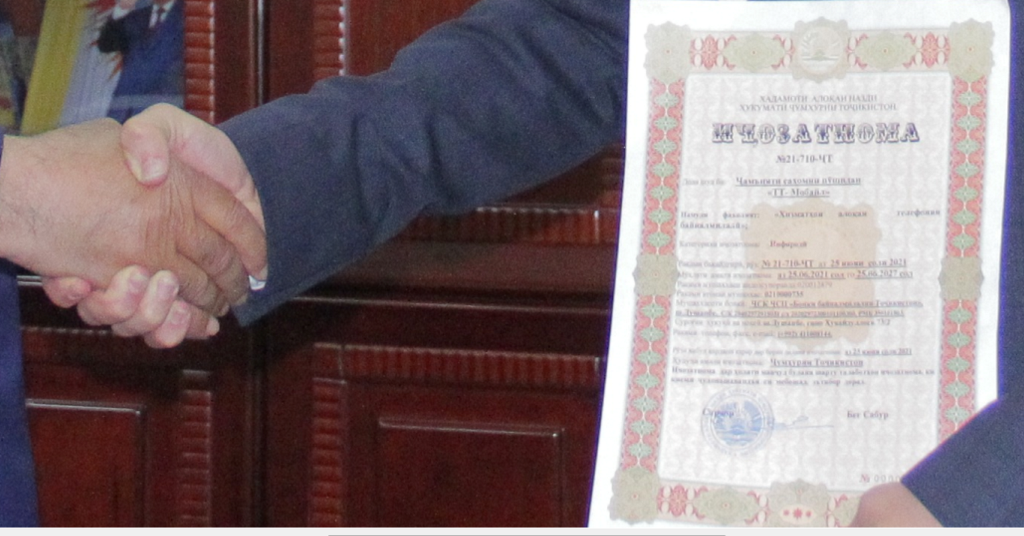
Two Closed Joint-Stock Companies (CJSCs) Indigo-Tajikistan (Tcell trademark) and TT-Mobile (Megafon Tajikistan trademark) have been granted license to provide high-speed Internet to Tajikistan.
According to information posted on the communications service agency’s official website on November 17, the document was issued for period until July 2027.
The Communications Service’s website says the companies will begin providing a high-speed Internet to Tajikistan within the next few days.
“This step will help reduce the cost and improve the quality of the Internet,” the website says.
Recall, the communications service agency noted on November 16 that “this move will contribute to the creation of a healthy competitive environment in the telecommunications sector and attraction of private capital in this sector.”
No other details were given. The Communications Service does not say whether these companies will have right to sell Internet to the population directly bypassing the centralized data spigot called the Unified Electronic Communications Switching Center, or EKTs in its Russian-language acronym.
In Tajikistan, the process of monopolization of the telecommunications market began in 2016 and that's when the Unified Electronic Communications Switching Center was established. The Tajik authorities required that all Internet and mobile communications traffic be run through the single state-owned telecoms provider Tojiktelecom. The Center centralizes all telephone and Internet communications with the aim of facilitating surveillance on the grounds of combatting terrorism and extremism. It allows the government to have complete control over domestic communications without any safeguards.
It should be noted that the idea of creating a government-administered information gateway has been circulating since 2005. The stated aim of the recurring initiative has been to prevent “illegal” communications that could undermine national security.
Changes to the rules at the start of 2018 radically enhanced Tojiktelecom’s earning power. Citing vague security concerns, the government deprived local fixed-lined and mobile service providers of the right to buy data traffic from neighboring countries. Instead, Internet service providers (ISPs) were required to buy their data from Tojiktelecom. This has given the company a suffocating degree of leverage over its privately owned peers.
Previously, ISPs had purchased Internet directly in bulk from Kyrgyzstan, Uzbekistan and China at the rate fluctuating from 10,000 to 20,000 US dollars per one gigabit, while according to data of 2019, the Unified Electronic Communications Switching Center sells Internet at the rate of 53,000 US dollars per 1 gigabit.
The Center itself does not name the price at which it sells the Internet to ISPs, referring to trade secrets.
Independent ISPs are as a result forced to pass on their own soaring costs to customers or, which is mainly what has happened, to reduce the quality of their services.
The greatest risk of the state’s monopolistic control over data traffic is that in the event of any serious technical issues arising at the telecommunications agency, the entire country will be left without any means of online communication. Experts worry this could pose a security risk.
It is to be noted that there were 4.1 million internet users in Tajikistan as of January 1, 2023. At the start of 2023, Tajikistan’s internet penetration rate stood at 40.8 percent of the total population
Kepios analysis indicates that internet users in Tajikistan increased by 164,000 (+4.2 percent) between 2022 and 2023.
For perspective, these user figures reportedly reveal that 5.95 million people in Tajikistan did not use the internet at the start of 2023, suggesting that 59.2 percent of the population remained offline at the beginning of the year.