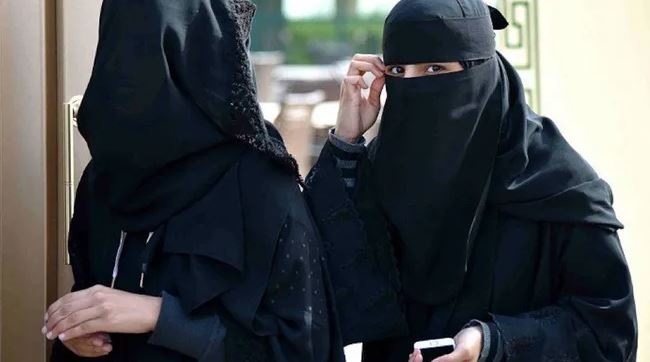
The head of Russia’s Human Rights Council, Valery Fadeyev, has said the government should consider a ban on wearing niqabs, a traditional Muslim veil that covers the entire face apart from the eyes, in the country.
The official voiced the proposal in an interview with the Parlamentskaya Gazeta newspaper published on May 20, which focused on the risks of extremism in multi-ethnic society.
Fadeyev, in particular, noted that wearing face coverings is banned in several countries in Central Asia, adding that he is planning to discuss potential measures in Russia with representatives of the Muslim community, as well as to raise the issue at a regional level.
“First of all, I’d like to outline my position: I think niqabs should be banned in Russia,” the human rights chief said.
Asked what migration problems pose the greatest threat to Russia today, Fadeyev said the most dangerous problem is the emergence of enclaves that are already forming in the territory of Russia.
“They are not created on purpose; migrants are just attracted to each other and prefer to live in certain areas, and those who are richer buy apartments there. The main problem is that the law stops working in enclaves as we see in the examples of France and England. And this problem can be solved only by using tough methods. You can, for example, place quotas on the purchase of apartments in certain areas so that migrants do not accumulate based on nationality. But this issue requires discussion, it is important not to violate human rights,” Russian human rights official said.
It is to be noted that Fadeyev’s proposal to impose ban on wearing niqab in Russia has met with a mixed response.
Eva Merkacheva, a member of Russia’s Presidential Human Rights Council, has supported Fadeyev’s initiative, noting that the European Court of Human Rights upheld a ban on wearing the burqa and full-face niqab veil in public, after it was introduced by several EU states nearly a decade ago.
The head of the State Duma (Russia’s lower chamber of parliament) Labor Committee, Yaroslav Nilov, told RTVI that any such measures should be discussed behind closed doors with representatives of Muslim groups and local authorities, without widespread media coverage.
Russian MP Ildar Gilmutdinov argued that a radical ban on wearing niqabs would worsen the situation, and that discussions should be conducted via religious organizations and federal agencies.