Every year landmines lead to the death and injury of thousands of people, in some cases even after a conflict has been resolved, says a statement released by Azerbaijan’s Embassy in Dushanbe.
Along with endangering human life, the mines seriously challenge socioeconomic development, damage the environment and cultural heritage, hinder post-war recovery and development initiatives, and ultimately impede the Sustainable Development Goals.
At least 60 states, including Azerbaijan, are still contaminated with landmines. In other words, more than 60 million people estimated to be living in areas affected by landmines around the world.
Humanitarian demining remains one of Azerbaijan’s key priorities in its state policy, mobilizing all available domestic resources to mitigate the mine danger. However, Azerbaijan considers international political and practical support crucial in preventing the humanitarian impacts of mines.
Azerbaijan faces a significant challenge due to landmine and explosive remnants of war (ERW) contamination.
Azerbaijan is among the most heavily mine-contaminated countries globally, with an estimated 1.5 million landmines and unknown number of ERW contaminating more than 13% of nation’s territories, posing severe risks to civilians and hindering socio-economic development.
The latest survey indicates that total contaminated area in the liberated territories of Azerbaijan stands at approximately 11,667 square kilometers. This area constitutes approximately 13.47% of the nation's total territory (the previous figure was 11.88%) of 86,600 square kilometers.
From the end of war in 2020 until June 30, 2024, 219 landmine explosion incidents occurred, resulting in 377 victims, including children and women, underscoring the urgent need for mine clearance and victim assistance. Over the last 30 years, the cumulative toll of landmine victims in Azerbaijan has reached 3,456.
The end of war in 2020 marked the beginning of an extensive humanitarian demining in Azerbaijan to restore safety in the liberated territories, facilitating the reconstruction of these areas and the safe return of former internally displaced persons (IDPs). Foreign assistance has accounted for merely 5% of the resources dedicated to demining. This is notably low, both in light of the gravity of demining challenges Azerbaijan confronts and when compared to the level of contributions typically made by the international donor community to similar issues elsewhere.
Azerbaijan is implementing humanitarian demining at its own expense. Adequate political and practical support from the international community for mitigating humanitarian consequences of mines and demining the affected areas are of utmost significance.
While addressing its mine problem, Azerbaijan has simultaneously launched multiple initiatives to rivet the international community’s attention to this matter. Last year Azerbaijan has officially declared humanitarian demining as the 18th National Sustainable Development Goal, and working to ensure the recognition of this issue as the UN’s Global 18th SDG. In the meantime, Azerbaijan has launched an initiative to establish a Special Contact Group on Humanitarian Demining within the Non-Aligned Movement. The Contact Group has begun operating since last September.
At the 15th meeting of the State Parties to the 1954 Hague Convention for the Protection of Cultural Property in the Event of Armed Conflict, a resolution on the “Impact of Mines on Cultural Heritage” was adopted at Azerbaijan’s initiative. Following this resolution, a special conference on the “Impact of Mines and Unexploded Ordnance on Cultural Property” was organized in Aghdam, in the Karabakh region of Azerbaijan, in May of the current year.
Over the past three years, Azerbaijan has hosted a number of international conferences, in collaboration with the UN, dedicated to the subject of mines. Along with being leading platforms for the discussion of mine action matters, these events draw greater attention to this significant problem that troubles humanity in the modern era. Presently, Azerbaijan is working with the UN to establish the “Center of Excellence” to provide education on the mine action.
Humanitarian demining is among the top priorities of Azerbaijan’s state policies. Today, the primary body in charge of humanitarian demining in Azerbaijan is the Mine Action Agency of the Republic of Azerbaijan – ANAMA.
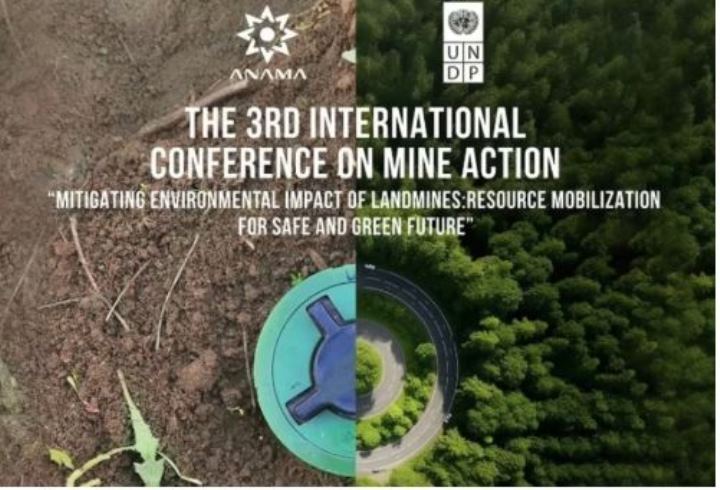
On May 30-31, 2024, co-organized by the Azerbaijan National Agency for Mine Action (ANAMA) and the United Nations Development Program (UNDP), the 3rd International Conference on “Mitigating Environmental Impact of Landmines: Resource Mobilization for Safe and Green Future” was held in the city of Zangilan and Baku, Azerbaijan.
Overall, as it stands, the presence of landmines and other unexploded munitions prevents civilians from returning to their homes by terrorizing and threatening humanitarian activities in Karabakh, Azerbaijan. Also, a mine-contaminated region has detrimental effects not only on the social and economic growth, but also on the rehabilitation of the local population as people cannot move around freely even if they return back their homes.
Demining is an important element of Azerbaijan-Armenia normalization deal, and therefore should be supported more vigorously by the international community, the statement says.