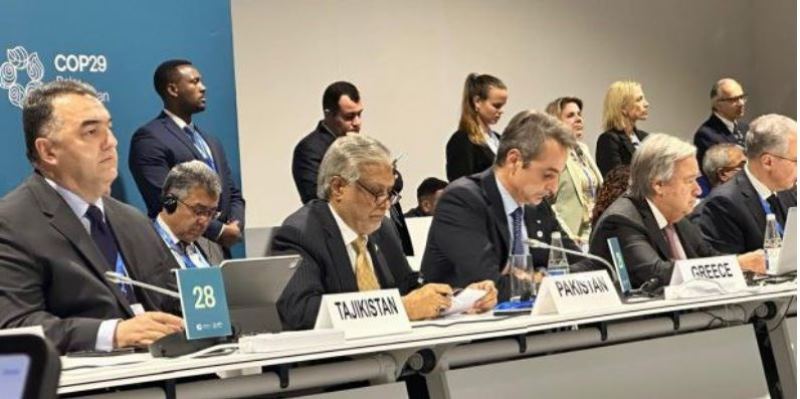
On Wednesday November 13, Tajikistan’s Minister of Energy and Water Resources, Daler Juma, participated in the High-Level Dialogue titled "Advancing the Mountain Agenda, Common Trends, and Climate Change" in Azerbaijan’s capital, Baku, reads the press center of the Ministry of Energy and Water Resources of Tajikistan (MoEWR).
Speaking at the event, which was organized by Kyrgyzstan as part of the 29th Conference of the Parties to the UN Framework Convention on Climate Change, Mr. Juma emphasized that Tajikistan is a mountainous country, with 93% of its territory covered by mountains, and nearly half of the country’s area lies at an altitude of over 3,000 meters above sea level.
Roughly 60% of Central Asia's water resources originate from Tajikistan's glaciers. The Zarafshan, Gissar, and Alay mountain ranges are located in Tajikistan, and the Pamir range spans the eastern part of the country. The highest peak in the Pamir range, Ismoil Somoni, reaches 7,495 meters, and there are more than 24 peaks over 6,000 meters in Tajikistan.
These mountains are reportedly rich sources of minerals, forests, and agricultural products and are home to glaciers, lakes, and rivers. Glaciers cover 6% of the country, including the well-known Vanjyakh Glacier (formerly Fedchenko Glacier).
The minister noted that rapid glacier melting due to climate change poses a serious threat to global water resource conservation. Over the past 30 years, more than 1,000 of Tajikistan's 14,000 glaciers have disappeared, glaciers essential to the region's ecosystem.
Daler Juma highlighted that rising air temperatures have accelerated glacial melt, leading to an increase in natural disasters and the degradation of water ecosystems. Integrated approaches and cooperation are critical for the development of mountainous regions, particularly in improving the economy and quality of life in mountain areas.
Tajikistan will continue constructive collaboration with countries worldwide to strengthen vital sectors, especially environmental and climate initiatives, Tajik minister added.