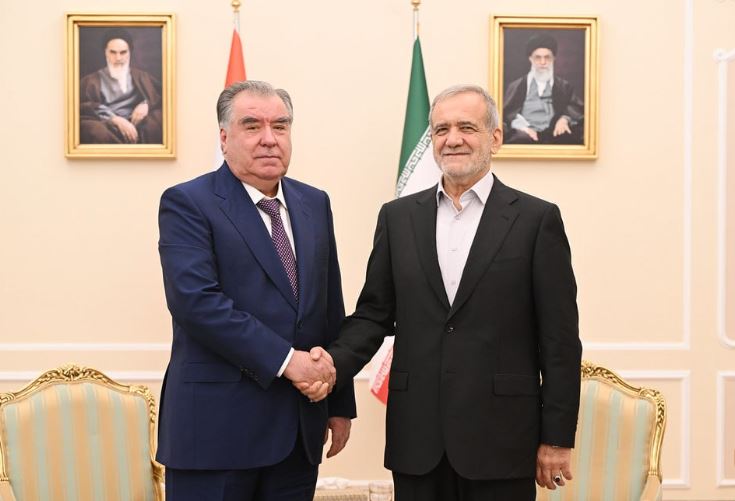
Masoud Pezeshkian, the President of the Islamic Republic of Iran, is expected to make a visit to Tajikistan in mid-January.
While in Dushanbe, Masoud Pezeshkian is set to meet with Tajikistan's President, Emomali Rahmon and some other high-ranking Tajik state officials, an official source within Tajikistan’s Ministry of Foreign Affairs (MFA) told Asia-Plus in an interview.
According to the source, the visit will include not only meetings between the two leaders but also other discussions, negotiations, and the signing of various agreements.
The delegation will also include a group of high-ranking Iranian entrepreneurs who will discuss cooperation opportunities with their Tajik counterparts, the source added.
Business delegation and forum
During the visit on January 15–16, a large delegation of Iranian businesspeople, led by the Chairman of the Iran Chamber of Commerce, Industries, Mines and Agriculture (ICCIMA), along with figures from the industrial, mining, and agricultural sectors, is expected to arrive in Dushanbe.
ICCIMA’s official website says the program includes a business forum, B2B meetings with Tajik companies and officials, visits to industrial and commercial facilities, and a conference at the Iranian Embassy.
Additionally, Iranian Students' News Agency (ISNA) reports that a group of Iranian doctors will accompany the delegation to exchange experience with their Tajik counterparts.
From establishing the Roudaki School to increasing direct flights
It is noteworthy that Nizomiddin Zohidi, Tajikistan’s Ambassador to Iran, recently held discussions with senior Iranian officials about establishing a joint Roudaki School in Dushanbe.
As it had been reported earlier, Ambassador Zohidi met with Iran’s Education Minister, Alireza Kazemi, in Tehran on December 29.
IRNA says the parties discussed educational challenges and the ways to improve cultural bonds between the two countries.
Zohidi reportedly highlighted cultural, historical and religious commonalities between the two countries, saying Tajikistan and Iran have had good cooperation and signed numerous documents, including the Joint Commission for Trade and Economic Cooperation.
Referring to the legal problem of Roudaki School in Tajikistan, which was built jointly with Iran, Tajik diplomat was cited as saying that the project is facing challenges in the three areas of ownership, textbook content, and management, which will be resolved and the school be opened as soon as possible.
A Joint Committee for Cooperation between Tajikistan and Iran is also expected to be established. In this context, the Tajik ambassador held talks with Iran’s Minister of Cultural Heritage, Tourism and Handicrafts, Reza Salehi Amiri.
Plans are underway to establish direct flights between Dushanbe and Shiraz, complementing the existing direct flights to Tehran and Mashhad.
Another initiative includes a joint film project highlighting the cultural and historical heritage of both nations, to be produced in multiple languages.
It remains unclear whether these matters will be discussed during the meeting between Emomali Rahmon and Masoud Pezeshkian. However, it is evident that the visit will mark a new chapter in bilateral relations.
This will mark President Pezeshkian’s first official visit to Tajikistan.
Masoud Pezeshkian was elected President of Iran in July 2024 following the death of his predecessor, Ebrahim Raisi, in a helicopter crash.
The Complex path of relations between the two countries
Tajikistan and Iran have traditionally close relations, sharing many similar cultural, religious and ethnic identifiers and Iran has been a major sponsor of essential hydropower infrastructure in Tajikistan, but Iran has angered Tajikistan by inviting the Islamic Revival Party (IRPT) leader Muhiddin Kabiri to attend the International Islamic Unity Conference that took place in Tehran on December 27-29, 2015.
Tajikistan started taking efforts to improve its relations with the Islamic Republic of Iran in early 2019, and the long period of chill in relations between Tajikistan and Iran has come to an end. There was clear evidence of that in late May of 2022, when Tajik President Emomali Rahmon paid an official visit to Tehran and signed 17 cooperation agreements.
In June 2022, Deputy Iranian Interior Minister for Security and Police Affairs Sayed Majid Mirahmadi, visited Dushanbe to attend the first meeting of the joint security task force between Iran and Tajikistan.
In September 2023, Tajik President Emomali Rahmon and his Iranian counterpart Ebrahim Raisi held talks in New York on the margins of the 78th session of the United Nations General Assembly. The two presidents discussed further expansion of the bilateral cooperation and a number of topical and regional issues being of mutual interest.
In July last year, Emomali Rahmon attended Pezeshkian's inauguration ceremony. During that meeting, the Iranian president emphasized the importance of strengthening ties with Tajikistan, highlighting efforts to reduce political barriers and enhance cooperation.
On August 10 last year, Iran and Tajikistan agreed to scrap visa requirements for travels between the two countries.
On September 23 last year, Emomali Rahmon met with Iranian President Masoud Pezeshkian in New York on the sidelines of the 79th session of the United Nations General Assembly (UNGA 79). The parties discussed a wide array of issues related to bilateral cooperation between the Republic of Tajikistan and the Islamic Republic of Iran. At the end of the meeting, Emomali Rahmon invited Masoud Pezeshkian to visit Tajikistan at a time convenient for him
Meanwhile, Iran’s Tabnak reported on January 6 that the Iranian president will travel to Moscow on January 17 to sign a comprehensive strategic partnership deal between Iran and Russia.
Tehran and Moscow previously established a 20-year strategic agreement in 2001, encompassing collaboration across various sectors including industry, technology, security, energy, and the development of nuclear power plants.
This original pact was automatically extended for an additional five years in 2020, while both nations agreed to initiate the drafting of a new long-term strategic agreement.