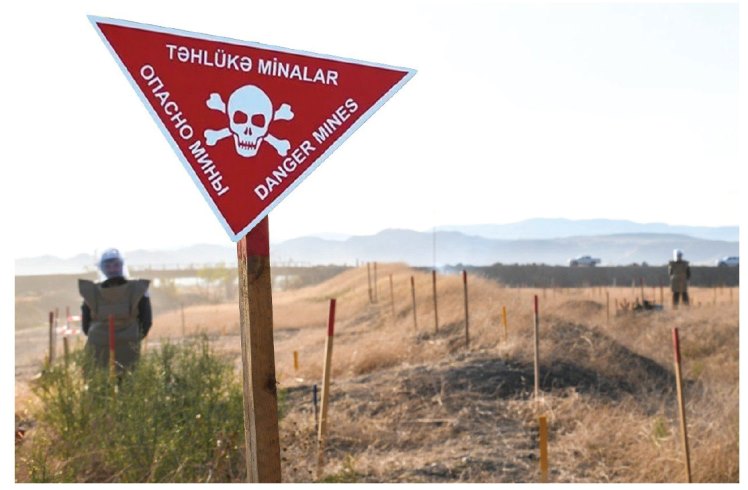
The Republic of Azerbaijan that suffered from the landmine threat and has many landmine victims both throughout 30-year-long military occupation of its territories, as well as during post-conflict period, emphasizes the importance of seriously addressing the landmine threat.
Azerbaijan is among the most heavily mine-contaminated countries globally. Ongoing landmine menace even in the post-conflict period, remains a source of enormous danger to the lives and health of Azerbaijan citizens, along with impeding the restoration and reconstruction works in the region and the return of former IDPs to their lands.
Geography of landmine cases that have occurred so far, the fact that majority of them have taken place outside the former contact line, particularly in places where civilian facilities, residential areas, as well as cemeteries are located, proves that landmine threat has been purposefully aimed at high casualties among the civilian population.
The latest survey indicates that total contaminated area in the liberated territories of Azerbaijan stands at approximately 11,667 square kilometres. This area constitutes more than 13% of the nation's total territory of 86,600 square kilometres. Estimated 1.5 million landmines and unknown number of ERW contamination in these territories pose severe risks to civilians and hinder socio-economic development.
From the end of war in 2020 until now, 230 landmine explosion incidents occurred, resulting in 383 victims, including children and women, underscoring the urgent need for mine clearance and victim assistance. Over the last 30 years, the cumulative toll of landmine victims in Azerbaijan has exceeded 3,400.
The end of war in 2020 marked the beginning of an extensive humanitarian demining in Azerbaijan to restore safety in the liberated territories, facilitating the reconstruction of these areas and the safe return of former internally displaced persons (IDPs). Foreign assistance has accounted for only 6% of the resources dedicated to demining. This is notably low, both in light of the gravity of demining challenges Azerbaijan confronts and when compared to the level of contributions typically made by the international donor community to similar issues elsewhere.
Following the victory of Azerbaijan glorious army in 44-day Patriotic War the Azerbaijan National Agency for Mine Action, established in 1998, was restructured into the Mine Action Agency of the Republic of Azerbaijan (ANAMA) in 2021 by the decree of the President of Azerbaijan. As a public legal entity ANAMA is not only responsible for planning, coordinating and managing mine action but also oversees all humanitarian mine clearance operations across the country. It serves as the primary executing body in this field.
As part of the “Great Return” program to liberated territories of the Republic of Azerbaijan, identified as one of the main strategic goals in the National Priorities for Socio-Economic Development: Azerbaijan 2030, ANAMA is conducting large-scale mine clearance activities in accordance with International Mine Action Standards (IMAS). The clearance operations, primarily in areas designated for residential infrastructure, agriculture, transportation, energy, industrial parks, and other priority sectors, are carried out with the support of manual deminers, specialized mechanical equipment, mine detection dogs, and rats. International non-governmental organizations (NGO’s), such as MAG and APOPO, also contribute to the mine clearance efforts. Additionally, relevant state institutions, local companies, and NGO’s are actively involved in the process.
Refusing to present accurate maps of landmines it planted in the Azerbaijani territory complicates the demining efforts and obstructs return of former 800,000 IDPs to their homes.
Given the immense adverse humanitarian impact, and the fact that lingering landmine contamination represents a challenge to efforts to achieve peace and reconciliation, Azerbaijan counts on adequate political and practical support by the international community to its demining efforts as a matter of human solidarity.
Azerbaijan would appreciate practical assistance for demining efforts, as well as given Azerbaijan's relatively developed institutional capacity and training frameworks, the most critical form of assistance needed at this juncture is direct financial donations to amplify the scope of operations. Other priorities include mine victim assistance (as well as providing prostheses); technical surveys and feasibility studies; data management and technological advancements; implementing geo-spatial methodologies and technology layering to refine clearance needs; support for female demining teams; mechanical demining enhancement; mine detection dogs (MDD) training; demarcation and fencing; and explosive ordnance risk education (EORE).
Currently, while conducting mine clearance activities in the liberated territories, ANAMA also participates in various international projects and initiatives, mobilizing its efforts globally to combat mine threats and safeguard human safety.
Azerbaijan conducts its mine action efforts using mainly its resources, with approximately 95% of this work being funded by the Government of Azerbaijan.
While international organizations and partner countries contribute to mine action efforts in Azerbaijan, given the scale of the problem, this support is insufficient. Therefore, increasing international attention and support in this area is essential. We believe that only by collective efforts at the global level we can make effective contributions towards resolving this issue.