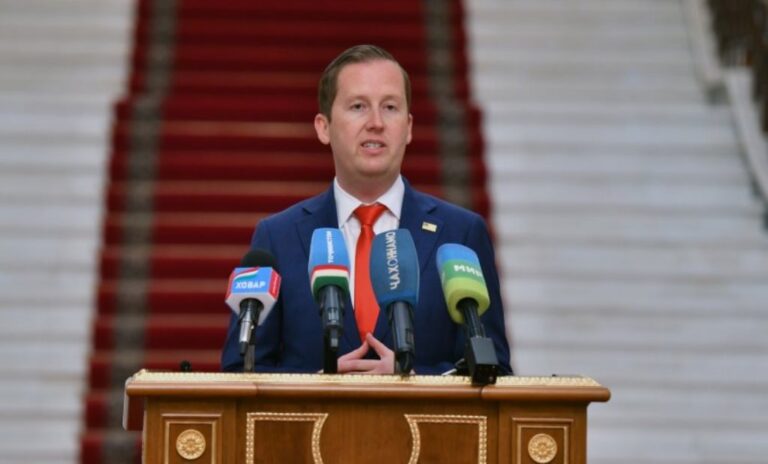
On February 27, members of several committees of Kyrgyzstan’s parliament (Jogorku Kenesh) listened to the report of the head of the State Committee for National Security (GKNB), Kamchybek Tashiyev, during the discussion of the Agreement on the Demarcation and Delimitation of the Kyrgyz-Tajik Border. He shared the details of the border areas exchanged between the two countries.
Here is the full text of Kamchybek Tashiev's speech, published by the AKIpress news agency:
"Regarding the description of the border in the Leilek district, Kyrgyzstan has been handed 155 hectares of the Kayragach area from Tajikistan and 35 hectares of the Kayragach enclave. The total area is 190 hectares. In exchange, Kyrgyzstan transferred 21 hectares from the Saada area, 23.5 hectares from the Razakov area, 4 hectares from the Selkan area, 7 hectares from the Mayty area, 12.5 hectares from the Proletarsk area, 15 hectares from the Ulak-Jai area, 7 hectares from the Ak-Aryk area, and 65 hectares from the Karabak area. In addition, 35 hectares from the Mayty area were exchanged for the Kayragach enclave. The total area exchanged was 190 hectares.
"We received 190 and gave away 190. The Leilek people know… We gave up small plots and conducted the exchange. If you ask, 'What about the 12.5 hectares of Proletarsk?' In the Soviet times, there was an organization called 'Selkhozkhimiya' or 'Selkhoztekhnika' located there, which had a 12.5-hectare plot. But this plot was sold. We reclaimed this land. If we had stayed silent, no one would have noticed. But we returned these lands. Also, lower down from Ak-Aryk, there were 7 hectares of land that our people never visited or used. These places were used by the Tajiks. But we counted these lands as ours.
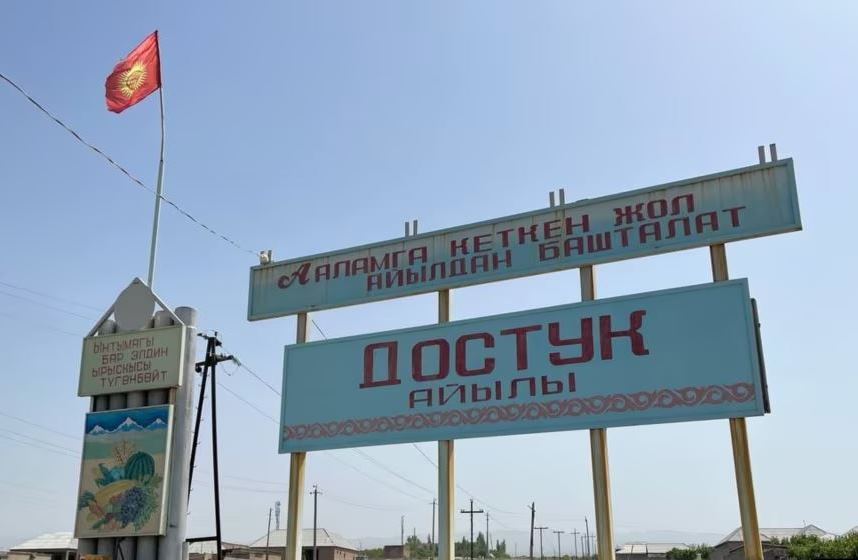
Due to the fact that the state border, established in 1992, passes along the middle of the Khujand–Arka–Kanibadam highway, the Tajik side proposed to fully hand over this highway and 3 hectares of the 'Dostuk' market to them. The total area was 12 hectares. So, the middle of the road on our side and the market. In return, we received double the area – 25 hectares of agricultural land in the Lakkon region. Why? We explained that the market was a commercial area, and people were making money there. This is the first point. The second point is that the road is not just a plot of land. The Kyrgyz side handed over 200 hectares in the Karabak-Lakkon region. In exchange, the Tajik side handed over 200 hectares, including 130 hectares in the Karabak-Lakkon region and 70 hectares in the Kuruk-Say region. These are agricultural lands.
In the Kayragach region, the state border runs along the Selkan canal. The Kayragach enclave has been abolished. The Karabak–Lakkon highway was handed over to the Tajik side.
Let me explain why. The Tajik side had a bypass road around Karabak. They asked to create conditions to allow direct passage instead of the detour. We agreed and asked for 200 hectares of agricultural land in exchange.
So what happened? Below Kulundu, there is a large Selkan canal, and on that side, there were small plots, which we gave up. We received land from them. Now, the border will pass along the Selkan canal, not as before, where there were 2 hectares on one side and 4 hectares on the other.
Regarding the 'Golovnoy' water intake, because the border passes along the Ak-Suu/Isfara river… Let me explain further. During the negotiations in 1989, the Kyrgyz and Tajik sides agreed to divide the 'Golovnoy' water intake equally. But we didn't consider it, and we didn't accept it. The Ak-Suu river initially splits into two, but when it reaches the 'Golovnoy' area, it no longer splits. They said it should be divided, but we said no. These were disputes that lasted for two years.
As a result, we said that if we are going to divide it, you must compensate us. Still, there are agreements on how to divide the water. We divided the three sluices equally – one and a half each. There was a difference of about 3 meters. As a result, we took 500 hectares of land in the Munzhy-Bulak area in the Chon-Alai district, a very contentious area, and 100 hectares of land in the Karool-Don area.
At the entrance to the city of Sulyukta, the border passed directly over the city. We shifted this part by 100 hectares. We moved it away from the main road. We also received 150 hectares of the Katta-Tuz area. This area was alternately considered Tajik and Kyrgyz, and there were disputes. However, after reviewing the documents, we determined that this area was never ours. Despite that, we divided it equally – 300 hectares each. All the oil wells were split in two. Additionally, from the 300 hectares, we received 150 hectares. So, if the Katta-Tuz area was 600 hectares, we received 450 hectares. For the one and a half sluices at the 'Golovnoy' water intake, we received 750 hectares."
Here is what was exchanged between Tajikistan and Kyrgyzstan
We have organized the strip of land between Batken district of Kyrgyzstan’s Batken region and Isfara district of Tajikistan’s Sughd province, Tashiyev said.
According to him, the following areas were exchanged:
Lands transferred to Tajikistan:
- 91 hectares of land from the village of Dostuk
- 8.3 hectares from the Mazait area
- 17.5 hectares from the village of Kok-Terek
- 20.1 hectares from the village of Tash-Tumshuk
- 5 hectares from the Dacha area
Lands received in exchange:
- 18.4 hectares from the village of Somoniyon in the Isfara district
- 3.1 hectares from the Dakhmu area
- 21.5 hectares from parts of the village of Khoja-i-Alo
- 2.7 hectares from the Govsuwar area
- 42 hectares from the Min-Bulak area
- 55 hectares from the Lakkon area
In total, Kyrgyzstan received 142.7 hectares.
Additionally, instead of compensation for the new houses in the village of Dostuk, Kyrgyzstan received 30 hectares of agricultural land in the Lakkon region. Tashiyev explained, "We completely gave up the village of Dostuk. This village is the most remote, and it holds no economic or strategic value for us. We gave up 91 hectares and received the same amount in return."
Voruukh enclave: In 1991, the Tajik side had been using 19 hectares of land in the Voruukh enclave. After complex negotiations, Kyrgyzstan handed over 14.5 hectares to Tajikistan. Tashiyev stated that the Tajik side had crossed over the mountains and fully occupied the area, making it inaccessible for Kyrgyz citizens. Following their request, the Tajik side also received 1,000 hectares of pastureland around the Voruukh enclave. In exchange, Kyrgyzstan received 1,000 hectares of pastureland in the Karagan-Say area of the Chon-Alai district.
The Tajik side had requested 5,000 hectares of land for grazing, but Kyrgyzstan agreed to give them 1,000 hectares. Tashiyev noted, “We couldn’t give them 5,000 hectares, but we gave them 1,000 hectares. In return, we received 1,000 hectares of pastureland in the Chon-Alai district.”
Disputed areas and infrastructure: Tashiyev also highlighted an area where a conflict had occurred involving wagons. “There was a conflict, and we had to intervene with two helicopters, one of which had to make an emergency landing. We forced them to remove the wagons. This area, where the wagons had been placed, is now under Kyrgyz control – 300 hectares.”
Furthermore, the former bridge in the Karagan-Say area, which was transferred to Tajikistan, will no longer need a new bridge to be built, as Kyrgyzstan plans to use the existing bridge for access to pasturelands.
Neutral status roads: the agreement also covers the construction and use of neutral status roads:
- Dacha-Kapchygay-Khojai-Alo-Voruukh (3,425 meters long, 40 meters wide)
- Min-Oruk-Samarkandek-Oriona-Shuriston (3,241 meters long, 40 meters wide)
Additionally, a road section at Tort-Kocha (253.74 meters) located at the intersection of the Osh-Razzakov and Isfana-Voruukh roads will also have neutral status, ensuring access for both countries.
Other developments:
- Both Kyrgyzstan and Tajikistan will use roads such as Kulundu-Maksat in the Sai Leilek district.
- The agreement includes provisions for shared use of border infrastructure, such as agricultural and energy facilities previously built during the Soviet era, with both sides now granted access to these facilities under agreed-upon terms.
“All problematic issues concerning the Kyrgyz-Tajik border have been resolved,” Tashiyev concluded, noting that this exchange marks a significant step in the ongoing efforts to resolve the border disputes between Kyrgyzstan and Tajikistan.
Kyrgyzstan lifts the secret label
It has been reported that the materials concerning the delimitation and demarcation of the Kyrgyz-Tajik border will no longer be classified as “for official use only.”
According to Tashiyev, previously the documents related to the borders with Tajikistan were classified because there could have been various interpretations that might affect the outcome. However, now that an agreement has been reached and signed, the materials will be discussed openly.
“Before, all the documents were classified because, during the work, there could have been different interpretations that might negatively impact the results. But from today, this classification is lifted, and we will discuss everything openly because we have already reached an agreement and signed it. After the committees review the draft agreement, the document will be signed by the presidents. Then we will return to the Jogorku Kenesh (Parliament) for ratification, after which the final version will be signed by the presidents, and the treaty will be concluded," said Tashiyev.
Principles behind the border agreement
Tashiyev also shared the principles on which the agreement was reached. The total length of the Kyrgyz-Tajik border is 1,006.84 km, of which 519.9 km was determined by 2011, and the remaining 486.94 km was agreed upon only in the last three years. The Tajik side proposed signing documents concerning the 519.9 km of the border, but Kyrgyzstan insisted on resolving all issues fully.
During negotiations, both sides proposed using different historical documents: Tajikistan referred to maps from 1924-1927, while Kyrgyzstan used agreements from 1991, such as the Almaty Declaration and the Moscow Declaration. The delimitation work became more productive starting in 2021, when both sides agreed to use the 1991 documents.
"Decisions were made taking into account the interests of both sides. Boundaries defined only in the interest of one side will not lead to peace. Only when both sides' interests are satisfied can we expect peace and stability," Tashiyev emphasized.