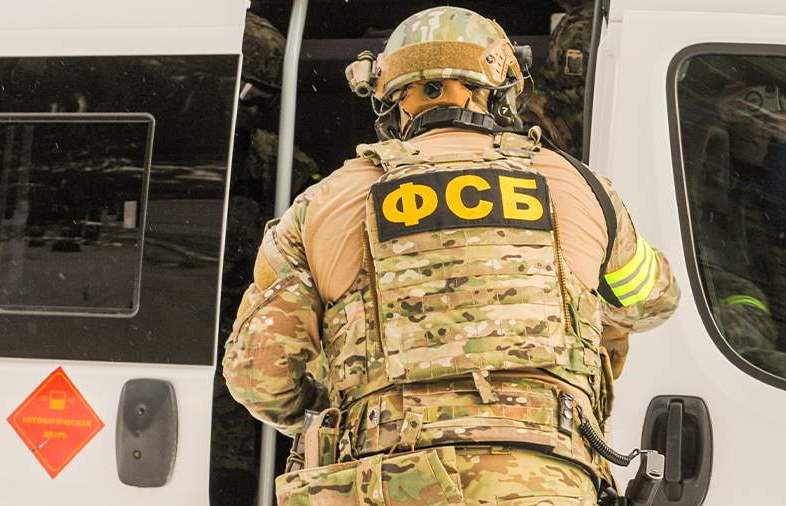
Citing a report from the Public Relations Center of the Federal Security Service (FSB) of Russia, TASS reported on April 24 that FSB officers prevented a terrorist attack at a petrochemical enterprise in the Nizhny Novgorod oblast. The attack was reportedly being prepared by two natives of Central Asia, “who were neutralized during an attempted arrest.”
The specific countries of origin of the foreign nationals who were killed are not disclosed.
The FSB noted that “the eliminated migrants were adherents of the ideology of an international terrorist organization banned in the Russian Federation.”
"Acting on the instructions of their Ukrainian handler, the foreign nationals retrieved FPV drones with homemade explosive devices from a hiding place to carry out a sabotage-terrorist act at one of the petrochemical enterprises in the region. During their arrest, they resisted with firearms and were neutralized by return fire," the FSB report states.
At the scene, two UAVs with explosive components made from foreign-produced explosives, a Kalashnikov assault rifle, and a Makarov pistol were reportedly seized. In the migrants' phones, there was correspondence with their handler, as well as “coordinates of a cache with means of destruction and firearms,” according to the FSB Public Relations Center.
The Investigative Department of the FSB”s Office in the Nizhny Novgorod Oblast has reportedly instituted criminal proceedings on the preparation of a sabotage and an investigation is under way.
Recently, Russia’s security services have mainly reported on the annihilation of terrorists, mostly Central Asians, who allegedly attempted to carry out terrorist attacks in the country.
Thus, two months ago, three young Tajik migrants in Russia were killed on suspicion of possible involvement in terrorism. Their relatives insist that the victims had no inclination towards extremism and had no criminal past. Two of them were the sole breadwinners for their families.
On February 13, Russian authorities suspected the three Tajik migrants of planning a terrorist attack at a railway station in the city of Pskov. During the preparation for the attack, they allegedly conducted reconnaissance of the area, purchased components for making an improvised explosive device, and began assembling it.
FSB officers killed them during a special operation in one of the residential buildings.
Experts argue that no one can be considered guilty without a court decision, but Russian security services are ignoring this principle and spreading various versions in the media.