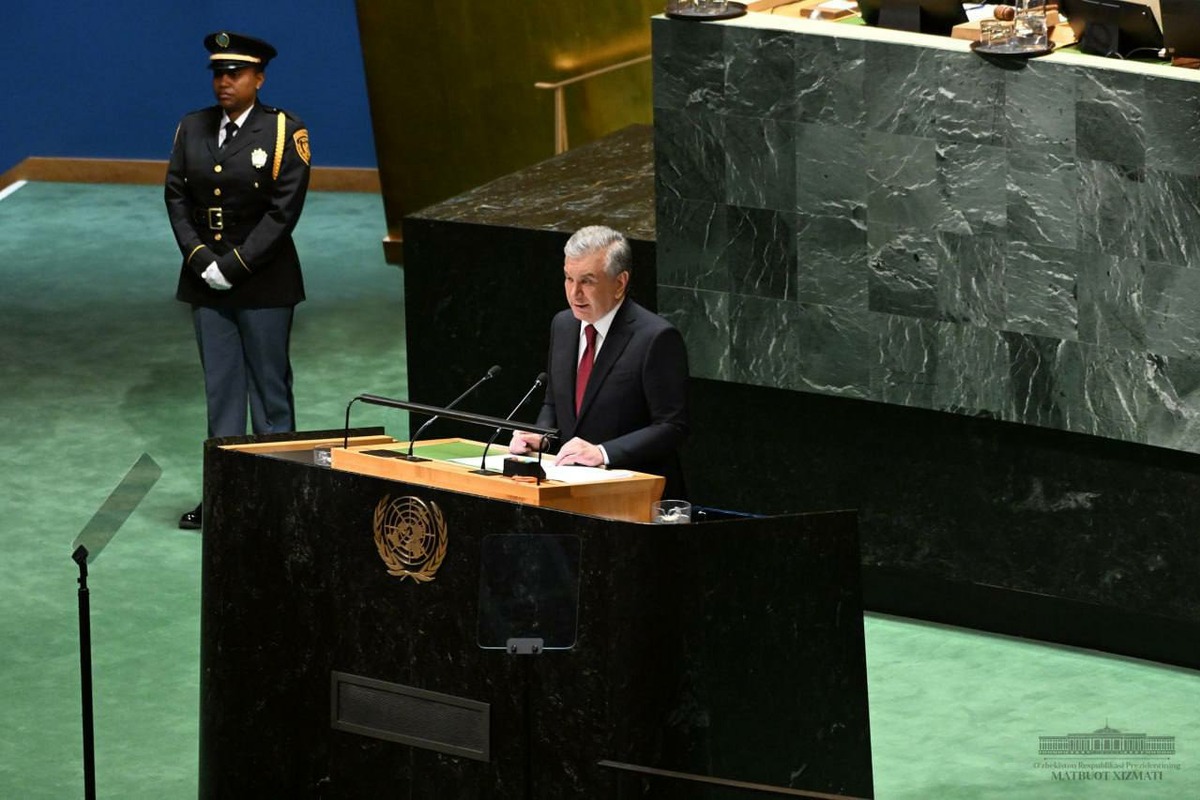
Addressing the 80th session of the United Nations General Assembly, President of Uzbekistan Shavkat Mirziyoyev declared that Central Asia has turned the page on an era of closed borders, disputes, and unresolved conflicts. According to him, the region is now entering a new era of peace, good-neighborliness, and partnership — a strategic goal first set eight years ago and now successfully achieved.
Trade, investment, and regional integration
Mirziyoyev highlighted that in recent years, trade, investment, and transport flows between Central Asian states have increased fivefold. Cross-border trade, joint investment funds, cooperation zones, and large-scale infrastructure projects are all expanding. Regular summits of regional leaders have played a decisive role in this progress, he noted, according to Fergana.
He described the emergence of a “New Central Asia” — a cohesive, stable, and independent region steadily strengthening its position on the international stage.
New initiatives with the UN
To further advance cooperation, Mirziyoyev proposed several initiatives in partnership with the UN: 1) convening a regional economic forum under the auspices of ECOSOC and UNCTAD; 2) establishing a hub for green technologies with UNIDO; and 3) launching programs on sustainable water management.
He also suggested that the UN General Assembly adopt a resolution supporting efforts toward deeper regional integration.
Security and Afghanistan
Addressing security concerns, particularly in relation to Afghanistan, Mirziyoyev warned against isolating the Afghan people. He called for a resolution to support the development of transport and energy corridors through Afghan territory.
Additionally, he proposed transforming the Regional Expert Council on Rehabilitation and Reintegration into an International Competence Center and expressed readiness to host a regional office of the UN Counter-Terrorism Office in Uzbekistan.
Environmental challenges
Mirziyoyev also focused on ecological threats, especially the crisis of the Aral Sea. He reported that over 2 million hectares of vegetation have already been planted on the dried seabed, with plans to green up to 80% of the territory by 2030.
Uzbekistan, he added, intends to organize a World Forum on Water Conservation and called for global recognition of the water crisis as a threat to sustainable development.