Changing one's surname, first name, or patronymic in Tajikistan has become significantly more expensive following recent amendments to the country’s law “On State Duty,” signed by President Emomali Rahmon.
Previously, the fee for officially changing personal names was set at 3 calculation indicators, with each unit equivalent to 75 somonis, totaling 225 somonis. Under the new amendments, the cost has doubled to 6 calculation indicators, or 450 somonis.
The legislative changes were initially approved by the Tajik government on May 29, followed by ratification from the country’s lower house (Majlisi Namoyandagon) of parliament on June 25. The upper house, the Majlisi Milli, also gave its approval before the president signed the bill into law on October 1. The law will come into force one month after its official publication.
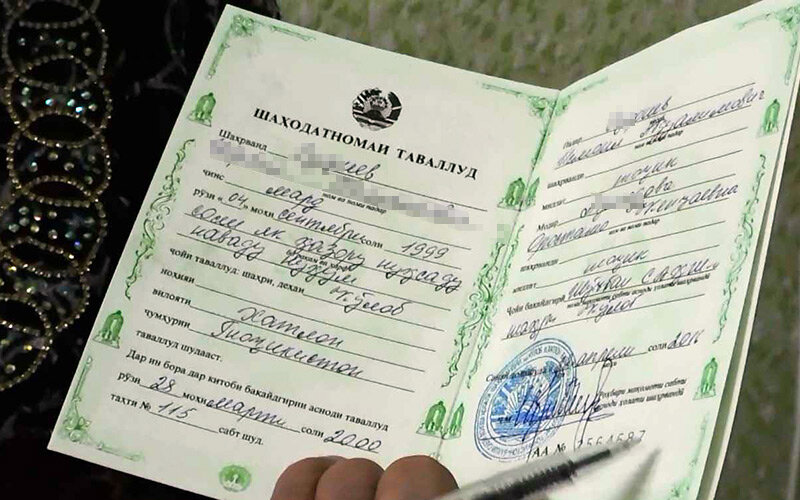
According to Article 67 of the Law of the Republic of Tajikistan “On Civil Status Registration,” citizens aged 16 and older have the right to change their name, surname, and patronymic. This right is voluntary and is considered a personal legal choice rather than an obligation.
Until January 2021, the process of reviewing a name change application took up to three months. However, amendments passed in late 2020 shortened this timeframe to one month.
Although not mandatory, name changes have become increasingly common in recent years. These changes are carried out in accordance with the national register of Tajik names.
In June 2020, further changes were made to Article 20 of the law governing civil status registration. The amendments banned the use of Slavic-style suffixes such as “-ov,” “-ova,” “-ev,” and “-eva” in surnames, as well as “-ovich,” “-ovna,” “-evich,” and “-evna” in patronymics for newborns.
Instead, the law encourages the use of traditional Tajik suffixes including “-i,” “-zod,” “-zoda,” “-on,” “-yon,” “-yor,” “-niyo,” “-far,” “-pur” (for men), and “-dukht” (for women).
It is to be noted that President Emomali Rahmon Rahmonov changed his surname to Rahmon, getting rid of the Russian-style "-ov" ending, in March 2007. He also removed the patronymic, Sharipovich, from his name altogether. Rahmon explained that he had done so out of respect for his cultural heritage. Following the move, scores of government officials, including members of parliament and civil servants, also removed Russian-style patronymics and "-ov" endings from their surnames. Tajikistan officially banned giving Russian-style patronymics and surnames to newborn Tajik children in April 2016, with children from minority and mixed families retaining the right to their traditional surnames. A new law that bans giving newborn babies last names with Russian-style endings went into effect in Tajikistan on April 29.