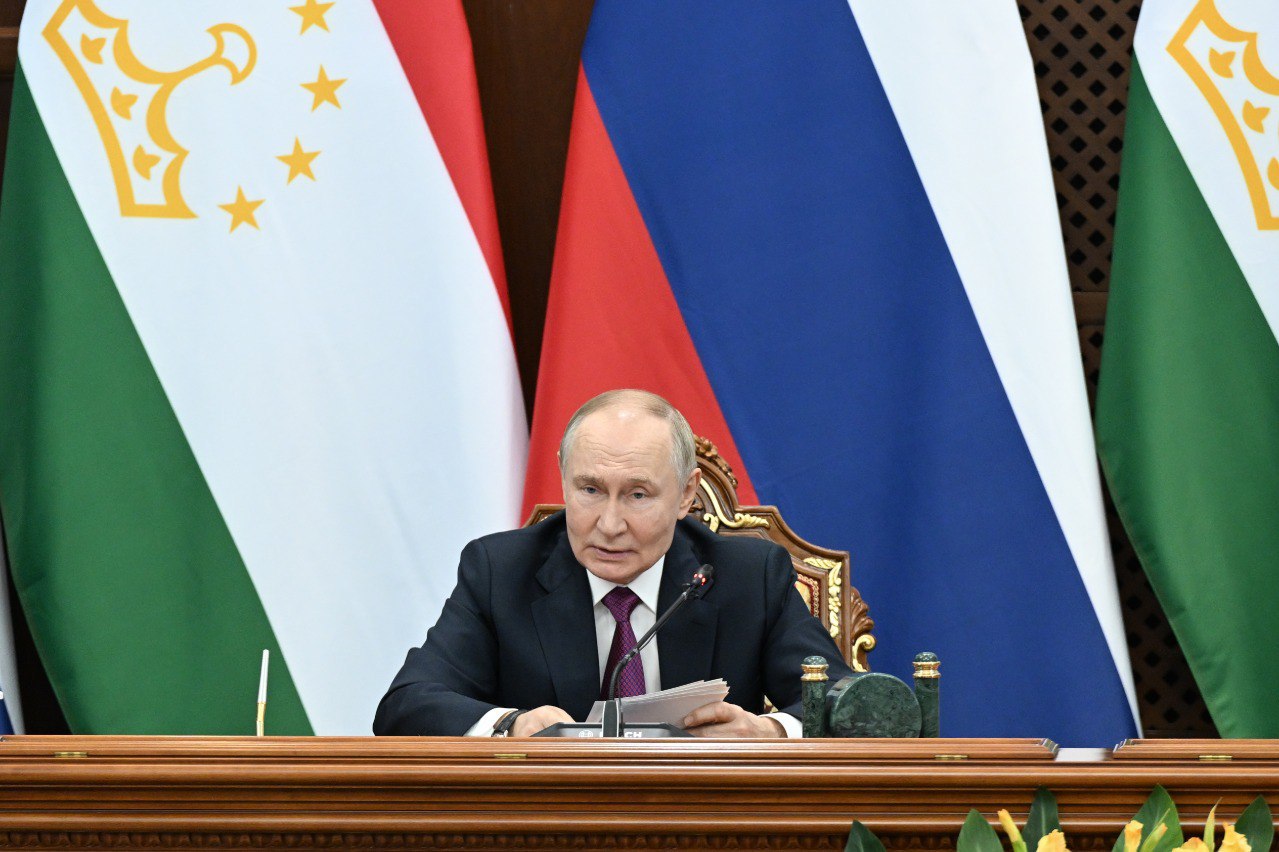
Russian President Vladimir Putin announced an ambitious plan to expand Russia’s energy investments in Central Asia, signaling readiness to support the construction of hydroelectric and nuclear power plants across the region.
Speaking at the second "Russia–Central Asia" summit in Dushanbe, Putin emphasized on October 9 that while Russian investments in the region have already surpassed $20 billion, much more is needed to fully realize the potential of regional cooperation.
“Russian companies are prepared to contribute not only to traditional hydrocarbon projects, but also to the construction of nuclear and hydroelectric power stations, the development of renewable energy sources, and the modernization of water and energy infrastructure,” said Putin.
He highlighted Moscow’s willingness to participate in projects ensuring the safe operation of transboundary water systems and efficient water resource management. “We are talking about modern Russian technologies and the integration of renewables into the regional energy mix,” he added.
Investment priorities and strategic focus
According to Putin, trade between Russia and Central Asian nations has exceeded $45 billion, and cumulative Russian investments in their economies have topped $20 billion. Still, he argued that these figures fall short of the region's true potential.
He called for intensified cooperation, particularly in high-tech and industrial sectors, and encouraged efforts towards import substitution and infrastructure modernization.
Among existing collaborative efforts is the renovation of hydroelectric facilities, many of which date back to the Soviet era. Projects include Russia’s participation in upgrading water infrastructure in the Amu Darya and Syr Darya river basins, as well as initiatives focused on water conservation, wastewater reuse, and reforestation in the Aral Sea region.
Putin also noted that Russia has already allocated over $33 million for joint programs with Central Asian states.
Energy aside, he stressed the strategic importance of improving transport and logistics, pointing to the development of key corridors such as “North–South” and “East–West.”
Existing and planned energy projects across the region
Russian energy companies have expressed readiness to invest in the construction of new hydroelectric power plants throughout Central Asia.
In Tajikistan, Russia has already established a foothold in the hydropower sector, notably through its significant stake in the Sangtuda-1 Hydropower Plant.
A flagship future project is the Kambarata-1 Hydropower Plant on the Naryn River in Kyrgyzstan, which is expected to become the country's largest power station upon completion. Another major initiative is the Upper Naryn cascade of hydropower stations, also backed by Russian investment.
Russia is also looking to expand its presence in the nuclear energy sector. In March 2025, Rosatom CEO Alexey Likhachev announced that Russia had proposed building a small-scale nuclear power plant in Tajikistan. The project, still in early discussions, is being reviewed by the Tajik government.
Rosatom is also in talks with Kyrgyzstan to build a small nuclear power plant with a capacity ranging between 110 to 440 megawatts. Meanwhile, in Uzbekistan, a project for a 330 MW nuclear plant using RITM-200N reactors in Jizzakh region has already been approved, with Rosatom serving as the main contractor.