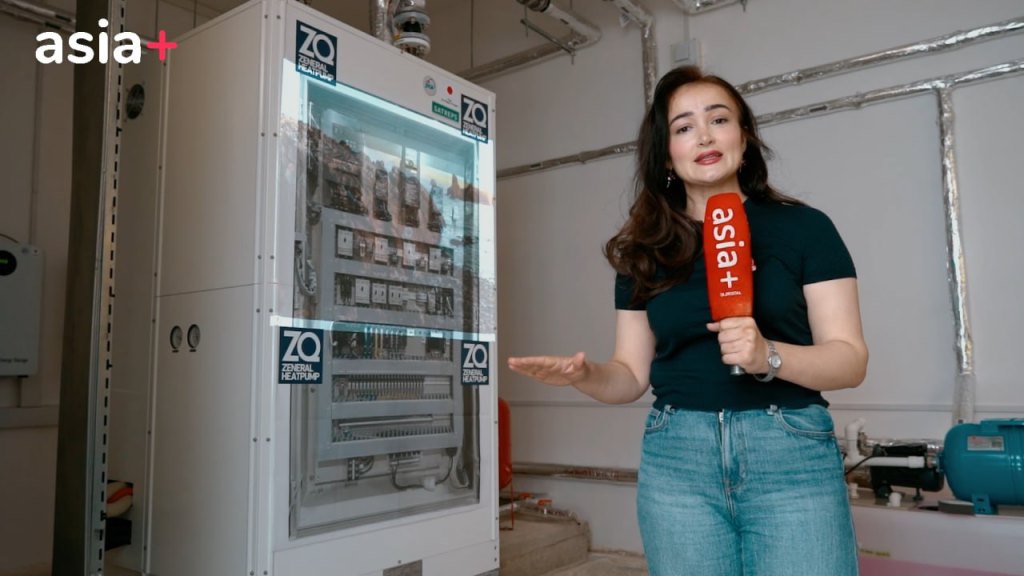
A geothermal heat pump system has been installed in Dushanbe at the National Academy of Sciences. This demonstration project uses the earth's stable temperature to heat buildings in winter and cool them in summer.
At a depth of about 100 meters, the ground temperature remains stable around +15°C — +17°C year-round, regardless of surface weather conditions. These measurements have been confirmed at the Academy of Sciences. Even when the soil temperature fluctuates, it returns to its natural state within 48 hours.
The system operates on a simple principle: the heat pump exchanges heat with the ground. In winter, it extracts heat from the soil and transfers it into the building, while in summer, it reverses the process by transferring excess heat back into the earth.
This approach allows for a 30-50% reduction in energy costs compared to traditional boilers and air conditioners, while producing virtually no carbon emissions. In Tajikistan, where winters are cold, summers are very hot, and electricity supply can be unstable, this solution is particularly significant.
The project is part of the SATREPS program, collaboration between Tajik and Japanese scientists aimed at addressing decarbonization challenges and transitioning to sustainable energy. While the system is still a demonstration project, its goal is to show that such technologies can function effectively in Tajikistan.
How does it work and what’s the cost?
To operate the system, several boreholes are drilled beneath the building, through which water or a special solution circulates to transfer heat between the soil and the heat pump. For buildings like the National Academy of Sciences, several boreholes and a 300-500 kW pump are required.
There are two types of systems: closed-loop systems (which can be installed in almost any conditions) and open-loop systems (which require sufficient groundwater). The equipment occupies about the same space as a traditional boiler and technical cabinet, with the main cost associated with drilling the boreholes. The cost of pumps for smaller buildings is tens of thousands of dollars, while for larger buildings, the cost can run into the hundreds of thousands, depending on the area and number of boreholes.
The ground in these systems acts as a natural accumulator: in winter, it releases heat, and in summer, it absorbs it. Underground water or heat carriers cool the building using the stable temperature of the soil.
The next geothermal system will be installed in Vahdat at the Republican Tuberculosis Hospital "Machiton," where sufficient groundwater is available. Pumping and injection boreholes have already been constructed, with a safe water consumption rate of 500 liters per minute. The system will initially provide heating and cooling for an area of 200 m², with the possibility of expansion if needed.
In the future, the government of Tajikistan plans to implement such technologies in other regions, especially in mountainous areas, where traditional coal heating causes significant environmental harm.
The SATREPS project has been implemented since 2022 by the Center for Innovative Development of Science and New Technologies of the Academy of Sciences of Tajikistan, in collaboration with Akita University (Japan), and with the support of Japan’s International Cooperation Agency (JICA).