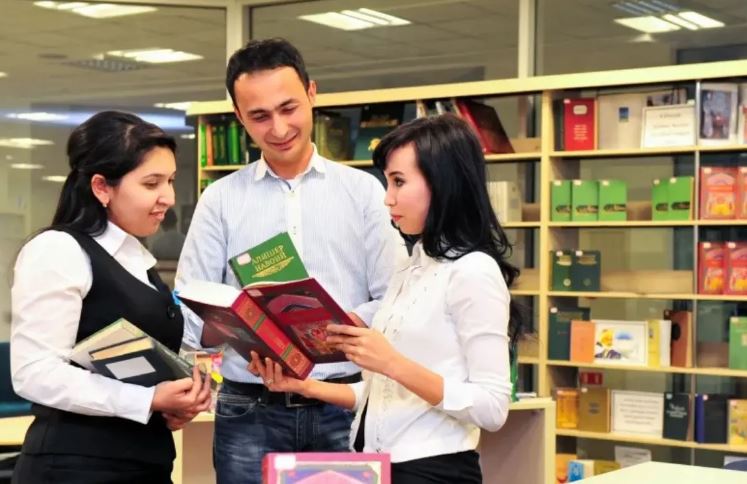
Uzbekistan will introduce cash incentives for government officials, school pupils, and university students who read the highest number of books. Citing the press service of the Ministry of Justice, Fergana News says the initiative is outlined in a decree signed by President Shavkat Mirziyoyev on January 15.
Under the decree, all ministries and government agencies must compile lists of recommended reading relevant to their employees’ professional activities by March 1. In addition, at least three books by foreign authors will be translated into Uzbek each year, accompanied by expert commentary and a glossary.
By April 1, “book corners” will be established in all government institutions, and monthly “book reading hours” will be organized for staff.
An internal reading culture ranking will also be introduced within government bodies. Officials who read the most books will be eligible for a bonus equal to one month’s salary, funded through a Special Financial Incentive Fund.
There are also separate rewards for school pupils and students who make it into the top 100 most active readers. They will receive a cash prize equivalent to 25 times the base calculation value — 10.3 million soums (approximately $856).
The decree also provides for the creation of a Reading Culture Development Fund under the Youth Affairs Agency. The fund will support the publication of works by young authors, promote children’s literature, organize competitions, and provide monthly stipends of 50 base calculation values (20.6 million soums, or about $1,712) to talented writers for up to one year.
In addition, the fund will cover up to 50% of publishing costs for local authors and up to 80% of copyright expenses for translating leading foreign literary works into Uzbek and vice versa.
Starting February 1, 2026, the national program “The Book as a Source of Enlightenment” will be launched. Government advertising promoting books and reading culture will be classified as social information. Public transport — including buses, trains, and airplanes — will offer access to the Mutolaa online reading platform via QR codes.
Schools will also establish reading clubs titled “Jadidlar izidan” (“In the Footsteps of the Jadids”), whose members will be required to read at least 20 books per year. The most active participants will receive quarterly incentives from the Ministry of Preschool and School Education.
The main objective of the decree is to raise the country’s average annual reading level to 10 books per person between 2026 and 2030.