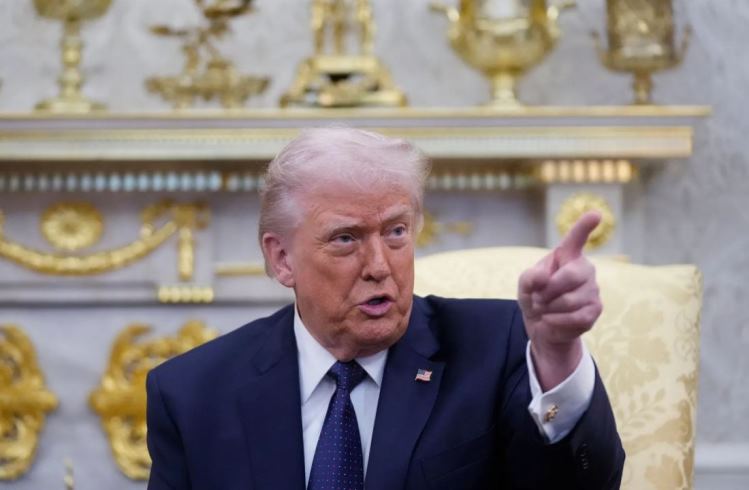
U.S. President Donald Trump has expressed his desire to be involved in the process of selecting Iran's next Supreme Leader, reaffirming his goal to help facilitate a shift in Iran's leadership that aligns more closely with U.S. interests.
Trump voiced strong opposition to the possibility of Mojtaba Khamenei, the son of the late Supreme Leader Ayatollah Ali Khamenei, assuming his father’s position. "They are wasting their time. Khamenei’s son is a lightweight. I have to be involved in the appointment," Trump said in an interview with Axios.
While the U.S. president did not elaborate on his preferred candidate, he mentioned that he would welcome a leader similar to Venezuela's Delcy Rodríguez. Rodríguez, who succeeded Nicolás Maduro after his abduction by U.S. forces in January, has cooperated with Washington's policies, including allowing the sale of Venezuelan oil to the U.S. and cutting off petroleum supplies to Cuba under the threat of further U.S. sanctions.
Trump has repeatedly expressed his desire to find an Iranian leader akin to Rodríguez, someone who would align with U.S. policies.
However, experts note significant differences between the political landscapes in Iran and Venezuela. While Rodríguez’s rise followed a swift military operation, Iran’s leadership is deeply entrenched in religious and political structures that may not easily accommodate such a shift.
In Iran, the Supreme Leader must also be a qualified religious scholar, a requirement that would limit the pool of potential candidates. Analysts argue that Trump’s ideal leader, someone willing to submit to U.S. demands, is unlikely to emerge from within the current Iranian system.
Trita Parsi, Executive Vice President at the Quincy Institute, commented in an interview with Al Jazeera, saying Trump’s strategy appears to be one of seeking Iranian capitulation. “He is fine with a symbolic figure taking over Iran as long as this person pursues Trump’s policy preferences, just as Delcy has done,” Parsi said. He further added that Trump is unlikely to find anyone within the Islamic Republic system who would be willing to submit to his policy demands.
In a separate statement to Reuters, Trump also reiterated his belief that the U.S. must play a role in choosing Iran’s next leader. He suggested that it would be "wonderful" if Iranian Kurdish forces, based in Iraq, were to cross into Iran and launch attacks on the Iranian security forces. The president voiced his support for their offensive, which came just days after U.S. and Israeli forces launched joint attacks on Iran.
The escalating conflict has claimed more than 1,000 lives, including at least six U.S. service members, and has left the Middle East in turmoil. Trump’s comments underscore the growing tensions between the U.S. and Iran, which have reached a critical point following the assassination of Iran’s Supreme Leader.
While Trump’s rhetoric suggests a hands-on approach to influencing Iran’s future leadership, analysts remain skeptical about the feasibility of such an outcome in a country with a complex, deeply rooted political and religious system.