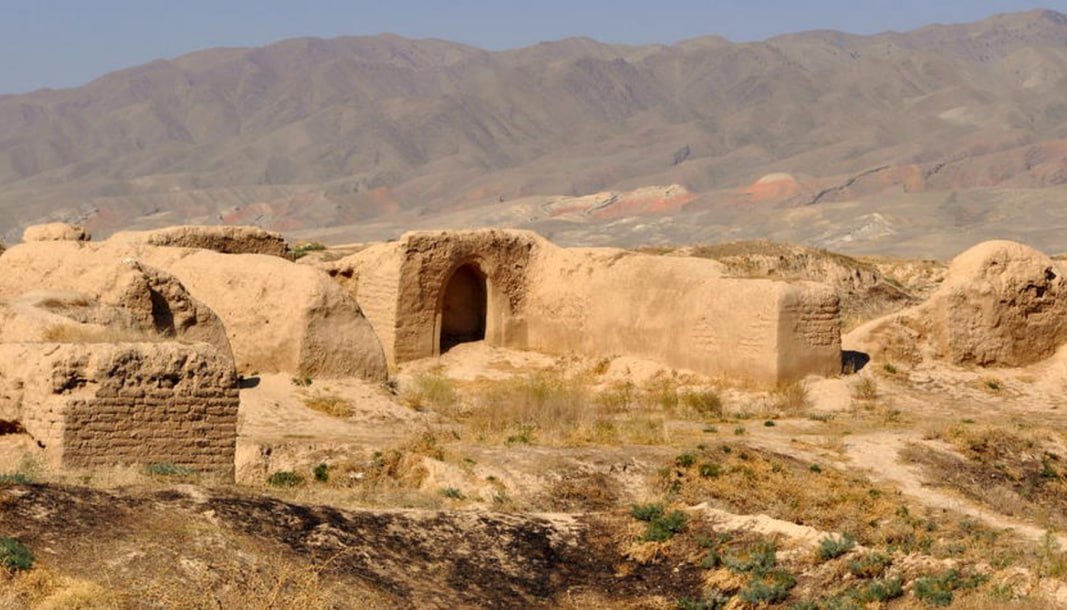
Archaeological excavations in the Zeravshan Valley, initiated in the mid-1930s and continuing to the present day, have unveiled the astonishing and rich world of the Sogdians — a people who made an invaluable contribution to world culture.
Archaeology, layer by layer, reveals to us new sensational finds from what seemed to be a lost world of our ancestors. Among these discoveries are many masterpieces of world art and architecture.
In the “Avesta,” ancient hymns of the Zoroastrians created more than 2,500 years ago, there are lines about the golden peaks from where the Iranian god Mithra sees the entire Aryan land, among which is Gava, which is in Sogdiana. This is probably the earliest mention of the Zeravshan Valley. Deciphered documents from the castle on Mount Mug have confirmed the East Iranian roots of the Sogdian language and revealed the tragic events for the Sogdians associated with the Arab conquest of the 8th century.
Sensational excavations of ancient Panjakent have allowed the unveiling of a previously unknown, vibrant, and distinctive picture of life in a small Sogdian town.
Panjakent, or as the Sogdians called it — Panch, arose in the 4th-5th centuries and was destroyed by the Arabs in the 8th century. The city was abandoned by its inhabitants and was not revived at this site, allowing archaeologists to study it in detail since there were no later layers as in the capital cities of Sogd: Bukhara and Samarkand.
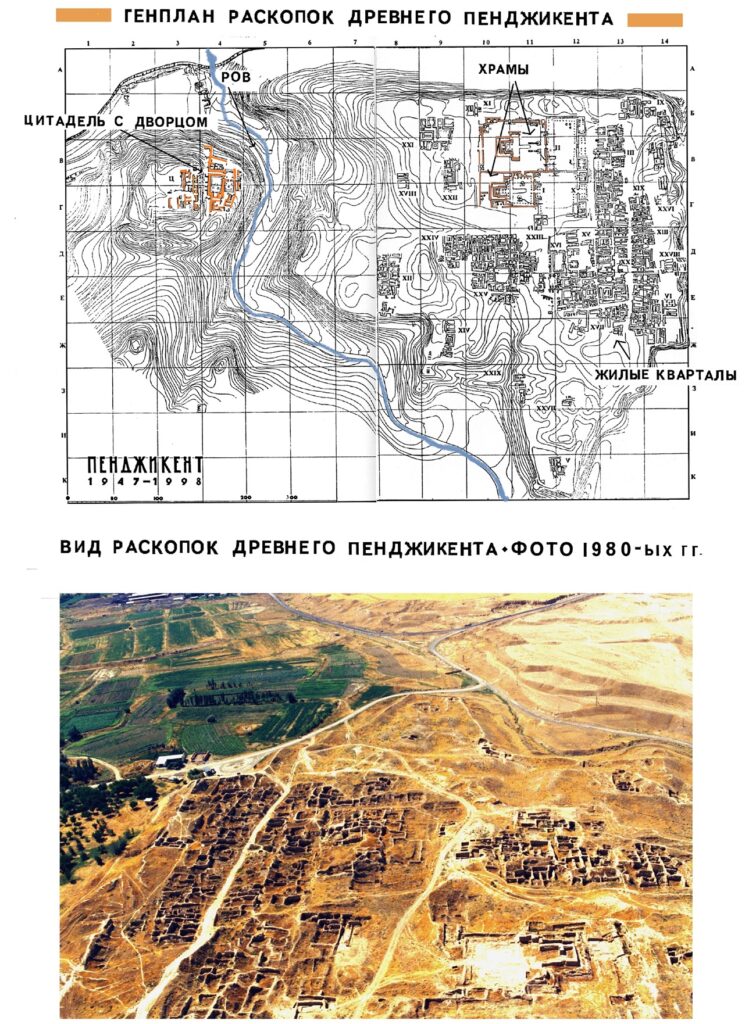
The city was located on two terraces surrounded by fortress walls: on the upper one, rising above the surroundings, was the citadel with the ruler’s palace and, below, the shahristan, the actual city where most of the population lived.
Outside the city walls was a vast suburb consisting of rural estates with castles, as well as a necropolis where townspeople buried their relatives in small crypts in ceramic ossuaries according to the Zoroastrian rite.
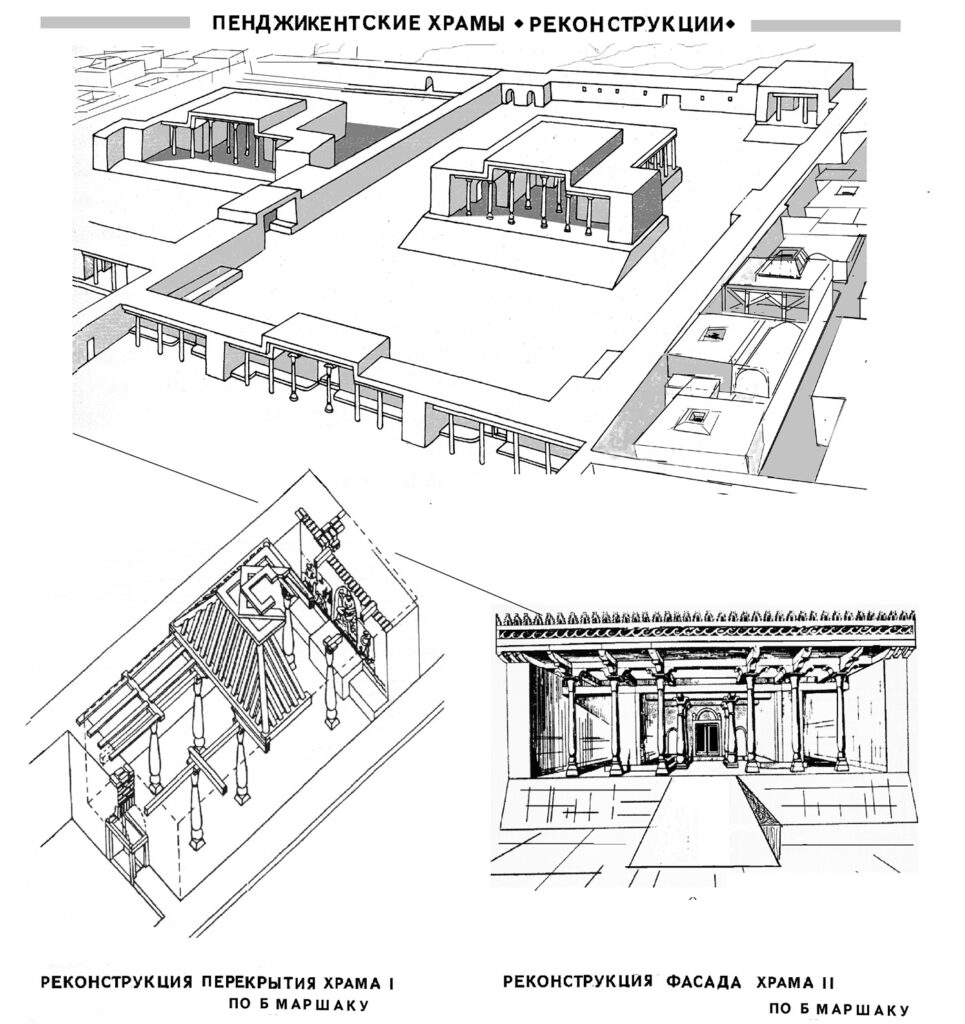
In the citadel, separated from the rest by a deep moat, was a large palace, which was a multi-tiered complex where the ruler’s chambers were located at the top. From the open terraces of the palace, a picturesque panorama of the city below unfolded.
The parade part of the palace included a spacious throne room of 250 square meters with a raised platform, which could be accessed via a ramp located on the central axis.
Two powerful square pylons and a deep niche in the back wall imparted the interior with appropriate solemnity and monumentality.
In the elevated part of the hall sat the ruler on the throne, while the subjects sat in the lower part of the hall on clay benches that stretched along the walls. The throne room was covered with an impressive complex wooden inclined-stepped structure with a skylight at the zenith.
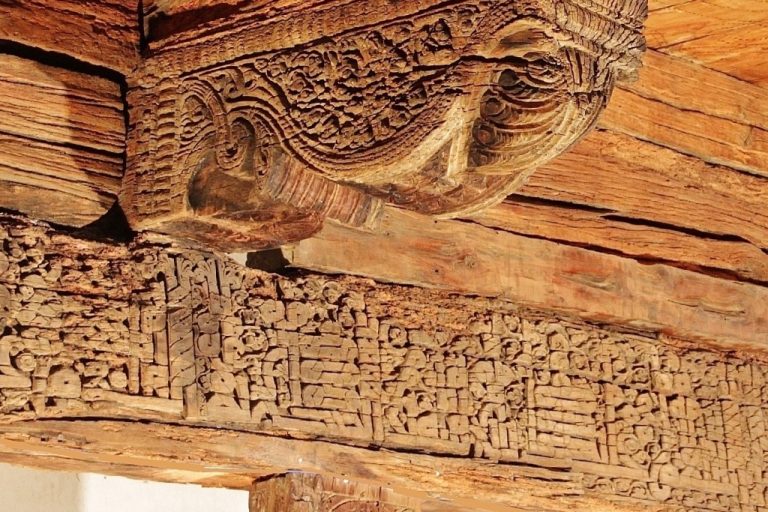
Fragments of carved wood and numerous wall paintings indicate that in terms of decorative richness, the palace of the Panjakent ruler Devashtich was not inferior to the palaces of the rulers of Bukhara — the Bukhar Khudats, the Ishkids of Samarkand, and the Ushrushana Afshins of Bunjikat.
What the “microdistricts” of ancient Panjakent looked like
The city’s quarters were formed by a rectangular network of streets dividing the construction into blocks. Conglomerates of residential and household structures began with vaulted corridors up to 5 meters high, from which ramps led to the second floor, where summer rooms were located.
Houses could be two or sometimes three stories high. The main focus in the house was on large parade halls, the area of which ranged from 50 to 100 square meters depending on the owner’s status.
Clay benches ran along the perimeter of the walls, and only one wall had a platform for the most important guests. The decoration of the halls was richly adorned and individual in each case, with a dense concentration of various types of art: wood carving, sculpture, and bright multi-plot wall paintings.
Based on the analysis of archaeological finds from ancient Panjakent, from a huge number of large and small fragments of burnt carved wood and wall paintings, architects and artists pieced together these time-scattered puzzles, thus creating graphic reconstructions of the interiors.
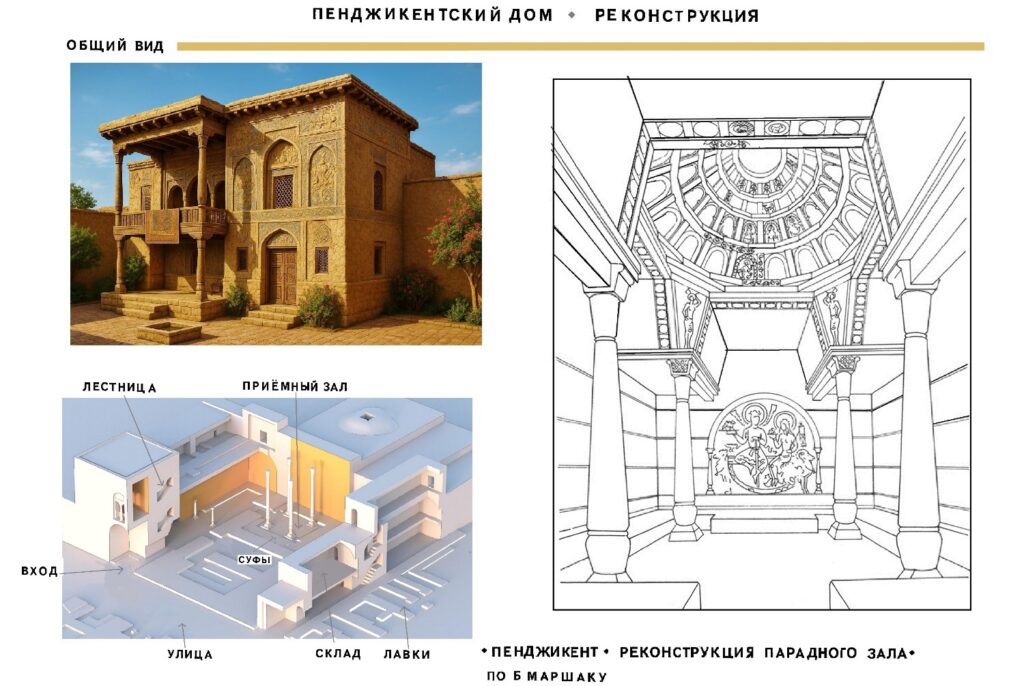
In these spacious halls illuminated by top light, four high columns, decorated with carved capitals, supported wooden ceiling structures, which in the central part represented various variations of a stepped wooden ceiling with a skylight at the top, often with female caryatid sculptures at the corners.
The light brightly highlighted the structures of the upper part of the ceiling and the middle area enclosed between the four columns and reflected down to the frescoed walls, the graceful carvings of columns and beams, carpets, and fabrics, filling the interior space with epic solemnity.
Many researchers rightly draw analogies to the Sogdian house with the dwellings of the Western Pamirs, which are, in our view, a folk version of the closed house type with a square four-columned hall with a stepped ceiling, “chorhona,” ending with a hole “rauzan” that was widespread in antiquity and the Middle Ages.
In essence, the eastern Iranians: the Bactrians and Sogdians invented this type of dwelling, which influenced the formation of fire temples and spread widely throughout Central Asia and far beyond. The parade halls, in addition to their representative functions, simultaneously served as peculiar museums, art galleries, libraries, and information centers of the ancient world.
Architecture and religion of the Panjakent temple
The two temples of Panjakent, located on artificial platforms, even in ruins, make a majestic impression. Each temple had its spacious, perimeter-built courtyard with a grand entrance portal on the main axis. The spacious columned canopies-ayvans of the temples were oriented to the east.
Under the rays of the rising sun, a graceful colonnade, numerous reliefs, and multi-colored wall paintings opened up to the believers’ view. All this together was meant to create a festive and solemn mood.
Small sanctuaries adjoined the bypass corridors of the temples, where the statue of the main deity was located, and on the sides were rooms for storing the sacred fire — ateshgah.
Researchers have determined that the two temples in Panjakent were not identical: in temple I, according to the conclusion of the renowned Hermitage researcher V. Shkoda, from the mid-5th century, Zoroastrianism manifested itself in a purer form than in temple II, which was associated with the water element.
In the ayvan of temple II, fragments of bas-reliefs with mythological water element characters, a mythical triton — a creature with a human body and fish tail, dolphins, a sea god with a trident in hand, and dragons against a backdrop of blue waves have been preserved. All these attributes, apparently, are related to the deified river Zeravshan, in Sogdian Namik — “The Water Carrier.”
The patroness of Panjakent was the four-armed goddess Nana, who sat on a lion with symbols of the sun and moon in two raised hands. This goddess was revered even by the Kushans.
On the Rabatak inscription (Afghanistan) carved in stone in the Aryan (East Iranian) language, King Kanishka (2nd century) declares that he “received the kingdom from Nana and all other gods.” The cult of the goddess Nana came to Central Asia from Mesopotamia, and in Sogd, Parthia, and Bactria, her image merged with the Avestan goddess Ardvısura Anahita.
Moreover, among the Sogdians, in addition to the common pantheon of gods, individual families revered their patron gods, associated with the history and genealogy of the family and stories of the exploits of their ancestors. They placed the image of such a family patron on the wall opposite the entrance to the parade hall.
But the main religion of the Sogdians was undoubtedly Zoroastrianism, in its Sogdian-Bactrian variety, possibly having more ancient Indo-Iranian roots, which later incorporated Indian, Near Eastern, and Hellenistic influences.
In Sogd, a special type of building was developed, formed under the influence of the architectural traditions of Bactria-Tokharistan, associated with the cultural heritage of Persia, Greece, and the ancient Near East. These are square, four-columned halls illuminated through skylights in the ceiling, bypass corridors, wide columned ayvans opening towards the courtyard, and special rooms for the sacred fire — ateshgah, represented by temples in Persepolis, Susa, Ai Khanoum, Takht-i Sangin, Surkh Kotal, and Dilberjin.
This widely spread type of temple among the Western and Eastern Iranian peoples persisted until the 8th century, up until the Arab conquest of Central Asia. According to V. Shkoda, this “allows us to consider the history of Sogdian temples as part of the history of world architecture.”
Gods breaking barriers
In the 1980s, in a cave near the Upper Zeravshan village of Sarvoda, a meter-long wooden figure of a pre-Islamic idol was discovered, dressed in armor, a long cloak, and high soft boots. From the pose of the wooden sculpture, dated to the 6th-7th centuries, it can be concluded that it was placed on a horse. In one hand, the deity held a metal staff, in the other a censer with sacred fire, indicating the dominant religion of the Sogdians.
Researchers see in this figure the god Mithra, worshipped since the times of the Indo-Iranian community. He is often depicted with a weapon — “vajra” in his hands — this is a battle ax, hammer, mace, with four protrusions.
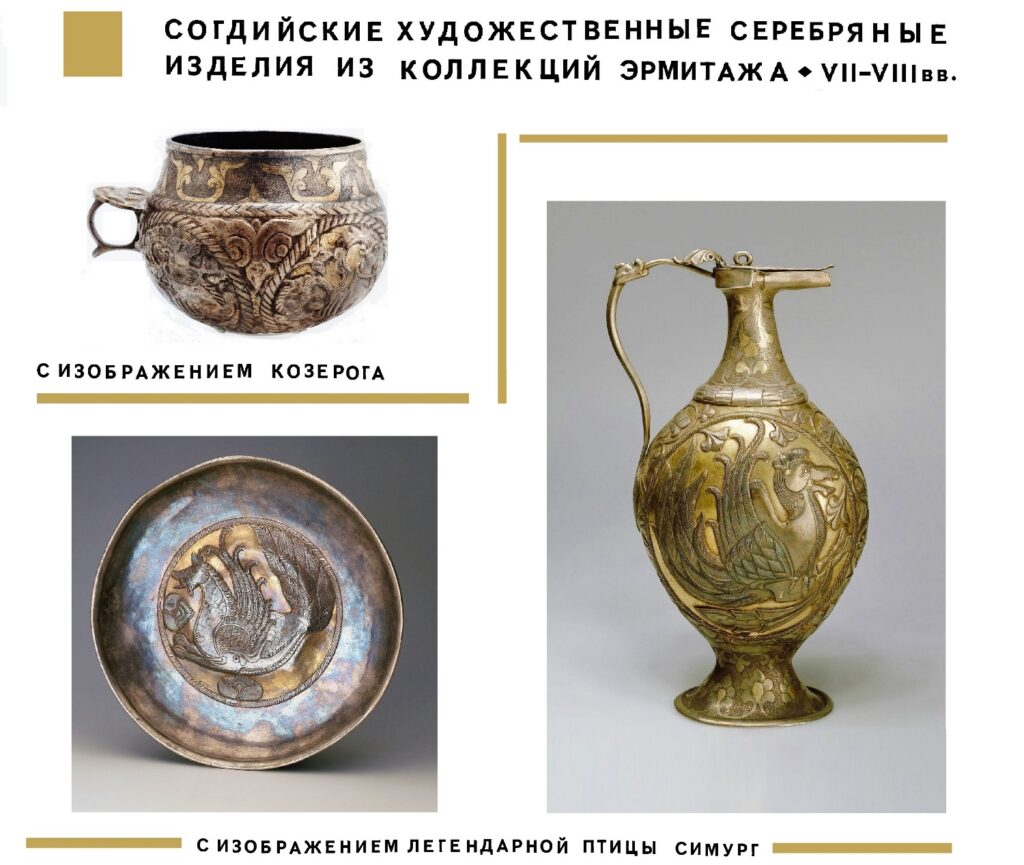
In Indian conceptions, the vajra was four-pointed. To confirm this, the staff in the hand of the deity ended with four diverging heads of mountain goats.
Relatively recently, in the same village, a bronze figurine of a rider was discovered, also dated to the 6th-7th centuries, which also held a club-staff in hand, and notably, a bird was placed on his headgear. The horse and bird are also attributes of Mithra.
Another version is that both Sarvoda figures could depict the constant companion of Mithra, the god Verethragna the Victorious, “breaking barriers” (Varahran, Bahram in Persian mythology). In the Indian Vedas, the epithet of the god Vṛtrahan is “victor of Vṛtra.”
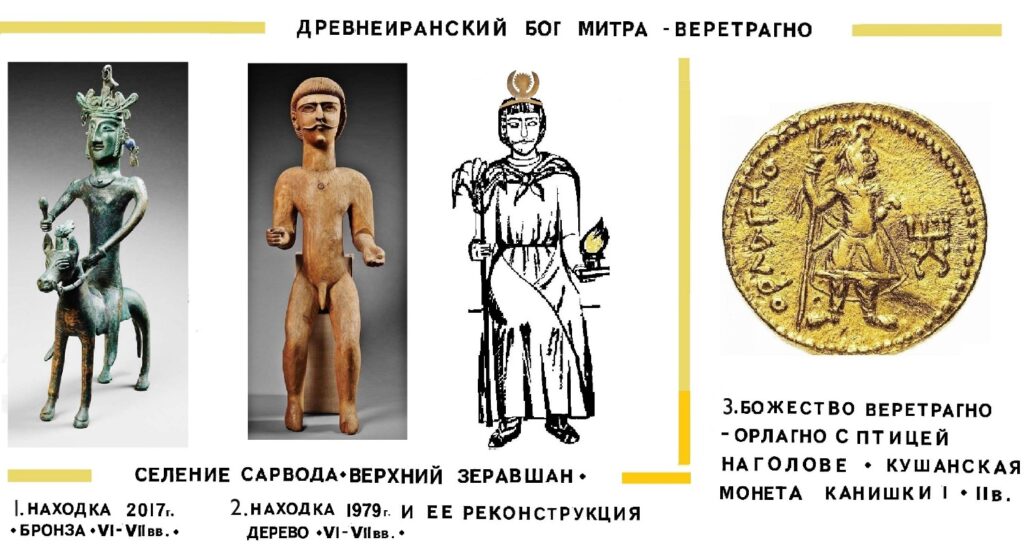
In the Avesta, Verethragna transforms into a predatory bird, whose name in the Avestan language sounds like “varaghna,” or “varengana.” It is believed that this bird could have been a falcon or a kite, but the sound of this word is quite familiar to us, resembling the Slavic “raven,” “vran.”
On a Kushan coin of Kanishka I from the 1st-2nd centuries, such a bird is placed on the head of the god Verethragna-Orlagno (eagle, falcon, or crow).
From Madm and Kum to the city of Rome
The director of the Hermitage, academician Mikhail Piotrovsky, recalls his youthful years spent on archaeological expeditions in Tajikistan: “I passed through several of the most difficult valleys of the Pamirs (Bartang and Shakhdara), crossing the Zeravshan Valley.” He participated in excavations of early medieval castles in the upper Zeravshan villages of Kum and Madm.
In one of the TV programs, he quoted a local saying in Tajik, the meaning of which he found difficult to explain: “Dar miyoni Madm va Kum kalidoni shakhri Rum (“Between the villages of Madm and Kum the keys to the city of Rome lie”). The meaning of the proverbs is probably explained by artifacts from Panjakent and neighboring Ustrushana with depictions of symbols of Rome — the Capitoline Wolf suckling Romulus and Remus.
This includes a gold bracteate from Panjakent (5th century) and murals in the Ushrushana palace of Bunjikat from the 7th century.
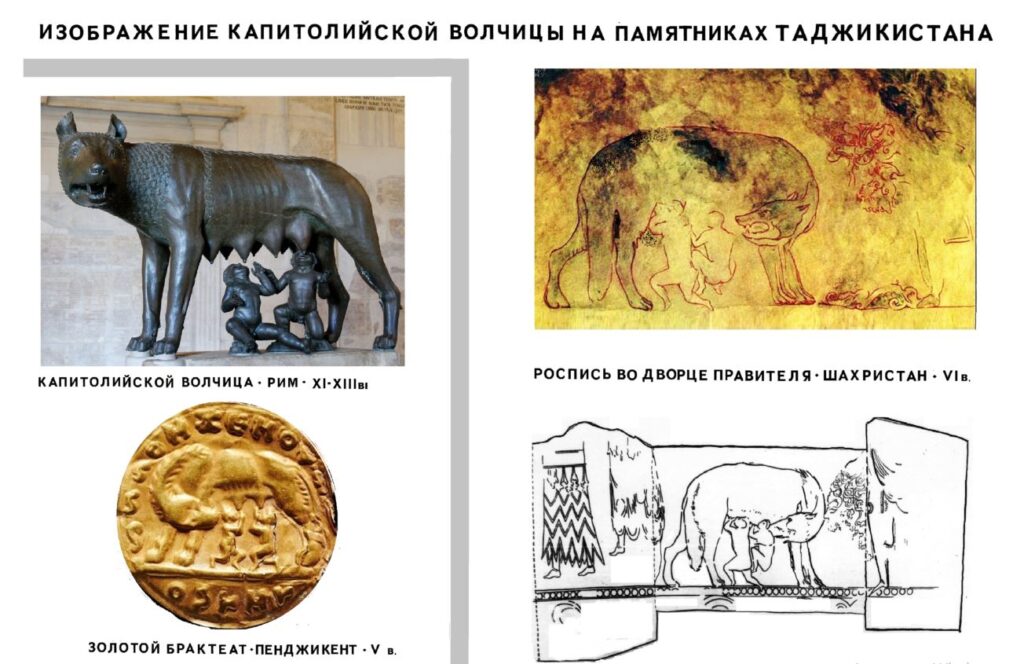
In the historical memory of the Sogdians and their descendants, who traveled all over the world, a legend about the founding of an ancient city and “the keys to it” has been preserved. Moreover, as researchers believe, this legend also had Eastern roots.
On Sogdian soil, elements of late Kushan and Hellenistic art from southern Central Asia, Afghanistan, and northern India were reworked.
The clay sculptural depiction of the Hindu god Shiva and his consort Parvati, found in the courtyard of the Panjakent temple, sitting on the bull Nandi, complements the diverse picture of ideological and cultural ties with India.
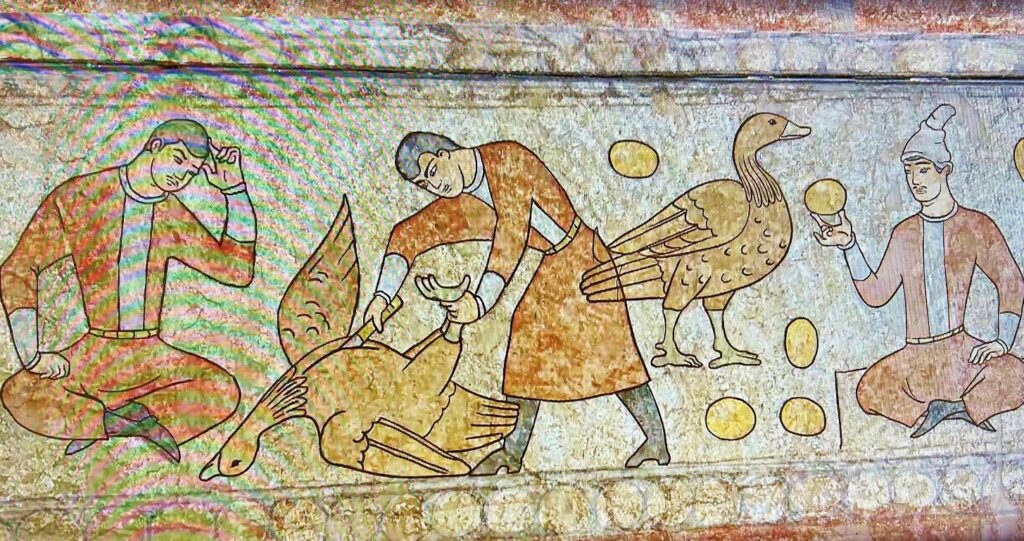
In one of the Panjakent murals, it is not difficult to discern Aesop’s fable about the greedy owner who killed the goose that laid golden eggs; in another, there is a scene from the Indian “Panchatantra” about a clever hare that destroyed a dull-witted lion by making it jump into a well.
The Sogdians have once again brightly reminded us of themselves
In 2025, an interesting article by M. Shenkar, Sh. Kurbanov, and A. Pulotov about the results of excavations of an early medieval palace in Sanjar-Shah, located 12 km from Panjakent, was published by Cambridge University Press.
The excavated palace complex from the 5th-8th centuries, apparently belonging to the rulers of Panjakent as a country residence, was located on a wide plateau with well-fortified walls and towers. A moat bordered a uniquely architectured round multi-tiered tower-castle.
On the plateau were palace structures similar in architecture to those of Sogd and Ushrushana. These included several asymmetrically located reception halls connected by a T-shaped corridor. The palace part included a square, large four-columned reception hall (13.5 × 13.8 m). Traces of fire on one of the podiums in this hall indicate its ritual use.
Adjacent to the square hall was a large “rectangular hall” (15.6 × 19 m) with benches along two walls. But the main sensation was the discovered fragment measuring 1.54 × 2.54 of a painting once part of a large composition depicting a scene of fire worship in the rectangular hall. The authors of the article write that “the scene of fire worship is a rare phenomenon in Sogdian visual culture, previously encountered only in a funerary context.”
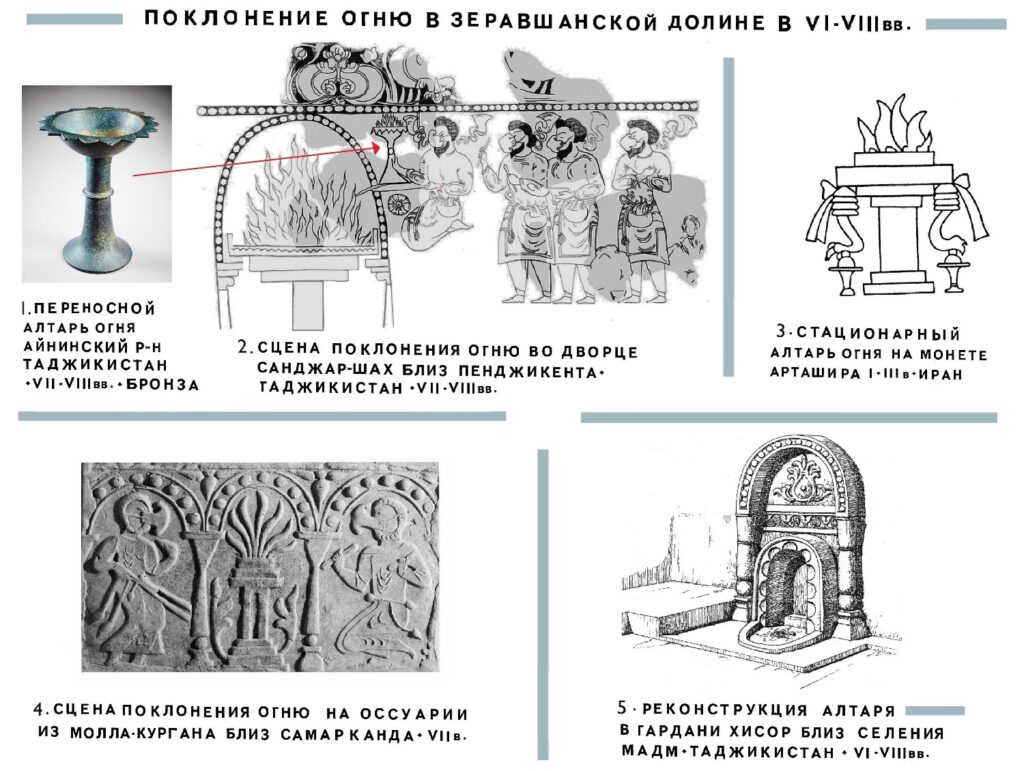
We see on the fresco four priests, possibly accompanied by a child, moving towards a large stationary stepped fire altar, located under an arch or dome. In the hand of one of the figures is likely branches of sacred twigs — barsom. The faces of the priests are covered with ritual masks — padam, to avoid defiling the sacred fire with their breath — similar masks are still used by Zoroastrian priests today.
In the hand of the first kneeling figure is a small portable altar-censer for burning incense. Moreover, this portable altar depicted on the fresco is exactly similar to a bronze censer found in the Aini district, indicating established rituals for fire worship and related attributes.
The published mural from Sanjar-Shah confirms the undeniable dominance of Zoroastrianism in the beliefs of the Sogdians.
Despite the fact that the Sanjar-Shah palace has come down to us as an archaeological object, numerous fragments of burnt carved wood and paintings indicate that the palace and especially its parade halls were elegantly and richly decorated. Carvings covered the complex structures of the high ceiling with sloping beams and a skylight at the top.
We see fragments of carved wood left from sculptures, geometric, vegetal ornamentation, and zoomorphic plots. On the wall paintings, scenes of hunting animals, and battles of riders in heavy armor with demonic creatures are consistently revealed.
This entire world reflects the rich East Iranian mythology, as well as numerous wandering plots brought by the Sogdians from Indian, Chinese, and Greek sources.
Castle-keshk
An original building of Sanjar-Shah is the round multi-level tower located in the northwestern corner of the plateau. This structure has two divided rooms at the top and a large number of trapezoidal rooms on the lower floors, connected with a bypass gallery and an observation terrace.
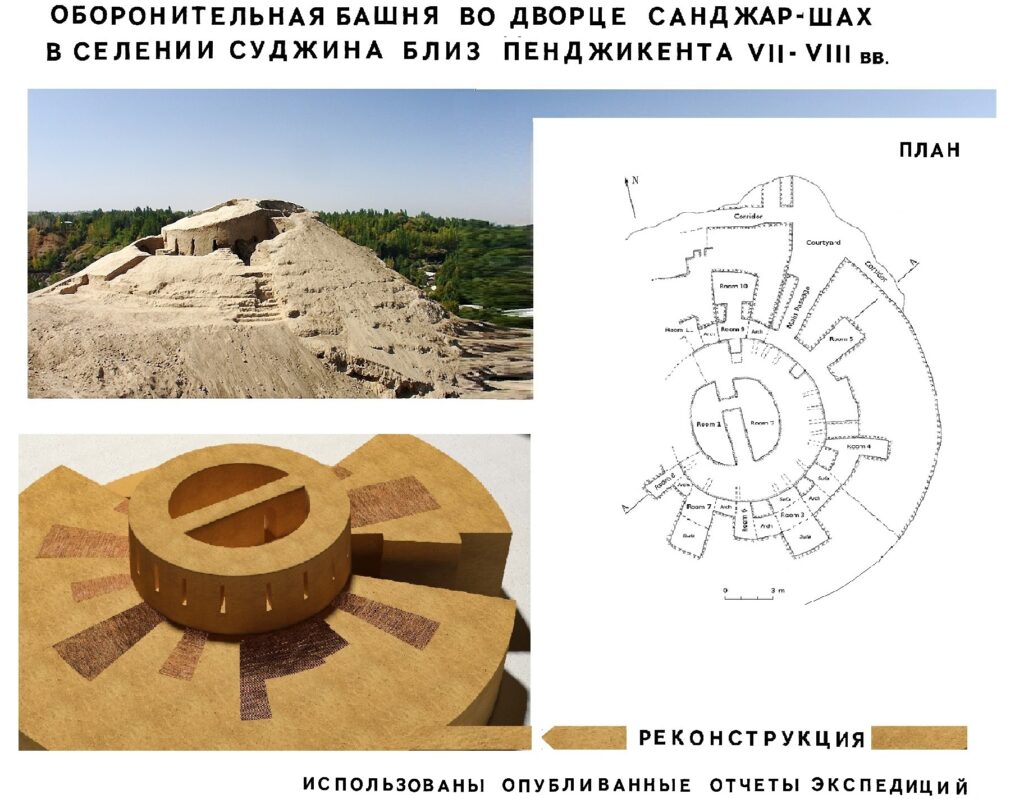
The tower, on one hand, allowed for surveying the territory where the palace complex was located, and on the other, served defensive functions as a place of refuge for the palace inhabitants.
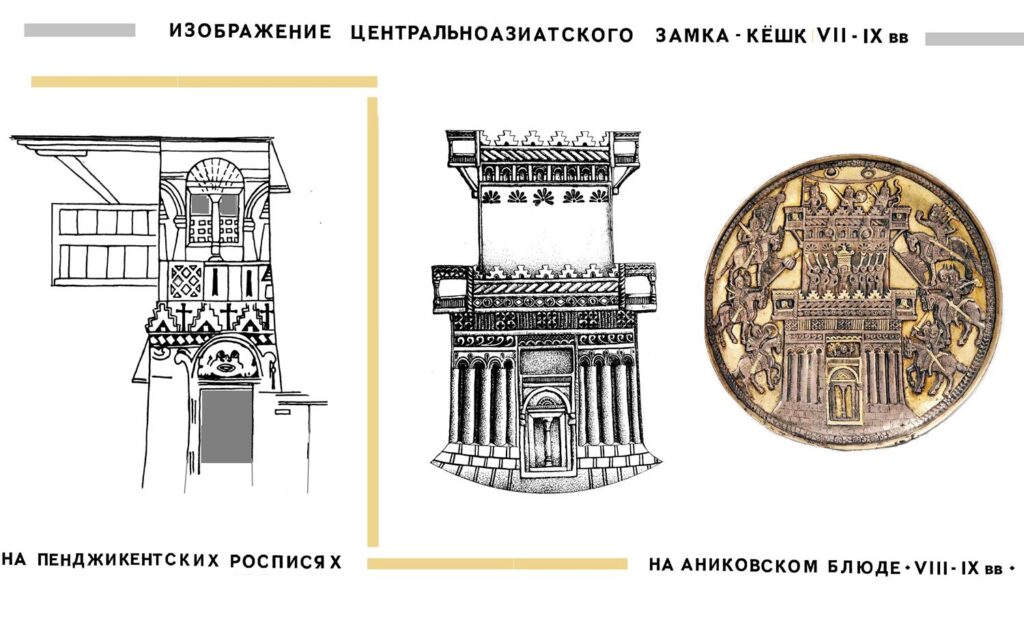
Perhaps the upper part of the castle was wooden and had overhanging balconies-galleries, similar to those we see in images of castles on Panjakent murals and the Central Asian origin Anikov dish.
Monumental castle-keshks, located on artificial platforms with uniformly designed facades and corner towers, towered over rural settlements of Sogd and Ustrushana. Around these castles, future Central Asian cities gradually formed. A large number of such castles were built in the “gold-bearing” Zeravshan Valley.
In 2023, the UNESCO World Heritage Committee declared the Sanjar-Shah complex a World Heritage site as part of the transnational project “Silk Road: Zarafshan — Karakum Corridor.” This, still not fully excavated site, may bring many new sensational discoveries to the world.
The Sogdians — “Phoenicians of the East”
The Sogdians not only created a unique culture but also spread it to adjacent territories, where they introduced new ideology, built cities, temples, created trends in art and architecture, and controlled the international trade of Central Asia with the Middle East.
Their signature is recognized in the architecture and murals of Buddhist caves, artistic items, writing, and music in countries located on different segments of the Great Silk Road. Thanks to archaeology, written, and linguistic studies, today we know much about their way of life, enterprise, beliefs, architecture, and art.
Sogdian merchants established silk export to Sogdiana and organized its production so quickly that by the 5th-6th centuries, they began competing with China. Sogd became the largest center of silk reeling and weaving in Central Asia.
The same happened with paper production. Then all roads led not to Rome, but to Samarkand. Known is the story of a Sogdian from Bukhara, An Lushan (8th century), whose Iranian name was possibly Ravshan or Rushan, who became the most influential military leader in China, honored to be depicted on specially minted coins. In 718 AD, the Sogdians sent him a chainmail to China as a gift, which was accepted as a model for the Chinese army.
Many interesting details about Central Asia are provided by Chinese travelers Xuanzang (629 AD) and Hye Cho (726 AD), who passed through Tokharistan and the Pamirs.
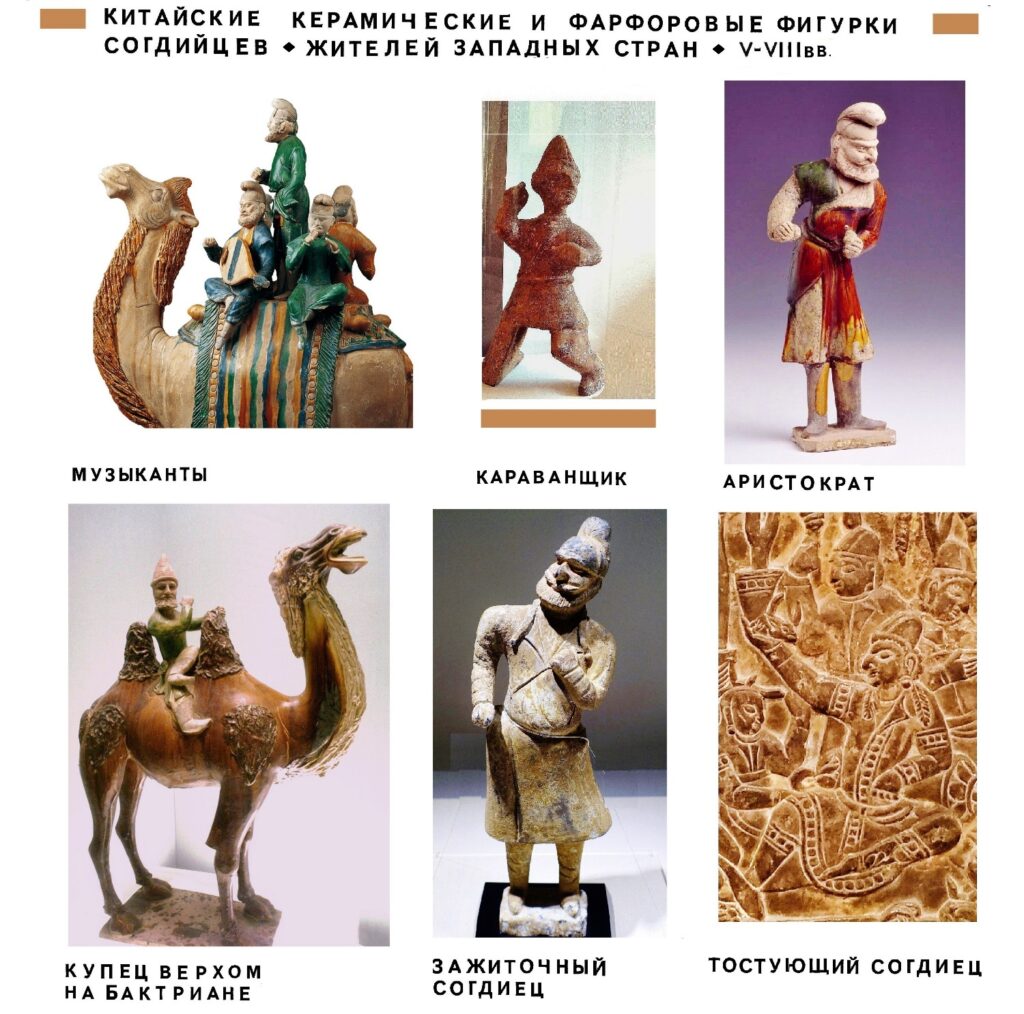
Russian researcher S. Yatsenko drew attention to the findings of a large number of Chinese porcelain and ceramic figurines “mingzhi,” depicting Sogdians during the Tang dynasty (665-755 AD). They represent vivid portraits of Sogdians, depicted with ethnographic precision. The Sogdians are portrayed with features such as large eyes, prominent noses, and thick beards.
With the same precision, the features of their costumes are conveyed, bright robes with laid-back collars, pointed hats, high soft boots, characteristic musical instruments familiar to many from Panjakent murals.
The manner of depiction and costumes of the figurines, sometimes in a grotesque form, convey social status: an important aristocrat, an official, a musician, a wine merchant, or a modest caravaner.
The high art of the Sogdians did not disappear without a trace; it creatively transformed and continued in the culture of their direct descendants — the Tajiks, who from the 9th century replaced the Eastern Iranian languages with Tajik-Persian and adopted the new ideology of Islam.
They became the creators of the classical Central Asian heritage of the 9th-10th centuries within the framework of the enlightened state of the Samanids, from which architectural monuments of this remarkable era have been preserved.
These are the mausoleums of the Samanids in Bukhara, of Kusam ibn Abbas in Samarkand, in the village of Tim, high-artistic examples of carved wood from Upper Zeravshan, a unique carved mihrab of the 10th century in the village of Iskadar, the mausoleum in Chorku in the Isfara Valley.
In this high art, poetry flourished, brilliantly embodied in the qasidas and ghazals of the native of Upper Zeravshan, the great Rudaki.