In the 1920s, during a scientific expedition to the mountainous regions of Upper Zeravshan, the renowned researcher of Central Asian history, Mikhail Andreev, discovered highly artistic samples of carved wooden columns and consoles from the 10th-12th centuries, which led him to call this valley the “Kingdom of Carved Wood.”
Later, this title was confirmed by the discovery of new masterpieces: columns, mihrabs, and even an entirely wooden mausoleum. Therefore, a century after that 1925 expedition, we can acknowledge that Tajikistan ranks first in the region for its preserved ancient samples of skillful wood carving.
Wood as a building material has always been highly valued in the forest-poor Central Asia. Wooden house constructions—columns, pillars, beams—constituted an interconnected, seismically resistant, load-bearing framework. But besides purely utilitarian functions, wood, thanks to carved decor, became an important means of artistic and aesthetic influence on people.
Sculptures were carved from wood, multi-story reliefs were created, and the structural elements of houses and religious buildings were lavishly covered with pictorial and ornamental carvings.
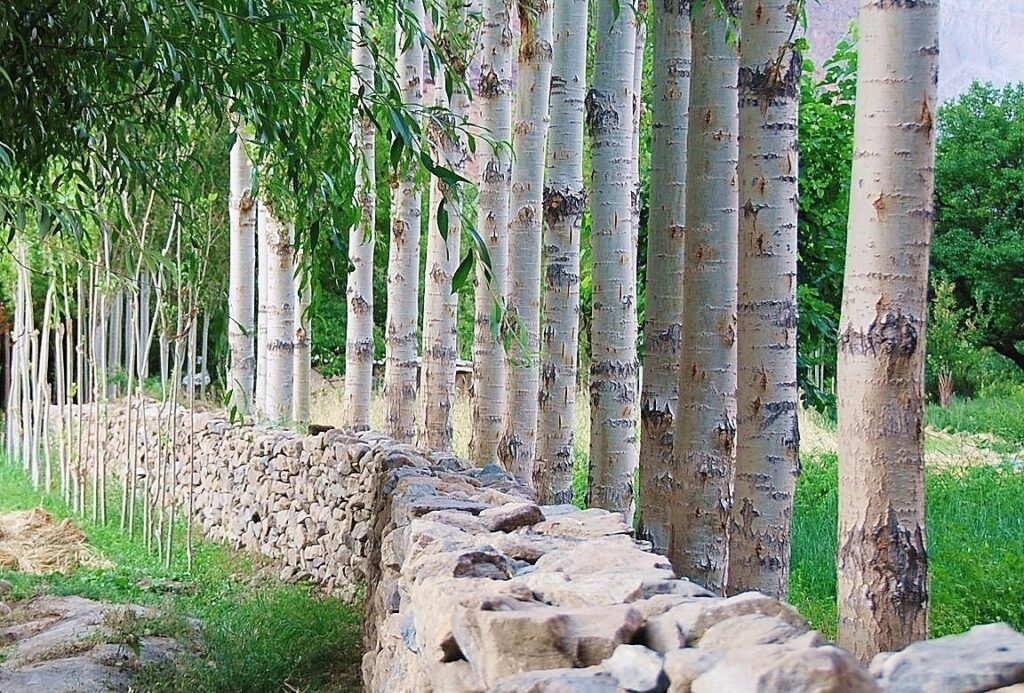
In ancient and medieval times, there were far more forest lands in the habitat of Tajiks and their ancestors than today, and the settled agricultural way of life near water sources allowed for the special cultivation of trees for construction. For instance, in the Pamirs, to this day, the boundaries of residential plots are densely planted with pyramidal poplars, used in future constructions.
In urban centers, due to numerous reconstructions, later overlays, wars, civil strife, and fires, old wood has not been preserved, but in mountainous areas such as the upper reaches of Zeravshan, Yagnob, Darvaz, and the Pamirs, due to natural isolation, carved wooden structures and archaeological fragments have been found, giving an idea of the artistic traditions of this craft.
Ancient samples of wood carving have survived to this day, no younger than the 9th-10th centuries. The population treated ancient carved structures with care, as sacred attributes that once adorned revered temples, holy mausoleums, and mosques.
The decorative treatment of wood is also driven by the desire to demonstrate the ideological status of a building if it is a temple or mosque; the status of the owner if it is a palace or residential house, and the abundance of decor is an act of wishing well-being and prosperity to the inhabitants of the house.
Columns, according to Indo-European mythology, were perceived as a connecting axis between worlds.
According to the theory of the Renaissance scholar L. Alberti, the first columns were made in “human likeness: head, torso, legs.” Pamir craftsmen also correlated parts of columns with the human body: the capital with the head-sitangal (literally “head of the column”) or “pehoni” (forehead), the trunk corresponded to the term “tana” – body, and the base “poth” – legs.
The main pillar-shokhsutun, or khasitan, stood out in particular. All five pillars in the house corresponded to sacred persons.
Archaeologist B. Litvinsky writes about the anthropomorphization of the central pillar among Pamir people, “ascending to the ideas of the supporting pillar of the dwelling as an embodiment of Purusha (in the Rigveda, the primordial man – Purusha, from whose body parts the Universe is formed), or a typologically homogeneous character with him.”
From the depths of Eastern Iranian mythology
Thanks to archaeological research of the 1930s-1980s, we have an idea of the art of wood carving of the 6th-8th centuries – the time of our Eastern Iranian ancestors. This is the period of the greatest flourishing of the Silk Road, linking the unique civilizations of the European and Near Eastern Mediterranean through Central Asia with the Far East.
Our ancestors, the Tokharistanis and Sogdians, who were called the “Phoenicians of the East,” played a significant role in the functioning of this trade and cultural bridge.
Researchers rightly note that in the early Middle Ages, all roads led not to Rome, but to Samarkand and Balkh. The Sogdians, as the main caravan drivers, penetrated deep into China, where they built temples, introduced new views, artistic styles in art and music. Back along these roads came technical innovations, cultural achievements, and creative ideas from China and India.
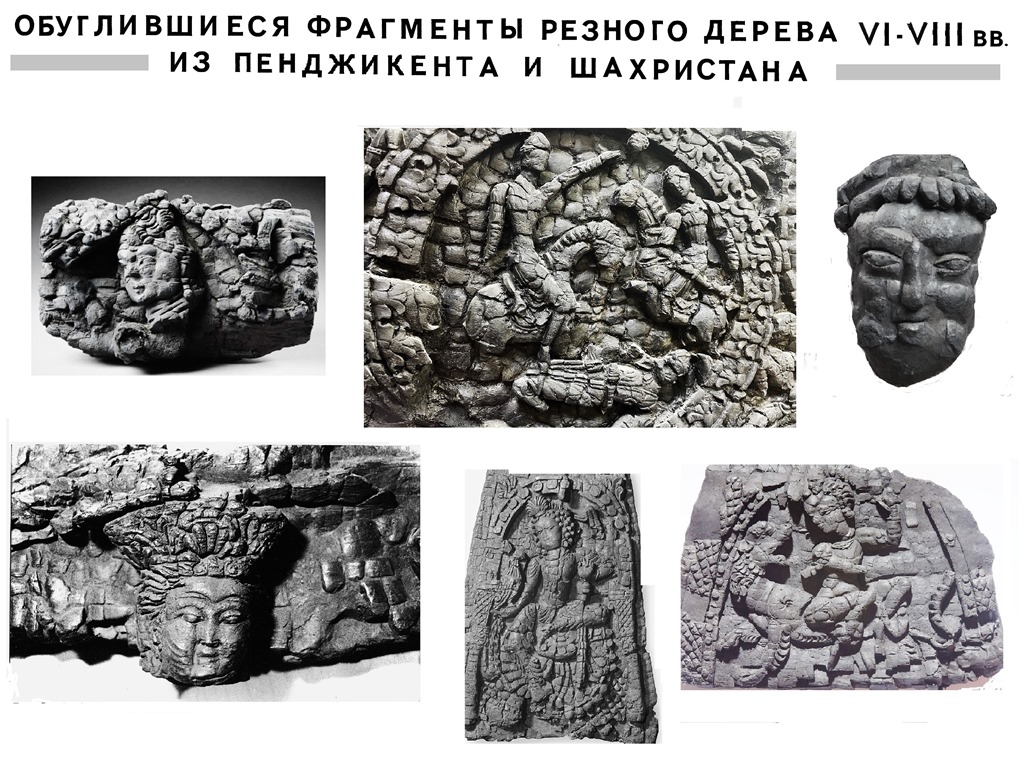
Thanks to extensive archaeological work carried out in ancient Penjikent and Shahristan in the 1950s-80s, fragments of carved wood, or rather samples that were preserved in case of fire, where wood burned without access to oxygen and turned into charcoal, were studied in detail.
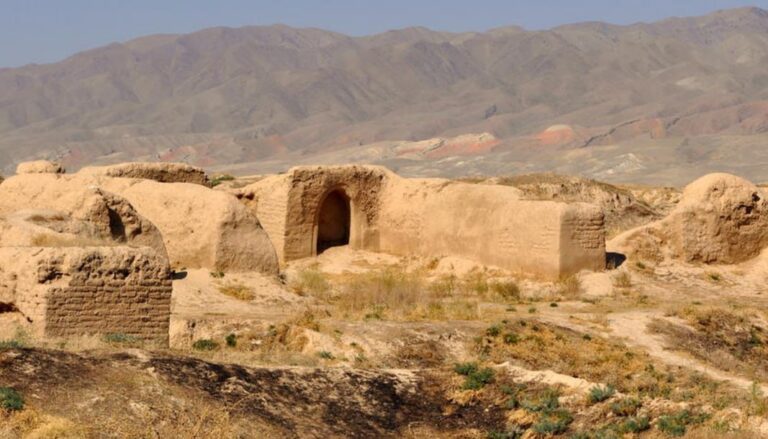
At the Kala-i Kakhkakha (Shahristan) site, 200 charred fragments of a carved wooden arched tympanum were discovered, decorating the entrance to the palace with pictorial scenes and ornamental compositions. Archaeologists meticulously pieced together these fragments into compositions, revealing to us only a small glimpse through which we can see a small part of the once vast and highly accomplished art.
Particularly noteworthy is the rich decorative decoration of the ceremonial halls of ancient Penjikent. The tall four columns in the center of the hall, adorned with carved capitals, supported complex carved wooden ceiling structures, which represented various variations of a complex stepped wooden ceiling with a skylight at the top.
Into the construction of inclined trapezoidal boards, wooden female sculptures-caryatids and figures of deities were often integrated. Overall, a very harmonious, spacious, top-lit interior of the hall was created. The light brightly highlighted the structures of the upper part of the ceiling and the middle recessed area between the four columns and, reflected, reached the walls decorated with multi-story frescoes, filling the interior space with epic solemnity.
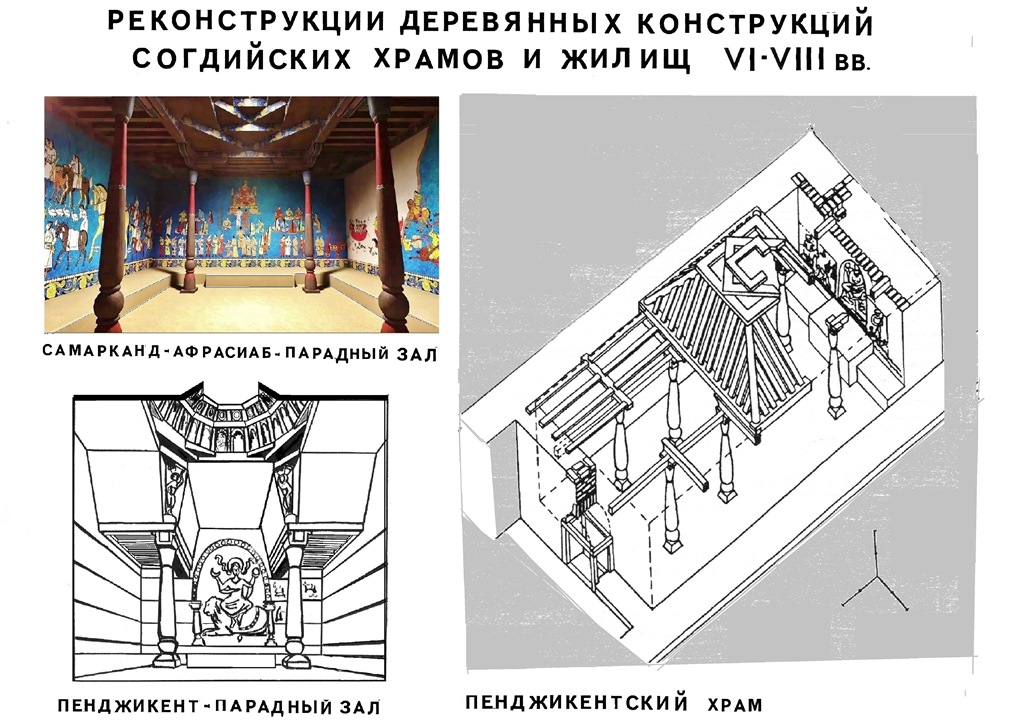
Many researchers cite the houses of the Western Pamirs as analogies to the Sogdian house, which, in our opinion, are a folk variant of the widespread ancient and medieval type of closed house with a square four-pillar hall with a stepped ceiling “chorkhona,” ending with an opening “ryodz” or “rauzan,” as confirmed by numerous archaeological materials.
Fragments of carved wood and paintings testify to the fact that, in terms of the richness of decor and elegance of carved decoration, the palace of ruler Devashtich on the citadel of Penjikent was not inferior to the palaces of Varakhsha Bukharkhudats, Ustrushana afshins, and other early medieval rulers of Central Asia.
Along with the abundance of carved house structures, the polychromatic and multi-tiered paintings brought world fame to Penjikent and the castles of Ustrushana. Due to religious tolerance in the states of Central Asia in the 5th-8th centuries, images of goddesses and demons emerging from the depths of Eastern Iranian mythology could be seen on the walls of houses and temples. Here are the feats of the legendary Rustam, the tales of Siyavush – a deity in the form of a beautiful youth embodying the annually dying and resurrecting nature. Everyday scenes, feasts with ensembles of musicians and dancers intertwine with such “wandering plots” as the depiction of the Capitoline Wolf feeding twins (Bunjikat) and Aesop’s fables.
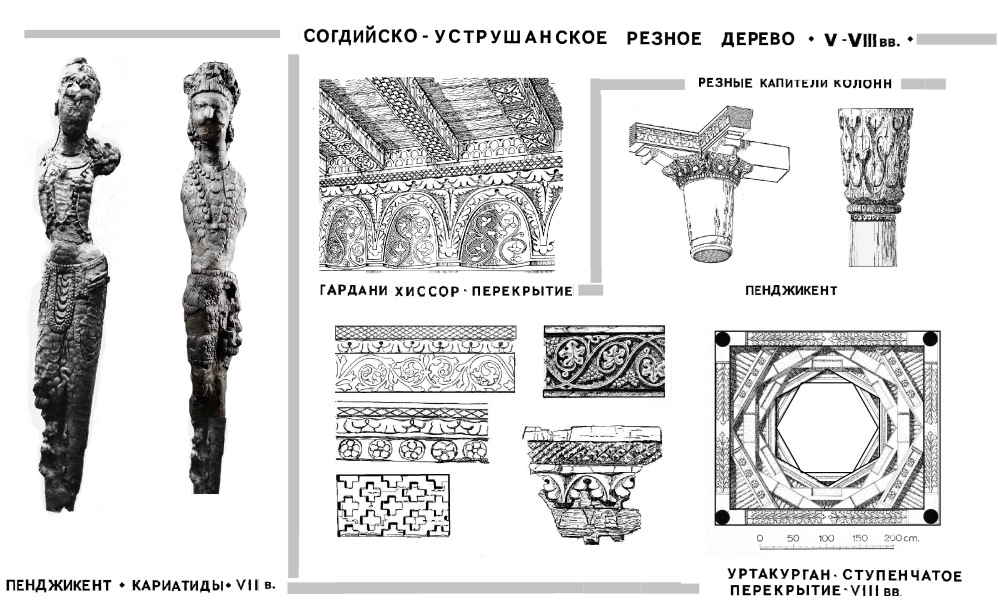
From the walls, we are gazed upon by deities borrowed from Buddhist and Hindu religions, plots from the “Panchatantra.” Among the finds is a sculpture of Shiva sitting on the bull Nandi and his consort Parvati. The conditional “patroness” of Penjikent was the four-armed goddess Nana, who sat on a lion with symbols of the Sun and Moon in her hands.
This goddess was revered by the Kushans: on the Rabatak inscription of the 2nd century in Afghanistan, King Kanishka testifies that he “received the kingdom from Nana and all other gods.” The cult of the goddess Nana came to Central Asia from Mesopotamia, and in Sogd, Parthia, and Bactria, her image merged with the Avestan goddess Ardvishura Anahita.
“Such saturation of a small early feudal town of the 5th-8th centuries (Penjikent) with works of wall painting is unknown in the East in any ancient city. Such a variety of plots is not found anywhere. Such an abundance of techniques, manners, styles in painting with relative unity of its style is also not found,” writes the famous researcher of Central Asian art, G. Pugachenkova.
Mithra, from the “golden peaks” of Zeravshan
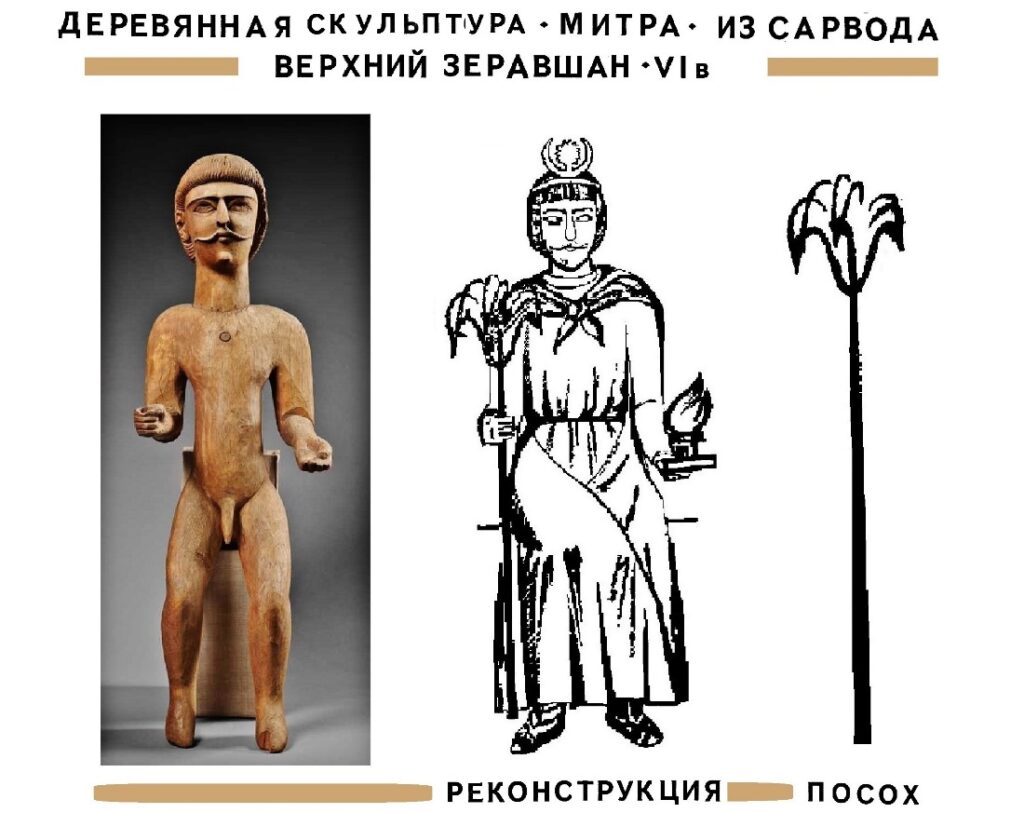
In the 1980s, a meter-long wooden figure dressed in armor of a pre-Islamic idol with a staff in hand was discovered in a cave near the village of Sarvoda, which researchers identify with the ancient Iranian god Mithra. In the “Avesta,” there are lines about Mithra who reached the “golden peaks, from where he sees the entire Aryan land and among which Gava, that in Sogdiana.” It is likely that this is the earliest mention of the upper reaches of Zeravshan. The geography reflected in the “Avesta” once again emphasizes the areas of Zoroastrianism formation.
By the end of the early medieval period (7th-8th centuries), a tendency to subordinate relief plastic to plane decoration is observed in decorative decoration. Geometric grids, stylized pictorial and plant motifs appear, patterning increases, foreshadowing the triumph of ornament in the subsequent Islamic era.
Masterpieces of carved wood from Upper Zeravshan (10th-12th centuries)
With the arrival of Islam in Central Asia, the art of wood carving continued to develop, but already within the framework of the new religion’s canons, replacing pictorial motifs (gods, mythological plots, zoomorphic images) with geometric (girih) and plant (islami) ornaments.
Geometric pattern – girih – allowed for infinitely filling complex surfaces, while the second type of pattern – islami – represented a combination of plant ornament, where intertwining shoots of flowers and leaves recreate the image of a blooming garden-paradise.
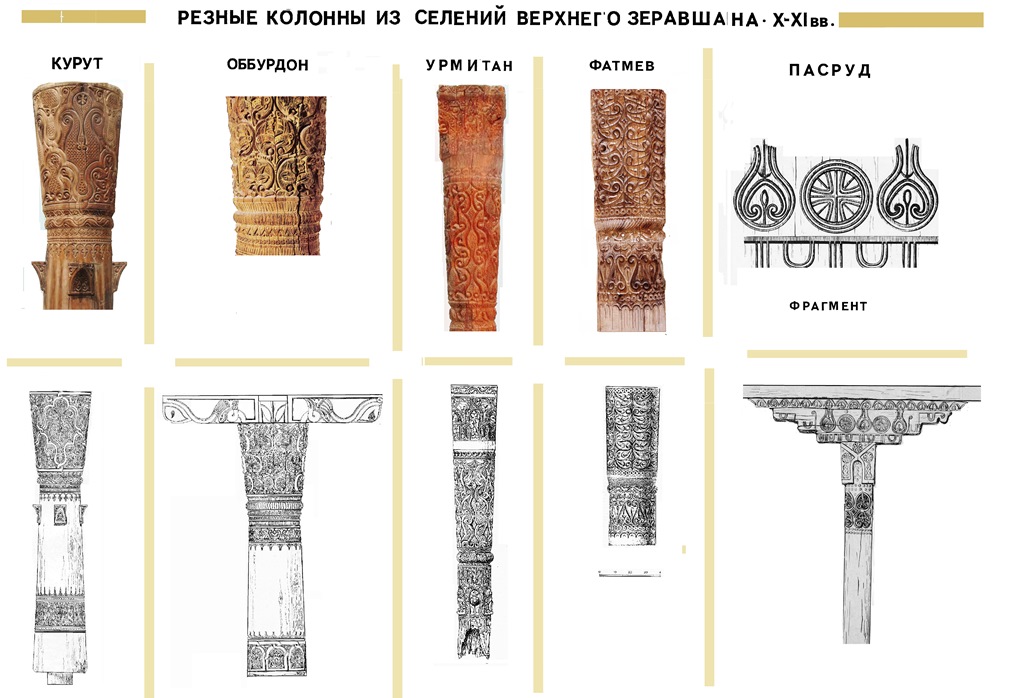
In the ornamental decoration of ornaments, the intricate interweaving of Quranic inscriptions was elegantly woven. It so happened that the earliest samples of carved wood from Central Asia of the 10th-11th centuries were discovered in the 1920s-30s in the upper Zeravshan villages of Tajikistan – Kurut, Obburdon. These finds were sensational and, as it was believed then, singular. But in 1946-1947, the Sogdian-Tajik expedition discovered new carved columns of the 10th-12th centuries in the villages of Fatmev, Urmetan, Rarz, Pasrud, and Zosun, demonstrating the early stages of style and technique formation in wood carving.
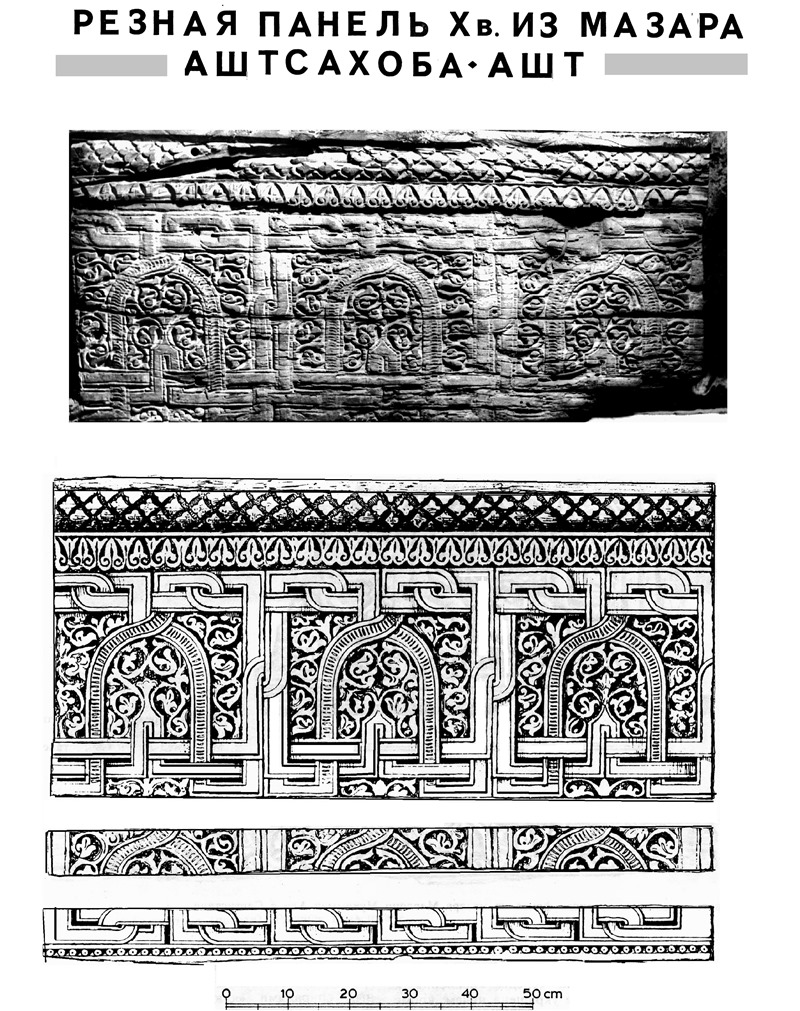
Later, this list was supplemented by highly artistic carved columns and consoles from Matcha, Yagnob, a 10th-century panel from the Ashsakob mausoleum in Asht, and the undisputed world-class masterpiece of artistic wood carving, an entirely carved mihrab from the village of Iskodar.
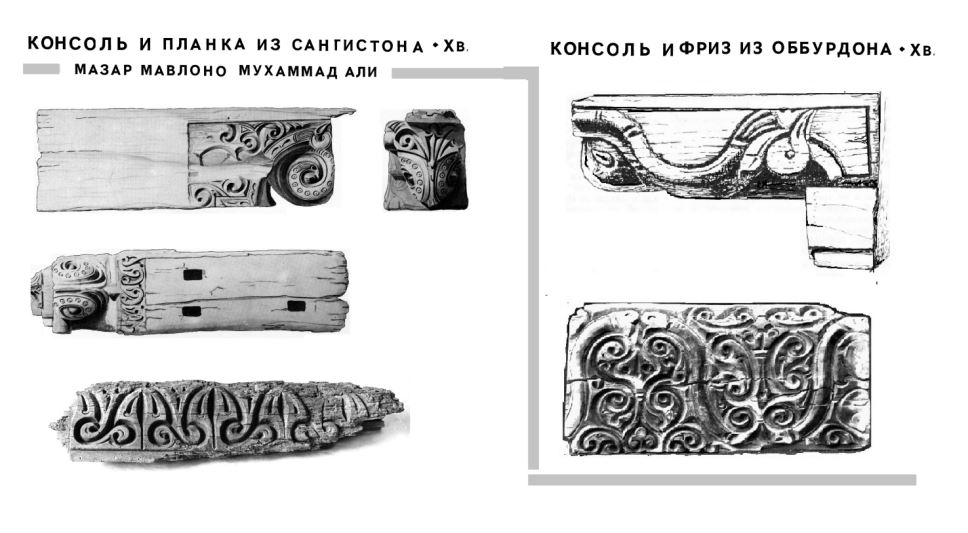
The discoveries of unique samples of carved wood in the upper reaches of Zeravshan initially gave rise to incredible hypotheses about its origin. The carving on the columns and details was so perfect that Uzbek researcher V. Filimonov doubted their local origin and hypothesized that all these samples once adorned the mausoleum of Kusam ibn Abbas in the Shahi-Zinda complex in Samarkand, where a wooden frieze and consoles have survived, similar in carving character and style to the Upper Zeravshan wood.
According to his version, they were allegedly transported to the mountainous regions so that they would not be burned by Mongol conquerors. But the discoveries of subsequent years in the villages of Sangiston, Pasrud, and also, the wooden mausoleum of the 10th-11th centuries found in the mountain village of Chorku refuted the assumption of Uzbek colleagues, thereby confirming their local origin.
In the Obburdon and Kurut columns, the smooth surface of the trunk is decorated with bands of dense carving under the capital and in the lower part of the trunk. Similar forms of early column capitals, with sub-beams in the shape of birds with pointed beaks, are considered by some researchers as echoes of local variants of stylized Hellenistic Corinthian and Ionic capitals.
This can be partially agreed upon since the basis of this artistic synthesis is undoubtedly Iranian, tracing back to zoomorphic motifs.
Let’s recall the capitals of Persepolis in the form of connected protomes of bulls and griffins, or Kushan capitals from Shahrinau in the form of fantastic horned mouflons with lion paws, as well as Nuristani capitals (from the collection of the Kabul Museum) in the form of heads of mountain goats with curled horns.
Mountain goats in Tajikistan have always been considered sacred animals. We agree with the well-known researcher of Central Asian architecture V. Voronina that “zoomorphic ornament flourished in the upper reaches of Zeravshan so brightly and uniquely that it must be considered an unparalleled phenomenon in the art of the East at all times.”
In the wooden frieze from Obburdon, dating back to the 9th-10th centuries, snake-like creatures as messengers from the depths of pre-Islamic art, with heads turned towards each other, form a rhythmic wave-like pattern, inside which clover motifs are embedded.
The stylistic similarity of wood carving from the 10th-12th centuries allows us to judge the existence of an original local artistic school, which has not yet been constrained by strict canons.
In the valley of forgotten ancestors
The Yagnob Valley is a reserve of ancient forms of art and architecture, language, and life—a living island of Sogdian culture. One of the most revered holy places in Yagnob is the Khatty Mullo mausoleum near the village of Sokan.
In 1964, a fragment of a carved column dated to the 10th-11th centuries and a small board with an ornate beautiful inscription containing a Shiite saying were removed by the expedition of academician A. Mukhtarov.
The column, or rather its preserved upper part, has an original decoration inherent in the best monuments of folk art. The strongly tapering trunk, rolls separating it from the capital, and the lower rounded part of the capital are covered with deep vertical and zigzag incisions.
Intertwining elegant spiral shoots are carved on the capital, remotely reminiscent of a free interpretation of Corinthian capitals. Fragments of small ancient wooden carved details could still be seen in the iwan of the mausoleum during our expeditions in 1991-1991.
Another attraction of the mausoleum is the interior of the one-pillar hall, in the center of which is a powerful, round polished column with four diverging sub-beams. This hall served not only and not so much as a memorial mosque but was used for an interesting ancient ritual associated with folk beliefs, matched by the mysterious structure of the interior.
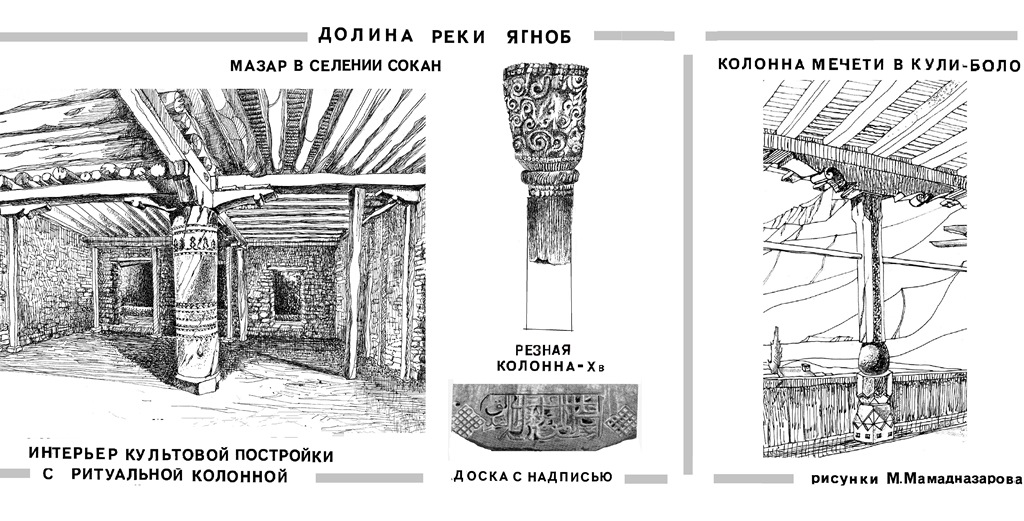
The essence of the ritual is that the pilgrim must, holding the trunk with one hand (the upper belt of the ornament), walk around the column three times. Then tightly embrace the trunk with both hands, and if your fingers meet, the wish was fulfilled; if they do not meet (the trunk supposedly became thicker), the saint did not accept your request. This was repeated three times.
The similar ritual with the Indian iron pillar and the hymn in the “Rigveda” dedicated to the sacrificial pillar comes to mind, whose verses were read while rubbing this pillar with fat.
Mihrab in the village of Iskodar (10th century)
A masterpiece of highly artistic wood carving art is considered the ancient mihrab of the 9th-10th centuries, discovered in the 1950s in the village of Iskodar in Upper Zeravshan, once adorning a non-preserved raw-brick mosque.
In a U-shaped frame 290 cm high and 180 cm wide, between two corner columns, is a semi-dome of the conch with an Indian-shaped arch – horseshoe-shaped inside and keel-shaped outside, decorated with openwork festoons.
Fine carving along the edges of the elegant kufic script is gradually replaced by deep carving and relief elements (columns, consoles, protruding semicircles inside the arch), drawing attention to the niche.
Inside the niche, an expressive dynamic composition is carved, consisting of spiral branches inscribed in a circle. The sculptural columns, adorned with exquisite carving, reproduce the appearance of large columns crowned with decorative consoles-sub-beams.
“The overall appearance of the mihrab, solemn and triumphantly festive, is filled with the spirit of old pagan art,” writes S. Khmelnitsky.
In the decoration of the Iskodar mihrab, as well as in the Upper Zeravshan columns, there are many motifs tracing back to the art of pre-Islamic Sogd: some elements of the carving exactly repeat ornaments found in the houses and temples of Penjikent of the 5th-8th centuries. The bases of the mihrab’s corner columns also reveal similarities with the bases of columns in early Islamic architecture of Central Asia.
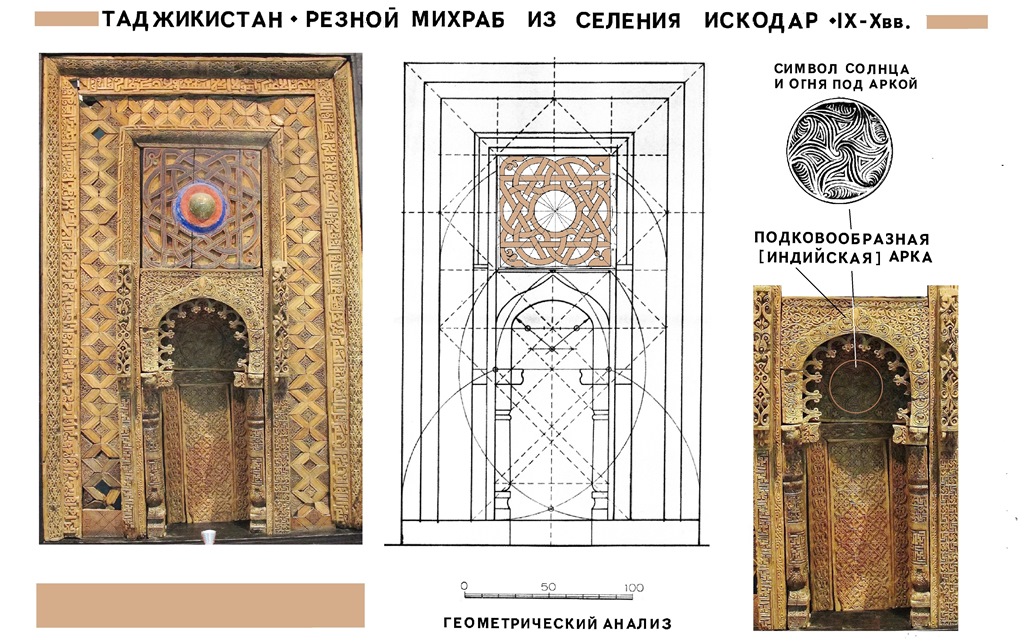
It is likely that among the purely Muslim attributes in the mihrab, there are also traditional elements characteristic of cult niches – altars of Sogd (altar in Gardani Hisar): corner columns, solar symbol, swastika motifs, and an unusual niche resembling an Indian arch in shape.
The appearance of the Indian motif is also not accidental, as Buddhism and Hinduism were widely spread in the Central Asian region, along with their accompanying architectural structures in southern Tajikistan.
Mausoleum in Chorku – a pearl hidden in a shell
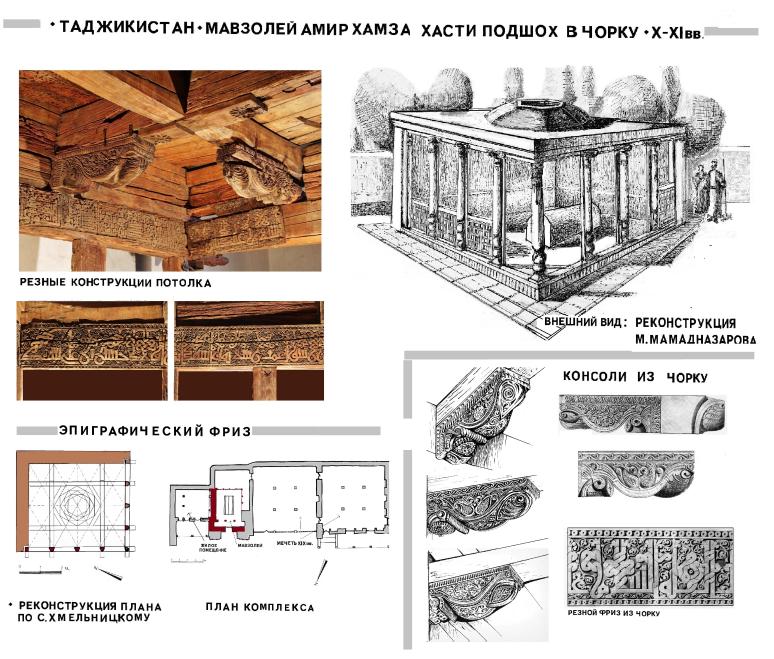
If in the mountainous regions of Zeravshan we became acquainted with architectural details of carved wood, the discovery of a unique, probably the oldest of the preserved carved wood monuments in Central Asia, in the picturesque village of Chorku, 20 km south of Isfara, was truly sensational. We are talking about the Hazrati-Bobo mausoleum, or as it is sometimes called by the people, Amir Hamza Hasti Podshoh.
The mausoleum itself is included in a multi-temporal complex from the 17th – early 20th century. In the external forms, there is no hint of the deep antiquity of the complex. For this reason, it long remained unnoticed by researchers of history, art, and architecture.
In 1962, upon entering the semi-dark interior of the mausoleum, Tajik art historian Manon Ruziyev was amazed by the stunning interior carved wooden decor, sharply contrasting with the external forms of the complex’s decoration. It turned out that behind the thick raw-brick casing of the late mausoleum, a monument dating to the 10th-12th centuries was hidden like a precious pearl in a shell.
In a small room measuring 4.5 x 5.75 m, a small iwan oriented to the south and west was “walled up,” hidden like a precious pearl in a shell, with magnificent, diverse in construction and decor columns, stands, consoles, and complex figured capitals, calligraphic inscriptions, and set lattices.
Moreover, this iwan had its own ceiling, which was lower than the ceiling of the later raw-brick building. The three western columns of the ancient building and one southern column facing the facade have a form not found in Central Asian architecture, in the shape of a half-column connected to a rectangular stand carved from a solid wooden beam.
The rectangular part of the columns facing inward had various ornamental carvings: in three stands, a motif of a winding stem outlined with pearls is depicted. The widest stand is decorated with a mesh ornament, with a four-petal rosette carved in each cell. A powerful architrave supported by the columns encircles the iwan to the south and west, and on the northern and eastern parts, where the iwan was bounded by walls, it is replaced by a frieze of wide boards.
On the inside of the beam – the architrave, an elegant kufic inscription is carved, in which the script intertwines with plant ornament. The epigraphic band is extended to the eastern wall, and there is a fragment of it on the northern part.
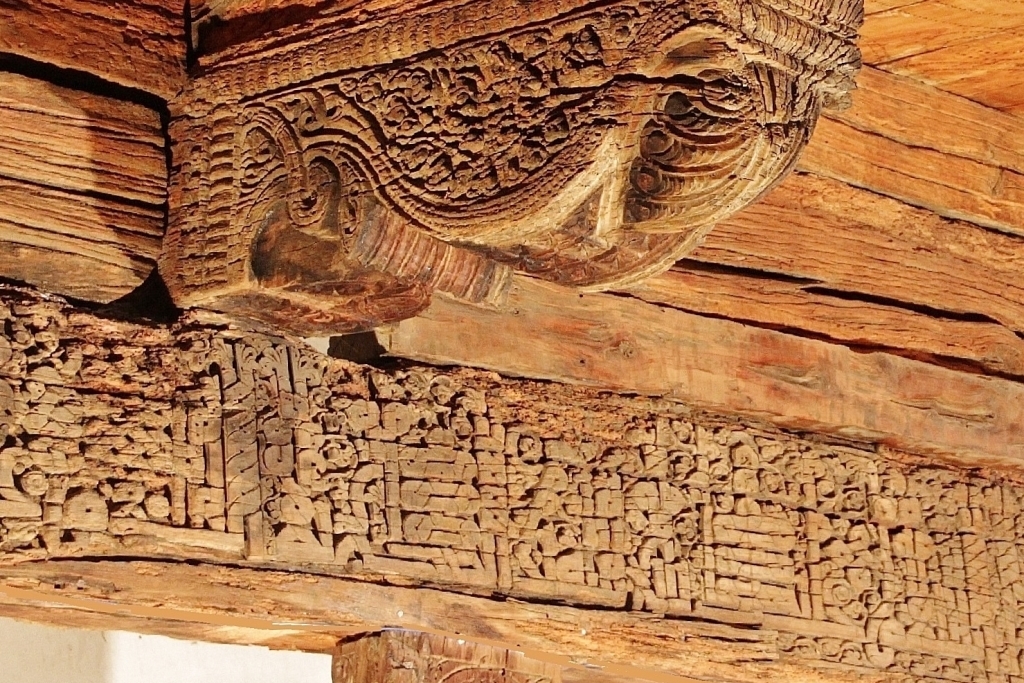
The four powerful ceiling beams intersect in pairs in the middle, dividing the ceiling into nine equal parts, with a central square. The curved 80 cm, protruding from the walls consoles with a complex convex profile, remind at first glance of a stylized image of a bird with eyes and a beak curved like an owl’s.
The convex belly is covered with a ribbon of plant ornament in the form of winding shoots, on the sides a more complex ornament, and further, crossing to the wide side, their character becomes more complex, and the composition resembles a bush with spiral shoots.
One of the interesting problems related to the ancient part of the Hazrati Bobo complex is the reconstruction of its original appearance.
What did this wooden monument of Tajik architecture of the 10th-12th centuries originally look like? Architect V. Voronina believes that the iwan was adjacent to a closed mosque attached to it from the east. If we accept this version, it should be noted that the adjoining building cannot be a mosque, as it is impossible to establish a mihrab in it, which should be located on the west side, and to the west, as is known, is the open iwan.
S. Khmelnitsky dates the monument to the 10th-12th centuries, in which “the earlier date is more convincing than the later one.” This is evident when comparing the architectural and decorative details of Chorku with the monuments of the 6th-7th centuries. Moreover, the consoles are genetically linked not to bird images, as he believes, but to the volutes of the antique Greco-Roman order of the first centuries AD.
The capitals of the columns in Chorku are also close to the Hellenistic order, tracing back to acanthus leaves. In the bizarre unique plasticity of wood carving, we see the organic fusion of ancient pre-Islamic pictorial traditions with new Islamic trends.
There are many mysteries in the architecture of the Chorku monument. For example, it is unclear why the consoles do not align with the columns. It is likely that the skewed structure could have collapsed in antiquity, and it was reassembled, allowing for gross distortions in replacing some lost parts.
S. Khmelnitsky assumed that the central square of the ceiling in Chorku fits a hexagon, and it was originally designed as a stepped ceiling of diminishing hexagons with a skylight at the zenith. Such ceilings were widespread in antiquity in Ustrushana and have rudimentarily survived in the figured ceilings of houses and mosques in northern Tajikistan.
The building existed in the form of an iwan open to the west and south, and to the north and east, it was, as it is now, enclosed by raw-brick walls, as shown in our graphic reconstruction of the original appearance of the mausoleum.
All researchers agree that this is one of the few miraculously preserved masterpieces of wooden architecture in Central Asia of the 10th-12th centuries.
We have made an excursion into the amazing world of ancient high-artistic Tajik wood carving art of the 6th-12th centuries, successively continued in subsequent centuries and reaching our days.
The ancient art of our ancestors cannot but evoke admiration.