Home Blog Page 88

Economic results of Tajikistan in 2025: growth, dependency, and challenges

0

The economic results for Tajikistan in 2025, as in previous years, are described as optimistic: high economic growth rates, increased household incomes, industrial production growth, a decrease in poverty, and significant investments. However, official statistics do not always reflect the real situation citizens face in terms of household budgets, the labor market, and access to opportunities.


GDP growth, continued dependence

In 2025, Tajikistan’s economy continued to demonstrate strong growth, despite external challenges. According to statistics, the gross domestic product (GDP) in January-November 2025 reached 173 billion somonis (over $18 billion), with a real growth rate of 8.4%. As a result, GDP per capita increased to 16.1 thousand somonis ($1,700).

For socio-economic development, more than 670 billion somonis were allocated, including 159 billion from foreign capital.

Despite the high GDP growth, independent economists highlight that much of this growth has been driven not by the expansion of domestic production and labor productivity, but by external sources of income, such as remittances from migrants.


Migrant remittances

Tajikistan remains one of the world’s most dependent countries on remittances from labor migrants. In 2024, remittances to the country amounted to $5.8 billion, making up 45.4% of Tajikistan’s GDP, the highest relative share globally.

Migrant remittances play a crucial role in sustaining domestic demand, covering the foreign trade deficit, and replenishing the state budget, supporting the purchase of goods and services, and financing necessary imports.


Economic growth and challenges

Agriculture and industry continue to be the primary drivers of Tajikistan’s economic growth, accounting for around 40% of GDP. Industrial production grew by 22%, and agriculture saw a 9.2% increase. However, the country’s heavy reliance on raw material exports limits opportunities for diversification.

In 2025, the country harvested approximately 1.7 million tons of grains, but a 5.8% decline in cereal production raised concerns. Meanwhile, metal production continues to grow, particularly in the mining sector, confirming the high demand for metals like aluminum and gold.


Inflation and salaries

Inflation in 2025 was reported at 2.9%, which is lower than in previous years. However, many citizens report that the real increase in prices for food and services is much higher, leading to skepticism about official inflation figures.

The average salary in October 2025 was 3,123 somonia ($335), but salaries in different sectors remain highly varied, indicating significant social differentiation.


External trade and deficit

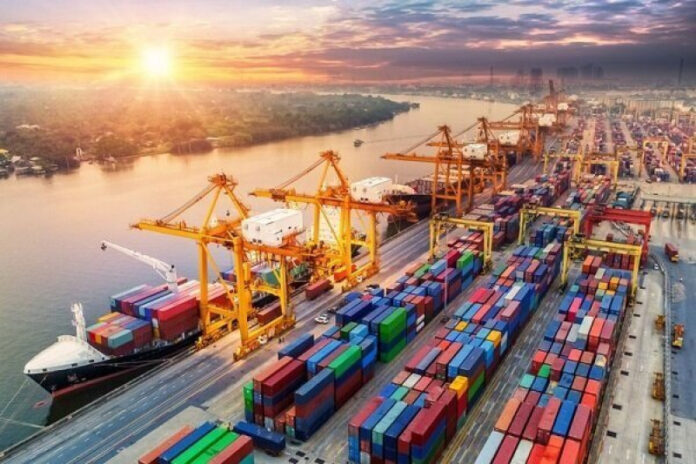
Tajikistan’s foreign trade turnover in 2025 reached $9.7 billion, a 21.6% increase compared to 2024. Exports amounted to $2.26 billion, and imports reached $7.4 billion. The trade balance remains negative, highlighting the country’s high dependence on imports.

Metals, including precious and non-precious metals, remain the main export product, alongside textiles and mineral products. In contrast, imports mainly consist of oil products, machinery, and non-ferrous metals.


Banking sector issues

Sanctions imposed by the European Union on three Tajik banks—OJSC Commerce Bank of Tajikistan, CJSC Spitamen Bank, and CJSC Dushanbe City Bank—have cast a shadow on the previously stable banking sector. These sanctions prevent transactions with these banks within the EU, signaling a serious concern for the country's financial system.


Prospects and challenges

Despite growth in some sectors, Tajikistan continues to face challenges in diversifying its economy, heavily relying on external factors such as migrant remittances and raw material exports. While household incomes are increasing, the gap between rich and poor remains significant, particularly in rural areas. The authorities face the task of increasing productivity and creating quality jobs to ensure sustainable development for the country. 
328 families relocated from hazard-prone areas in Tajikistan over two years

0

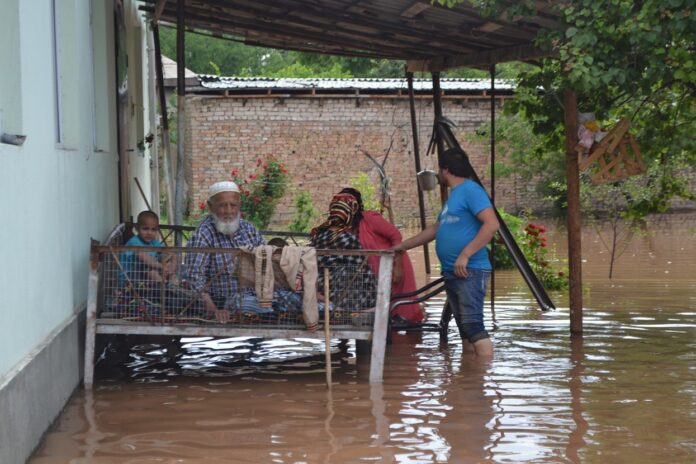
Over the past two years, 328 families in Tajikistan have been relocated from areas prone to natural disasters to safer locations, the state-run news agency Khovar reports, citing Jamshed Kamolzoda, a representative of the Emergencies Committee under the Government of Tajikistan.

Kamolzoda said that 174 families were relocated in 2025, while 154 families were moved from high-risk zones in 2024.

In 2025, Tajikistan recorded 287 emergency incidents, 12 of which were classified as natural disasters. The total damage caused by these events exceeded 20 million somoni.

“The most common natural disasters in Tajikistan are landslides, earthquakes, and avalanches. These types of disasters cause the greatest financial losses and pose serious threats to public safety. Among them, earthquakes are considered the most dangerous in terms of potential impact,” Kamolzoda said.

Such disasters are most frequently reported in mountainous regions, including the Gorno-Badakhshan Autonomous Region (GBAO), the Rasht and Zarafshon valleys, as well as mountainous area of Sughd province.

According to Kamolzoda, more than 28 million somonis were allocated in 2025 for riverbank protection projects and other preventive measures. The funds were used to purchase fuel, construction materials, and other essential supplies, as well as to deliver them to more than 20 vulnerable cities and districts.

In addition, in 2024 the Center for Disease Control and Prevention reported that 1,209 hazardous areas had been identified across the country, with residents gradually being relocated to safer areas.

Mystery surrounds death of three family members in Isfara more than a month later

0

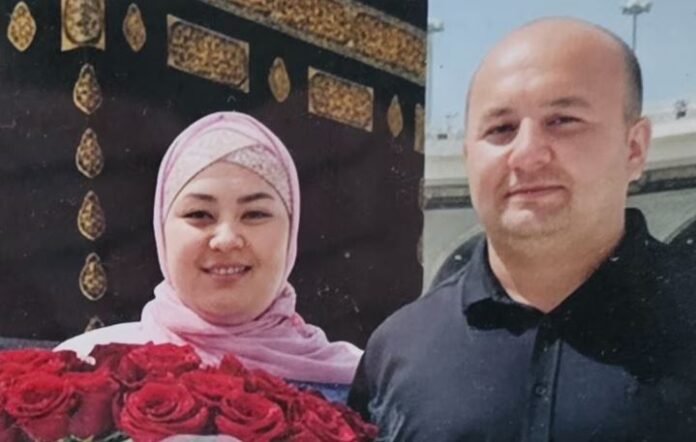
More than a month after the deaths of a man, his wife, and their four-year-old daughter in the northern Tajik city of Isfara, the cause of the tragedy remains unknown, raising growing concerns among relatives and the public.

Iskandar Shafeiyon (also known as Maliki), a former head of the organizational and human resources department of the Isfara city administration, died together with his wife Muattarakhon, 29, and their young daughter on the night of December 7, 2025. Authorities initially cited “poisoning” as the presumed cause of death, but say the final forensic conclusions are still pending.

Officials have not yet released the results of toxicological examinations, and relatives say the circumstances surrounding the incident appear suspicious.

According to an initial account from a source familiar with the case, all members of the family fell ill after dinner. By the time doctors arrived, Iskandar Shafeiyon, his wife, and one of their daughters had died. Two other children were taken to a hospital in Isfara in serious condition.

At the time, the Sughd regional health department said the cause of death would be determined through an investigation. However, more than a month later, no official findings have been made public.

On January 12, Mohammad Shafiev, the victim’s brother, told Asia-Plus by phone that the family has received no official response from the Isfara city prosecutor’s office, which they believe has opened a criminal case.

Meanwhile, Radio Liberty’s Tajik Service, known locally as Radio Ozodi, citing its own sources in the city prosecutor’s office, reported that no criminal case has been opened and that only a preliminary inquiry is underway. “The chemists have not yet provided the test results,” a source said.

According to the same source, samples have been sent to Uzbekistan for final forensic analysis. “Once the cause of death is determined, the information will be made public,” the source added.


“The family’s death looks mysterious”

Asia-Plus also spoke with a close relative of Muattarakhon, who requested anonymity, and shared details of the night of the incident.

According to the relative, Muattarakhon’s family tried to contact her repeatedly throughout December 7, but no one answered. Later in the evening, after 7:00 p.m., Iskandar Shafeiyon’s mother answered the phone and spoke while pretending to be Muattarakhon. Shortly afterward, she called again via WhatsApp and said her son’s health condition was poor.

“We told her to call an ambulance, but she said she didn’t know anyone in Isfara and didn’t know where to turn for help,” the source said. When asked to hand the phone to Muattarakhon, the woman said she was in another room and hung up.

Further calls went unanswered. Later, the couple’s seven-year-old daughter, Rukhshona, contacted relatives via a WhatsApp video call and showed her mother lying unconscious.

At around 11:00 p.m., Iskandar Shafeiyon’s mother informed Muattarakhon’s family that her son had died.

“We immediately left for Isfara and arrived after 1:00 a.m. When we entered the house, Iskandar’s body was in one room, while Muattarakhon and their four-year-old daughter were lying lifeless in another,” the source said.

An ambulance was then called, and at around 2:00 a.m. two other children—Sumayakhon, 6, and four-month-old Muhammadjon—were taken to the Isfara city hospital in critical condition. The eldest child, seven-year-old Rukhshona, and Iskandar Shafeiyon’s mother were not affected.

Relatives of Muattarakhon believe the deaths were not the result of accidental or natural poisoning and describe the incident as “mysterious.” They have appealed to the Sughd regional prosecutor’s office but say they have received no response so far.

According to the family, the apartment where the Shafeiyons lived in Isfara has been sealed, and authorities have not contacted them even once to inquire about the condition of the orphaned children.

These claims could not be independently verified. Attempts by Asia-Plus to speak with Iskandar Shafeiyon’s mother, who is considered a key witness, have so far been unsuccessful.

The three surviving children are currently staying with their maternal grandmother in Khujand, while Iskandar Shafeiyon’s mother is in Panjakent with her brother.

The bodies of Iskandar Shafeiyon, his wife, and their daughter were buried on December 8 in the village of Veshist in the city of Panjakent.

Iskandar Shafeiyon previously came to public attention after being injured during border clashes with Kyrgyzstan. He was later charged with fraud, fined, and dismissed from his post. In recent years, he had been engaged in private business. 

Tajikistan introduces criminal penalties for publishing photos and videos of illegal hunting

0

Tajikistan has introduced criminal liability for promoting illegal hunting and for publishing photos or videos of illegally obtained wildlife in the media and online. Offenders may face fines of up to 156,000 somoni or prison sentences of up to five years.

The amendments were introduced to the country’s Criminal Code and were signed into law by President Emomali Rahmon on December 17, 2025, after being approved by both chambers of parliament.

Under the new provisions, Article 232 (“Illegal Hunting”) has been amended to include offenses committed “with public demonstration, including through mass media or the Internet.” This marks the first time Tajik legislation has explicitly addressed public promotion of illegal hunting, including through social media platforms.

The law stipulates penalties ranging from fines of 78,000 to 156,000 somoni (1,000–2,000 calculation units; one unit equals 78 somoni in 2026) to imprisonment for a term of three to five years for promoting hunting or publishing related photo and video materials online.

A new Part 3 has also been added to Article 232, establishing harsher penalties for repeat offenses, including illegal hunting, the capture of birds and animals whose hunting is fully prohibited, as well as crimes committed through abuse of official position, by prior conspiracy, or by organized groups. Such offenses are punishable by fines of 156,000 to 234,000 somoni or imprisonment for four to seven years.

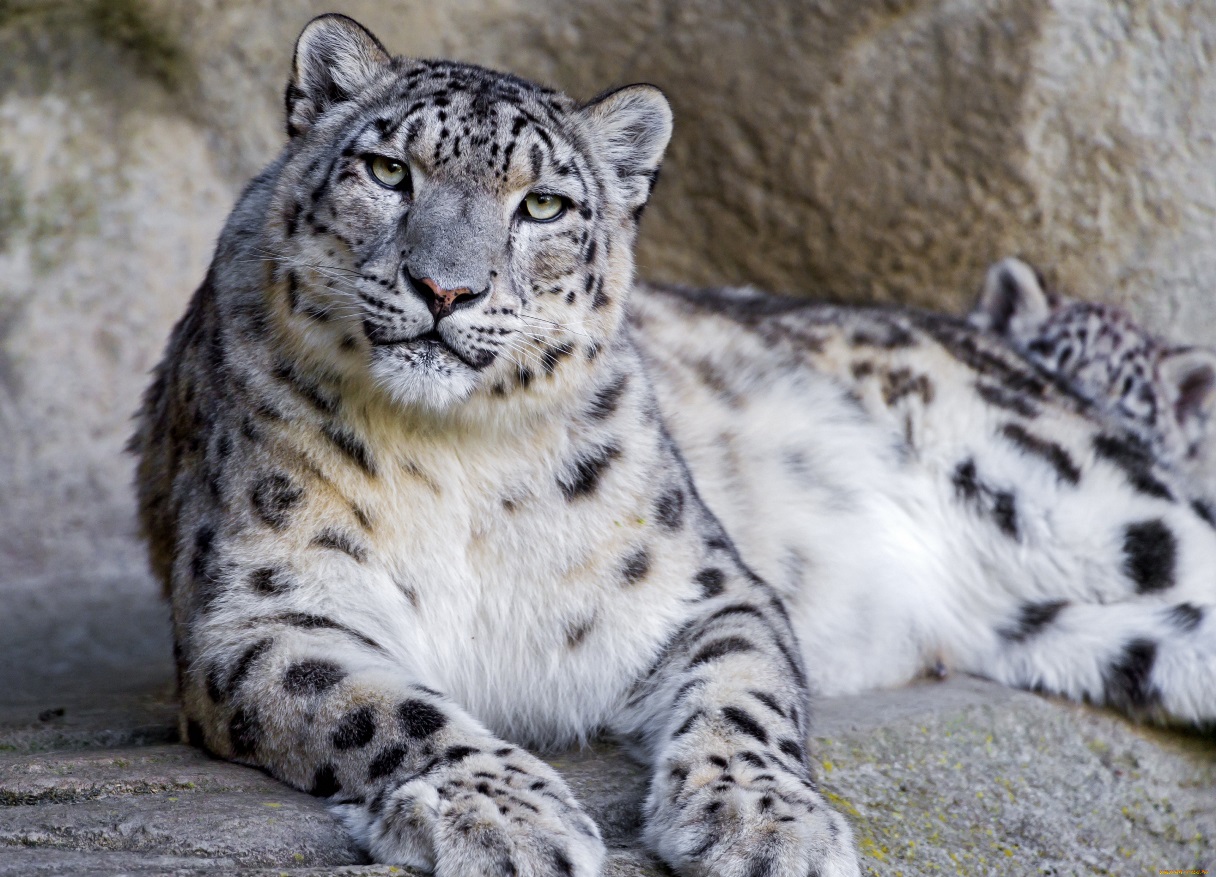
Penalties for crimes involving the snow leopard have also been strengthened. Amendments to Article 232(1) provide for fines ranging from 93,600 to 140,400 somoni for hunting or killing a snow leopard, while repeat offenses may result in fines of at least 156,000 somoni or prison sentences of up to eight years. Previously, the maximum prison term for repeat violations was five years.

In Tajikistan, hunting—especially of rare species listed in the Red Book—is permitted only with special authorization from the competent authorities. However, officials note that some individuals engage in illegal hunting and, in certain cases, publicly share footage of the hunt or its results online, including on social media.


Snow leopard under special protection

In addition, at the end of December 2025, lawmakers approved further amendments tightening penalties for crimes involving the snow leopard.

Under the revised law, hunting, intentional killing, as well as the illegal acquisition, storage, transfer, or sale of a snow leopard are punishable by fines of 1,200 to 1,800 calculation units or imprisonment for up to three years. Previously, fines ranged from 800 to 1,200 units.

Repeat offenses now carry fines of 2,000 to 3,000 calculation units or prison terms of four to eight years, along with a ban on holding certain positions or engaging in specific activities for up to five years. Under the previous version of the law, the maximum prison term was five years.


Tajikistan and Iran to waive visas for international truck drivers from March 2026

0

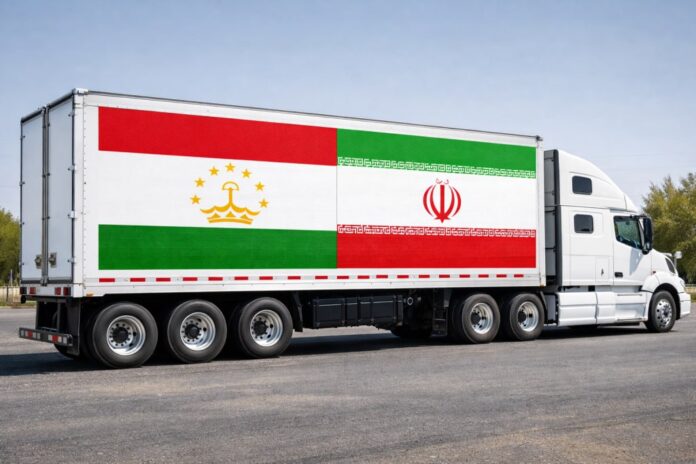
Tajikistan and the Islamic Republic of Iran will abolish visa requirements for international road transport drivers starting in March 2026, following bilateral agreements reached between the two countries.

According to the Ministry of Foreign Affairs of Tajikistan, the decision was made in line with resolutions adopted by the governments of both states and provisions of a bilateral agreement.

“Drivers and assistant drivers engaged in international cargo transportation who hold ordinary passports of Tajikistan and Iran will be able to enter each other’s territory without visas,” the ministry said.

Under the new rules, drivers will be allowed to cross the border through all checkpoints and remain in the other country for up to 30 days within any 90-day period without obtaining a visa.

The ministry noted that the measure is expected to simplify international transport operations, strengthen trade and economic cooperation, and improve the efficiency of logistics between Tajikistan and Iran.

Previously, the two countries lifted visa requirements for holders of diplomatic and service passports. In addition, citizens of Tajikistan and Iran holding ordinary international passports are entitled to stay in each other’s countries visa-free for up to 30 days within a 90-day period from the date of first entry. However, this preferential regime currently applies only to travelers using direct air routes between cities in the two countries.

Citizens entering via land borders or through third countries are still required to obtain visas.

A memorandum on the abolition of the visa regime was signed during the visit of Iran’s former president Ebrahim Raisi to Tajikistan in November 2023. In the summer of 2024, the relevant documents were finalized and approved by the parliaments of both countries, and the visa regime between Dushanbe and Tehran was officially lifted on August 10 of that year. 

U.S. urges its nationals to leave Iran immediately

0

The United States has updated its travel advisory for Iran, urging U.S. citizens to leave the country immediately amid rising unrest across the Middle East nation.

In a statement issued on Monday, the U.S. Virtual Embassy in Iran warned that Americans should be prepared for continued internet disruptions and make alternative communication plans. The advisory also recommends that, if it is safe to do so, U.S. nationals consider departing Iran overland via Armenia or Türkiye.

The statement noted that U.S.-Iranian dual nationals are required to leave Iran using Iranian passports, as the Iranian government does not recognize dual citizenship.

“U.S. nationals are at significant risk of questioning, arrest, and detention in Iran,” the embassy said, citing heightened security concerns.

The advisory also reported that airlines are continuing to limit or cancel flights to and from Iran, with several carriers suspending service at least until Friday, further complicating departure options for foreign nationals. 

Iran enters Tajikistan’s top five trading Partners in 2025

0

At the end of 2025, Iran entered the list of Tajikistan’s five largest trading partners, ranking fifth in terms of total trade turnover. Trade and economic cooperation between the two countries continues to grow steadily, although the structure of bilateral trade remains imbalanced.

According to data from the Customs Committee under the Government of Tajikistan, a two-way trade between Tajikistan and Iran last year valued at $483.9 million, up by 28 percent or $106.2 million from $377.7 million in 2024. This consisted of Tajikistan’s exports to Iran estimated at $112.8 million and Tajikistan’s imports from Iran worth $371.2 million. As a result, the trade balance recorded a deficit of $258.4 million.

Imports from Iran are mainly composed of petrochemical products, construction materials, and foodstuffs. The largest single import item remains petroleum bitumen, with supplies estimated at around $15.4 million.

Polymer materials also account for a significant share of imports, including various types of polyethylene worth more than $10 million and polypropylene valued at approximately $11.1 million. Other major items include Portland cement and clinker, with imports reaching up to $12.8 million.

Food products occupy an important place in the import structure as well. Supplies of matzo are estimated at about $3.2 million, while white sugar imports amount to roughly $3.3 million. Among fruits, the main items are fresh oranges worth around $2.6 million and kiwifruit, with total imports exceeding $2 million.

In addition, Tajikistan imported petroleum tar from Iran, used in road construction and infrastructure projects, valued at approximately $2.5 million, as well as detergents worth between $2.3 million and $2.8 million.

Tajikistan’s exports to Iran are predominantly raw-material-based. The overwhelmingly dominant export item is uncarded cotton fiber, with shipments exceeding $74 million in 2025.

Much smaller export volumes are accounted for by cotton yarn with a cotton content of at least 85 percent, totaling more than $480,000, and unprocessed aluminum worth around $95,000.

It is also noted that in 2025 several other countries significantly increased their trade with Tajikistan, including the Netherlands, China, Russia, Uzbekistan, Belarus, and a number of others.


Uzbek president orders review of the country’s defense doctrine amid changing nature of warfare

0

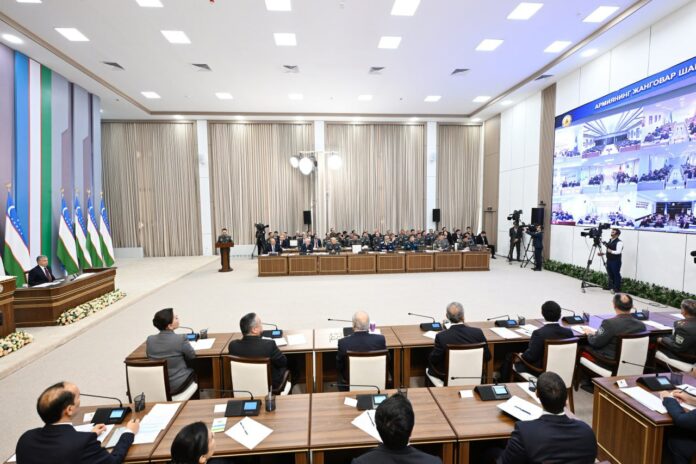
Uzbek President Shavkat Mirziyoyev has called for a revision of the country’s Defense Doctrine and National Security Concept in light of fundamental changes in the nature of modern warfare. He made the statement on January 13 during an expanded meeting of the Security Council chaired by the head of state, according to the Uzbek president’s official website.

Addressing the current international situation, Mirziyoyev pointed to the growing number of regional conflicts, the intensification of the global arms race, and the declining role of international law and diplomacy.

“It is crucial to understand one thing: the nature of modern warfare has fundamentally changed. Anyone who believes victory can be achieved solely through the number of tanks, aircraft, or soldiers is deeply mistaken. Today’s conflicts are waged using artificial intelligence, digital command and control systems, long-range precision strike capabilities, cyber and robotic technologies, as well as political and economic pressure,” the president said.

In this context, Mirziyoyev emphasized that peace and stability are becoming the country’s greatest assets, and that all sectors must operate in a proactive mode, responding in advance to potential threats.

Taking into account new challenges and risks, the president instructed officials to review the Defense Doctrine adopted eight years ago, as well as the National Security Concept dating back to 1997. According to him, the new doctrine should preserve Uzbekistan’s non-alignment status, rely on multilateral diplomacy, and serve as a foundation for the technological modernization of the armed forces.

“Overall, the new doctrine should become the basis for upgrading the army through advanced military technologies and solutions,” the head of state noted.

The meeting highlighted that significant efforts have been made in recent years to strengthen the country’s defense capabilities. The national armed forces are being equipped with modern weapons and military hardware, combat readiness and the moral and psychological training of personnel are improving, and the defense industry is actively developing.

New tactical approaches have been introduced in the armed forces, the number and intensity of military exercises have increased by 1.5 times, and dedicated units for unmanned aerial vehicles as well as specialized training centers have been established. The digitalization of the army has also delivered tangible results, enhancing command efficiency and information security.

Special attention was paid to the military education system. On the president’s initiative, it has undergone comprehensive modernization, including the establishment of the University of Military Security and Defense and the introduction of digital learning technologies, including those based on artificial intelligence.

Further improvement of military personnel training was identified as a key long-term priority.

“It must not be forgotten that modernizing the military education system and personnel training is the main prerequisite for shaping a new image of the army,” Mirziyoyev stressed.

Particular emphasis was placed on reforming compulsory military service. It should become not only a stage of military training but also an opportunity to acquire professional skills and prepare for the labor market. A new vocational training system with certification will be introduced within the armed forces, and each year 5,000 conscripts will be able to study under the “One Million Programmers” and “Five Million AI Leaders” programs.

“In short, compulsory military service should become a pathway to success for young people,” the president said.

Tasks were also outlined to further develop cybersecurity, enhance engineering and technical capacity, establish military technoparks, and equip the armed forces with AI-based robotic systems and unmanned platforms. 

Agreement on reducing the use of hydrofluorocarbons signed in Dushanbe

0

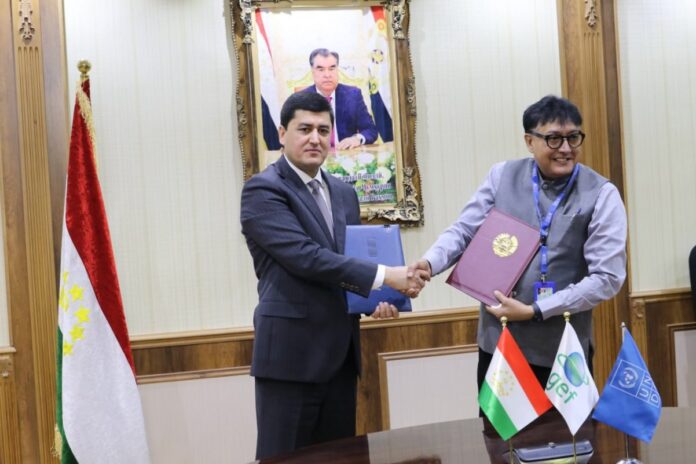
An agreement aimed at the gradual reduction of hydrofluorocarbons—substances harmful to the climate—has been signed in Dushanbe. The document was signed by the Committee for Environmental Protection under the Government of Tajikistan and the United Nations Development Programme (UNDP) on Jnuary 12, the Committee’s press service reported.

The agreement provides for the implementation of the project “Integrated Program for the Reduction of Hydrofluorocarbons and Sustainable Cooling in Tajikistan.” The project is financed by the Global Environment Facility and is designed to help the country fulfill its international climate commitments under the Kigali Amendment to the Montreal Protocol.

The main goal of the initiative is to reduce the use of hydrofluorocarbons by 70 percent by 2029.

Hydrofluorocarbons are synthetic organic compounds containing fluorine and hydrogen atoms. They are widely used in refrigerators, air conditioners, and other cooling equipment, but are among the most potent greenhouse gases and have a significant negative impact on the global climate.

The project provides for a phased strengthening of controls over the import of hydrofluorocarbons and equipment containing them, improvement of refrigerant management throughout their entire life cycle, and a reduction in harmful emissions into the atmosphere. Special attention will be given to the transition to modern, energy-efficient, and environmentally friendly cooling technologies.

The implementation of the project is expected to significantly reduce greenhouse gas emissions, improve energy efficiency, promote the development of green technologies, and strengthen Tajikistan’s climate resilience. The initiative also aligns with the priorities of the country’s National Development Strategy until 2030 and the Sustainable Development Goals.

It should be recalled that on June 30, 2022, Tajikistan became the 136th country to ratify the Kigali Amendment to the Montreal Protocol, thereby committing to the phased reduction of hydrofluorocarbons.

More than 160 fortune-tellers and healers detained and fined in Dushanbe last year

0

In 2025, police in Dushanbe held more than 160 people administratively liable for practicing fortune-telling and witchcraft, the Dushanbe Police Department reported.

According to the authorities, 163 cases of illegal fortune-telling were identified over the year. Offenders were punished with measures ranging from fines to administrative detention for up to 15 days under Article 482 of Tajikistan’s Code of Administrative Offenses. The exact amounts of the fines were not disclosed.

In addition, criminal proceedings were instituted against 14 individuals under Article 240 (1) of Tajikistan’s Criminal Code for repeatedly engaging in fortune-telling. The sanctions under this article предусматривают penalties ranging from fines to up to two years in prison.

The Interior Ministry recalled that penalties for fortune-telling and witchcraft were tightened in 2024. Parliament amended the Code of Administrative Offenses, increasing fines from 80 to 100 calculation indicators (one indicator equals 78 somoni) and extending the maximum administrative detention period from 10 to 15 days. Previously, fines ranged from 60 to 100 calculation indicators.

Amendments were also introduced to Article 240 of the Criminal Code. Under the revised provisions, repeated engagement in fortune-telling or witchcraft within one year after an administrative penalty carries a fine of 1,500 to 2,000 calculation indicators or imprisonment for a term of one to two years.

Following the tightening of the law, the Interior Ministry reported that nearly 500 cases of fortune-telling and witchcraft were identified nationwide during the first six months of 2025 alone.

The authorities also noted that clients of fortune-tellers will be held administratively liable as well. Under Article 482 (1) of the Code of Administrative Offenses, they face fines ranging from 50 to 60 calculation indicators, equivalent to 3,900–4,680 somonis.