

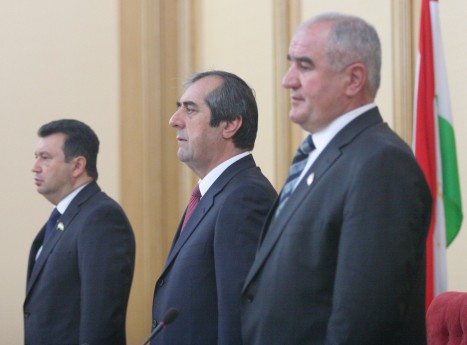
DUSHANBE, June 12, 2013, Asia-Plus — Inaugurating today’s extraordinary meeting of the Majlisi Milli (Tajikistan’s upper chamber of parliament), its head, Mahmadsaid Ubaidulloyev, noted that the president had offered to consider a number of laws toughening efforts against money laundering and the financing of terrorism that were recently adopted by the lower house (Majlisi Namoyandagon) of the parliament.
“The Financial Action Task Force (on Money Laundering) (FATF) will meet in Oslo, Norway from June 17 to June 21 and a Tajik government delegation will also attend that meeting,” Ubaidulloyev said.
The Majlisi Milli today seconded the following laws without discussion: “On the Currency Regulation and the Currency Control”; “On Making Changes and Addenda to the Penal Code of Tajikistan”; “On Making Changes to the RT Law “On Countering Money Laundering and the Finance of Terrorism”; “On Making Amendments to the RT Law “On the Fight Against Terrorism”; and “On Making Amendments to the RT Law “On the State Notariat”.
We will recall that the Majlisi Namoyandagon adopted these on May 29. Speaking at the Majlisi Namoyandagon session, Abdujabbor Shirinov, Chairman of the National Bank of Tajikistan (NBT) noted that international financial institutions assessed activities of the country’s banking system in 2007 and “following the assessment findings, Tajikistan has come under a tight monitoring by the Financial Action Task Force on Money Laundering (FATF).”
“The main reason for that was the fact that Tajikistan’s legislation did not determine precisely measures of punishment for money laundering and the financing of terrorism,” noted Tajik central bank head. “The proposed amendments provide for criminal responsibility for such crimes.”
Founded in 1989 on the initiative of the G7, the Financial Action Task Force (on Money Laundering) (FATF) is an intergovernmental organ. The Financial Action Task Force on Money Laundering (FATF) was established by the G-7 Summit that was held in Paris in 1989 in response to mounting concern over money laundering. Recognizing the threat posed to the banking system and to financial institutions, the G-7 Heads of State or Government and President of the European Commission convened the Task Force from the G-7 member States, the European Commission and eight other countries. The Task Force was given the responsibility of examining money laundering techniques and trends, reviewing the action which had already been taken at a national or international level, and setting out the measures that still needed to be taken to combat money laundering.
The purpose of the FATF is to develop policies to combat money laundering and terrorism financing. The FATF Secretariat is housed at the headquarters of the OECD in Paris.
