
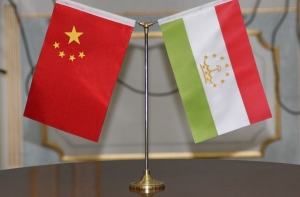
DUSHANBE, July 5, 2013, Asia-Plus – A delegation of the Communist party of China (CPC), led by Zhao Leji, the head of the Organization Department of the CPC Central Committee, arrived in Tajikistan on July 5 for a two-day visit.
Adham Mirsaidov, the head of the Analysis and Propagation Center of Tajikistan’s ruling People’s Democratic Party (DPT), says the CPC delegation is scheduled to hold talks with senior representatives of the PDP and visit the National Museum of Tajikistan and the Presidential Lyceum in Dushanbe.
Meanwhile, the Tajik president’s official website reports that Tajik President Emomali Rahmon received Zhao Leji, the head of the CPS delegation, in Qurghon Teppa, the capital of Khatlon province on July 5.
The two reportedly discussed state and prospects of further expansion of bilateral cooperation between Tajikistan and China.
The Communist Party of China (CPC) is the founding and ruling political party of the People”s Republic of China (PRC). Although nominally it exists alongside the United Front, a coalition of governing political parties, in practice, the CPC is the only party in the PRC, maintaining a unitary government and centralizing the state, military, and media. The legal power of the Communist Party is guaranteed by the national constitution, though due to the Party”s Leninist roots, it stands above the law.
The party was founded in July 1921 in Shanghai. After a lengthy civil war, the CPC defeated its primary rival, the Kuomintang (KMT), and assumed full control of mainland China by 1949. The Kuomintang retreated to the island of Taiwan, where it still remains to this day.
The CPC is the world”s largest political party, claiming over 80 million members at the end of 2010 which constitutes about 6.0% of the total population of mainland China. The vast majority of military and civil officials are members of the Party. Since 1978, the Communist Party has attempted to institutionalize transitions of power and consolidate its internal structure. The modern party stresses unity and avoids public conflict while practicing a pragmatic and open democratic centralism within the party structure.
