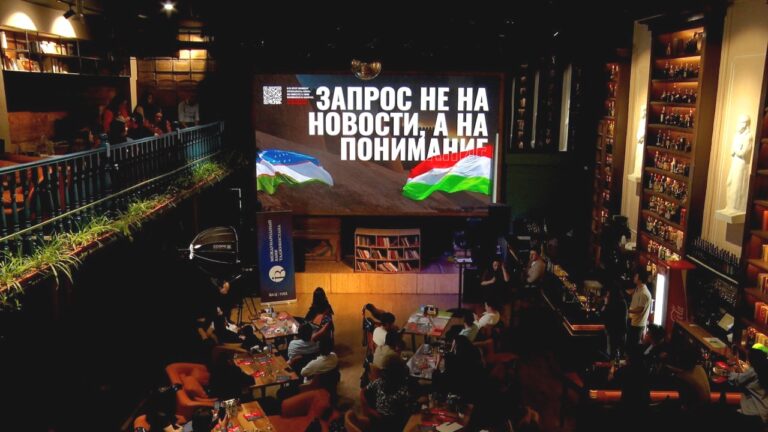
DUSHANBE, September 22, 2008, Asia-Plus — Today the seventh Annual Meeting of the Central Asia Border Security Initiative (CABSI) convenes representatives of EU member states and Central Asian partners to review the progress of the Border Management (BOMCA) and Drug Action (CADAP) Programs in Central Asia and to discuss their future direction and necessary funding, press release issued BOMCA/CADAP Country Manager in Kazakhstan.
CABSI is a consortium of EU member states led by Austria. Its members include the UK, Finland, France, Poland, Estonia, Latvia, Lithuania, Croatia, Hungary and the USA as independent partner.
The history of annual CABSI meetings dedicated to discussions on BOMCA and CADAP Programs dates back to the year of 2002, when at the suggestion of the CABSI Consortium the European Commission initiated its Border Management Program in Central Asia.
Each year, the CABSI Consortium meets to review the progress of the BOMCA program and to discuss its future direction and necessary funding. Before 2007 all annual CABSI meetings were held in Vienna. In September 2007 the sixth CABSI meeting was held in Central Asia, in the city of Bishkek, Kyrgyzstan. The reason for organizing the succeeding CABSI meetings in Central Asia was to ensure that senior representatives of Law Enforcement Agencies from the five Central Asian states also had an opportunity to participate and explain their priorities. This very productive and successful meeting, during which EU member states received first hand information from their partners, resulted in the consortium’s unanimous decision to hold future sessions in the region.
The principal goals of the two-day meeting are as follows: to present the latest achievements of the European Union’s Border Management Program in Central Asia; to provide an opportunity for coordination, comment and discussion; to share visions of the future ways of cooperation; to promote parallel funding from donor organizations and in-kind contributions to EU projects.
The agenda of this year meeting covers the following topics for discussion: current situation and challenges of BOMCA program activities in Central Asia; provision of experts from EU Member States; possible additional/parallel funding of BOMCA activities; and further development of CABSI towards a co-ordination platform on border management in Central Asia.
Besides the EU member states and the European Commission, all other national donors and international organizations involved in border security in Central Asia have been invited: UNDP, IOM, UNODC, OSCE, UNHCR, EURASEC. Additionally, representatives of similar to BOMCA EU-funded Programs have been invited to participate: EUBAM (EU border management mission to Moldova and Ukraine) and BOMBAF (Border Management Badakhshan Afghanistan).
Border Management in Central Asia Program (BOMCA) The overall objectives of the BOMCA Program are to encourage Central Asian states to adopt the principles and practices of a European Integrated Border Management approach, to contribute to facilitation of legitimate trade and transit, to reduce the illicit movement of goods and people. Program components include provision of infrastructure, equipment and training for the staff at Training Centers and selected Border Crossing Points (BCPs) on Central Asian transit corridors.
Important projects underway within the framework of BOMCA Program are as follows: Institutional Reform in Kazakhstan, Kyrgyzstan and Tajikistan; Strengthening Training Capacities in Central Asia; Strengthening Infrastructure Capacities Along Trade and Transit Corridors in Central Asia; Assisting Tajikistan in Securing the Tajik-Afghan Border in Gorno Badakhshan.
BOMCA is funded by the European Union and implemented by the United Nations Development Program (UNDP).