
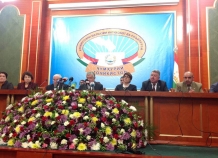
DUSHANBE, March 2, 2015, Asia-Plus – The Central Commission for Elections and Referenda (CCER) has published the results of elections through the party-list proportional representation system.
The CCER head Shermuhammad Shohiyon told reporters in Dushanbe today afternoon that four political parties have won seats in the Majlisi Namoyandagon (Tajikistan’s lower chamber of parliament) through a party-list proportional representation system from a single nationwide constituency, namely the People’s Democratic Party (PDP), the Agrarian Party (APT), the Party of Economic Reforms (PER) and the Socialist Party (SPT).
According to him, the PDP won 65.2 percent of votes, the APT – 11.8 percent, the PER – 7.6 percent, and the SPT – 5.2 percent.
“Thus, 16 members of the PDP, 3 members of the APT, 2 members of the PER and 1 member of the SPT came to the parliament from party lists,” Shohiyon noted.
Meanwhile four other political parties have failed to pass a 5-percent threshold to get into the Majlisi Namoyandagon.
“The Communist Party (CPT) has won 2.3 percent of votes, the Democratic Party (DPT) – 1.7 percent, the Islamic Revival Party (IRP) – 1.5 percent, and the Social-Democratic Party – 0.5 percent,” the CCER head said.
3,791,827 of 4,319,395 registered voters cast a ballot yesterday, well over the 50 percent turnout needed to make the election valid, Shohiyon added.
The 2015 parliamentary elections took place in Tajikistan yesterday, March 1.
Tajikistan’s Parliament (Majlisi Oli) has two chambers: the Assembly of Representatives (Majlisi Namoyandagon) and the National Assembly (Majlisi Milli). Majlisi Namoyandagon has 63 members, elected for a five-year term in, 22 by proportional representation (party list) and 41 in single-seat constituencies.
To get into the parliament political parties should pass a five-percent threshold.
In all, 285 candidates, including 30 women, competed for seats in the Majlisi Namoyandagon; 103 candidates competed for 22 seats from party lists and 182 candidates, including 80 self-propelled candidates, competed for 41 seats in single-mandate constituencies.