
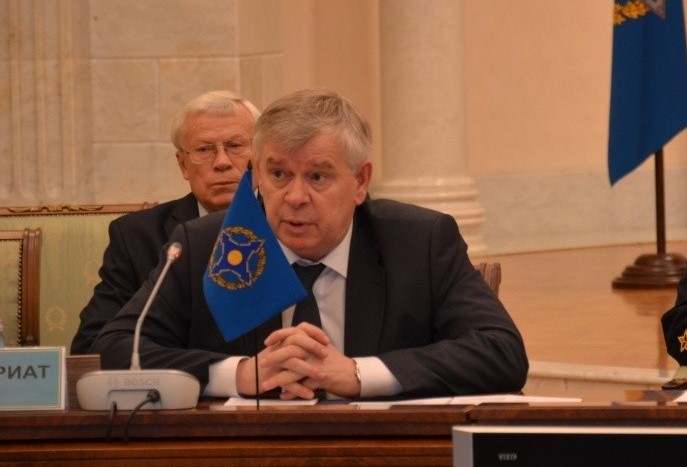
The Collective Security Treaty Organization (CSTO) has promised once again to assist Tajikistan to reinforce its common border with Afghanistan.
The CSTO acting secretary-general, Valery Semerikov, had a telephone conversation with the Tajik Security Council Secretary Abdurahim Qahhorov on February 9.
According to the SCTO official website, the two discussed issues related to implementation of the CSTO Security Council resolution to provide additional collective assistance to Tajikistan to reinforce its national border with Afghanistan.
Semerikov reportedly noted that a group of specialists from the CSTO Secretariat would arrive in Dushanbe this month “to work through the target program for reinforcement of Tajikistan’s national border with Afghanistan.”
Semerikov also informed Qahhorov of measures being taken to help Tajikistan mitigate effects of recent avalanches, according to the CSTO Secretariat.
Recall, one the hottest topics of the SCTO annual summit that took place in Sochi, Russia, on September 23, 2013 was how to strengthen the Afghanistan-Tajikistan border. The group, in the words of Russian President Vladimir Putin, resolved to “provide additional collective assistance to Tajikistan to reinforce its national border with Afghanistan.”
“The aid will include constructing new buildings of frontier posts, restoring warning and signaling systems and providing border troops with means of air patrol and surveillance as well as radar," said Tajikistan President Emomali Rahmon, speaking at the event.
According to the official CSTO statement released at the Sochi summit, “On the basis of a request from Tajikistan the member states of the CSTO will, according to their abilities, within three months render military-technical assistance to the border forces of the State Committee for National Security of the Republic of Tajikistan.”
However, the group has not rendered any serious assistance to Tajik border guards over the past three years. Only Belarus has sent a consignment of military uniforms to Tajikistan for Tajik border guards and Armenia has purchased several trucks for Tajik border guards.
The regional security organization was initially formed in 1992 for a five-year period by the members of the CIS Collective Security Treaty (CST) — Armenia, Kazakhstan, Kyrgyzstan, Russia, Tajikistan, and Uzbekistan, which were joined by Azerbaijan, Georgia, and Belarus the following year. A 1994 treaty reaffirmed the desire of all participating states to abstain from the use or threat of force, and prevented signatories from joining any “other military alliances or other groups of states” directed against members states. The CST was then extended for another five-year term in April 1999, and was signed by the presidents of Armenia, Belarus, Kazakhstan, Kyrgyzstan, Russia, and Tajikistan. In October 2002, the group was renamed as the CSTO. Uzbekistan that suspended its membership in 1999 returned to the CSTO again in 2006 after it came under international criticism for its brutal crackdown of antigovernment demonstrations in the eastern city of Andijon in May 2005. On June 28, 2012, Uzbekistan announced that it has suspended its membership of the CSTO, saying the organization ignores Uzbekistan and does not consider its views. The CSTO is currently an observer organization at the United Nations General Assembly.