
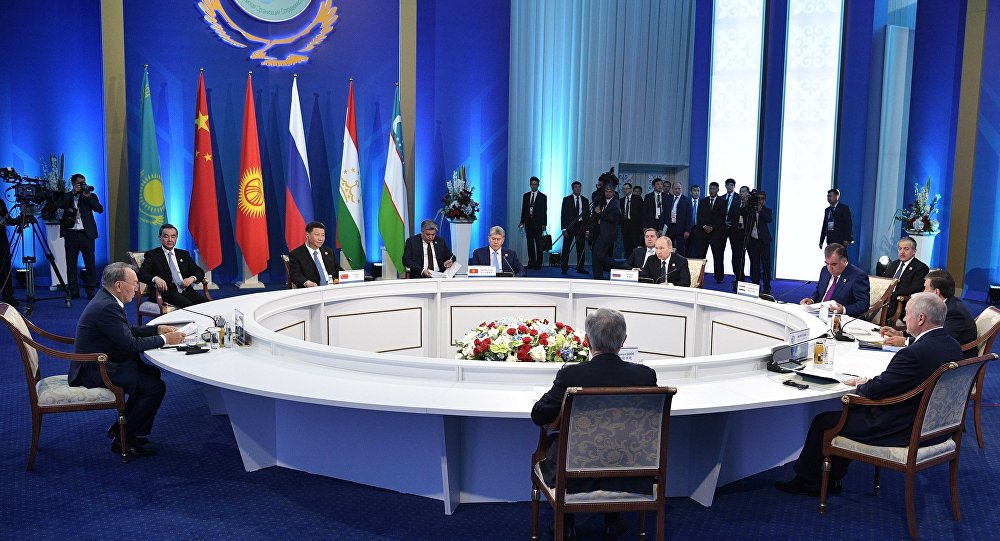
The Republic of India and the Islamic Republic of Pakistan have become full members of the Shanghai Cooperation Organization.
The accession of India and Pakistan to the SCO was formalized at the 17th meeting of SCO heads of state on June 9 in the Kazakh capital, Astana.
The President of Kazakhstan, Nursultan Nazarbayev, welcomed two new members of the SCO that fulfilled all the procedural obligations.
India and Pakistan that are home to some 1.5 billion people have broadened the geopolitical potential of the Organization, extending its reach to nearly half the world’s population.
India and Pakistan’s membership has expanded the SCO’s geographical coverage to nearly 70 percent of the Eurasian continent.
The official portion of the SCO summit in Astana reportedly began with talks between the presidents of the regional security grouping's members: China, Russia, Kazakhstan, Kyrgyzstan, Tajikistan, and Uzbekistan.
Later, wider talks were held with the prime ministers of India and Pakistan and the leaders of SCO observer states Afghanistan, Belarus, and Mongolia taking part.
The Shanghai Cooperation Organization now has eight full members — China, India, Kazakhstan, Kyrgyzstan, Pakistan, Russia, Tajikistan and Uzbekistan. Afghanistan, Belarus, Iran and Mongolia are four observer states, and SCO’s dialogue partners include Armenia, Azerbaijan, Cambodia, Nepal, Sri Lanka and Turkey. ACEAN, CIS and Turkmenistan are guest attendances.
The Organization’s six full members account for 60% of the land mass of Eurasia and its population is a quarter of the world’s population.
The Heads of State Council (HSC) is the supreme decision-making body in the SCO. It meets once a year and adopts decisions and guidelines on all important matters of the organization.
The SCO Heads of Government Council (HGC) meets once a year to discuss the organization’s multilateral cooperation strategy and priority areas, to resolve current important economic and other cooperation issues, and also to approve the organization’s annual budget.
In addition to HSC and HGC meetings, there is also a mechanism of meetings at the level of heads of parliament; secretaries of Security Councils; ministers of foreign affairs, defense, emergency relief, economy, transport, culture, education, and healthcare; heads of law enforcement agencies and supreme and arbitration courts; and prosecutors general. The Council of National Coordinators of SCO Member States (CNC) acts as the SCO coordination mechanism.
