
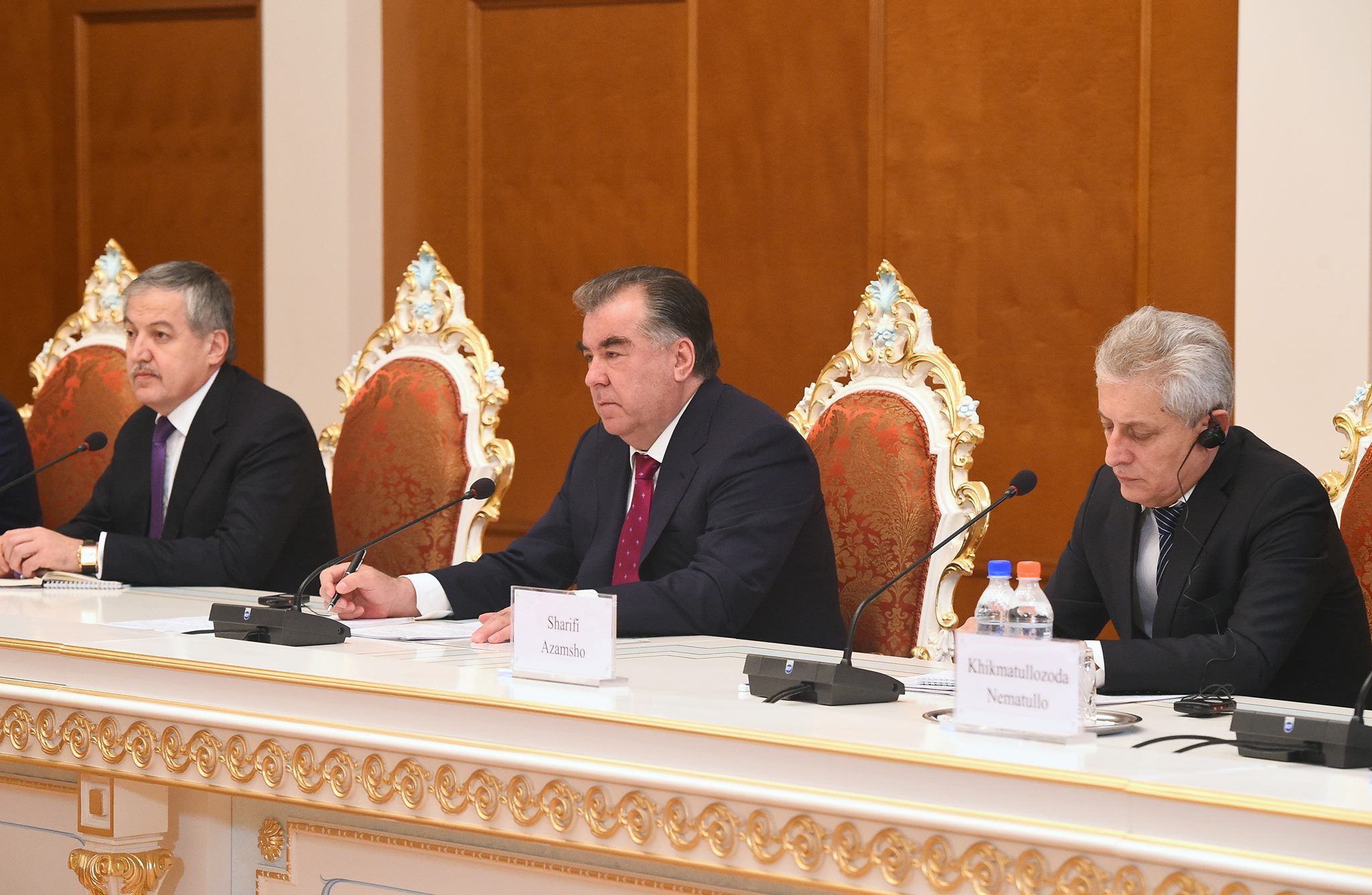
In a statement delivered at a conference on the Sustainable Development Goals in Dushanbe, Tajik President Emomali Rahmon noted on June 12 that strengthening and deepening of cooperation and partnership for achievement of the sustainable development goals are closely linked with joint efforts to address modern threats and ensure lasting peace and stability.
According to him, adoption of the global agenda for sustainable development until 2030 by the United Nations General Assembly took place at a time when millions of people are exposed to the risks and threats of religious and geopolitical wars and conflicts in various parts around of the world.
As it is seen today, in such circumstances no nation alone is able to succeed in countering the security risks and threats, and ensuring peace and stability, Rahmon stressed.
“We believe that we are able to combat the international terrorism and extremism and ensure comprehensive security and stability only by strengthening mutual cooperation and partnership and taking collective efforts at the regional and global levels,” said Tajik leader. “To this end, we are confident that the United Nations must play a key and coordinating role in this process.”
He further noted that the consequences of the financial, economic, energy and food crisis, as well as the aftermath of the climate change pose serious challenges to the efforts of many countries, especially the landlocked developing countries, to achieve sustainable economic and social development.
“Like many other landlocked developing country, Tajikistan faces certain challenges in ensuring integration and connectedness of the country with the multilateral trade system,” said Rahmon. “These circumstances have negative impact on the process of ensuring the development of other social sectors in the country.”
In this regard, this group of countries should enjoy favorable conditions in the global trade, he noted.
Rahmon said that Tajikistan stands for elimination of all unnecessary obstacles and barriers in transportation of goods and services, which affect the process of sustainable development.
“Since elimination of the transport deadlock and access to energy independence are identified as the national priorities, Tajikistan attaches particular importance to improvement and development of the transport and energy infrastructure, as well as expansion of domestic, regional and inter-regional trade.
“Access to modern energy sources and development of “green” energy is a key factor in achieving sustainable development.
“Our country, the energy potential of which is based on the hydropower, occupies the sixth place in the world in terms of utilization of the “green” energy.
“In this regard, Tajikistan supports the global initiative on “Sustainable Energy for All” and the United Nations Decade for Sustainable Energy for All, 2014-2024.
“To this end, building joint efforts for ensuring comprehensive access of the people to the modern energy services will serve for the benefit of all countries in the region and in the world.
“Recently, Tajikistan has ratified and completed the accession process to the Paris Agreement, the implementation of which requires adoption of joint measures for solution of the problems related to climate change.
“For its part, the Government of Tajikistan has been already taking necessary steps for adaptation to the climate change and reduction of natural disaster risks that are among the priorities of the environmental policy of the country.
“Therefore, in order to prevent and eliminate the consequences of natural disasters, we have created a system for management of emergency measures in our country.
“Ninety three percent of the area of Tajikistan is occupied by mountains, and 60 percent of water resources of Central Asia is located in its territory.
“In addition, due to its geographical features, our country is influenced by the negative consequences of the climate change.
“Annually, the country suffers from different natural disasters that bring economic damage to the national economy worth of hundreds of millions somoni, and cause human casualties.
“The climate change leads to rapid melting of glaciers and have negative impact on the water volume of rivers and thus to the main sectors of the national economy, such as energy, agriculture and industry.
Therefore, in recent years, the Government of Tajikistan has been giving particular attention to the solution of challenges related to the climate change, as well as calling upon the international community to develop and expand cooperation in the mentioned areas.
“Tajikistan will continue its constructive initiatives within the United Nations water agenda.”
