CIS interior ministers gather in Dushanbe to discuss cooperation

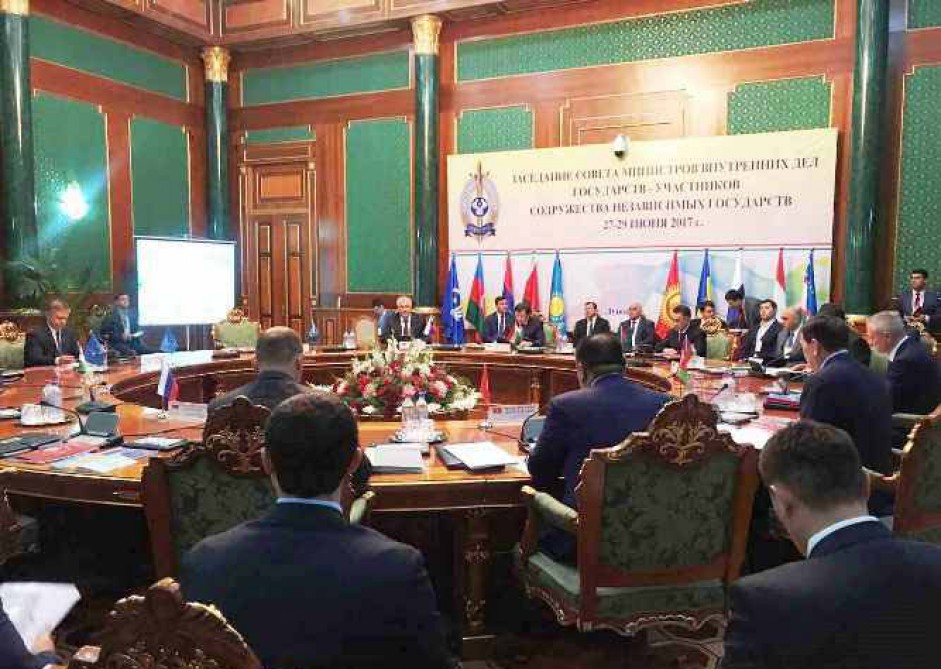
Dushanbe yesterday hosted a regular meeting of the CIS Council of Interior Ministers (Council). The meeting brought together interior ministers of Azerbaijan (Ramil Usubov), Belarus (Igor Shunevich), Kazakhstan (Kalmukhanbet Kasymov), Kyrgyzstan (Ulan Isroilov), Russia (Vladimir Kolokoltsev), Tajikistan (Ramazon Rahimzoda) and Uzbekistan (Abdusalom Azizov), according to the Tajik Interior Ministry press center.     They discussed a wide […]

Asia-Plus

Dushanbe yesterday hosted a regular meeting of the CIS Council of Interior Ministers (Council).

The meeting brought together interior ministers of Azerbaijan (Ramil Usubov), Belarus (Igor Shunevich), Kazakhstan (Kalmukhanbet Kasymov), Kyrgyzstan (Ulan Isroilov), Russia (Vladimir Kolokoltsev), Tajikistan (Ramazon Rahimzoda) and Uzbekistan (Abdusalom Azizov), according to the Tajik Interior Ministry press center.    

They discussed a wide range of issues related to combating transnational organized crime, terrorism, extremism, and illicit drug trafficking.

The meeting participants also discussed implementation of interstate crime prevention programs, draft interstate crime prevention programs designed for 2019-2023 and implementation of decisions on providing public order and safety of citizens during mass events that were adopted at the previous session. 

Besides, they discussed a draft protocol on making changes and addenda to the agreement on cooperation between the CIS member nations in combating drug trafficking (November 30, 2000) and implementation of the Council’s resolution on cooperation between interior ministries of the CIS member nations in preventing involvement of citizens in terrorist and extremist organizations (September 6, 2016).    

The CIS Interior Ministers Council was founded in 1996 to expand cooperation between the CIS member nations in crime prevention and law enforcement. The Council members include representatives of Azerbaijan, Armenia, Belarus, Kazakhstan, Kyrgyzstan, Moldova, Russia, Tajikistan, Uzbekistan, and Ukraine. Turkmenistan partakes in some of the Council’s meetings.

Established on December 8, 1991 after the dissolution of the Soviet Union, the Commonwealth of Independent States (CIS) is a regional organization.  It now consists of Azerbaijan, Armenia, Belarus, Kazakhstan, Kyrgyzstan, Moldova, Russia, Tajikistan, Turkmenistan, Uzbekistan and Ukraine.  Georgia pulled out of the organization in 2009.  
Article translations:

Related Article

Оби зулол

Most Read

Join us on social media!

Aura

Recent Articles

Sanctions lifted: Dushanbe City Bank resumes international operations

The bank is returning to full-scale international operations.

Gasoline and diesel fuel in Dushanbe rose in price by 8.9% due to the war in the Middle East

The rise in global oil prices and, consequently, the cost of petroleum products has triggered the closure of the Strait of Hormuz.

The Ministry of Labor organizes consultations for migrants returning from Russia at Dushanbe airport

Employees of the Migration Service explain the requirements of Russian legislation and offer job vacancies in their homeland.

Tajikistan and Uzbekistan discuss simplification of customs procedures and implementation of VIN.TJ system

The VIN.TJ system is designed to simplify the process of vehicle registration and control.

Tajikistan climbs four places in the global fixed internet speed ranking

This is the country's best performance in the past five years.

President of Tajikistan launches hydro unit No. 7 at Nurek HPP

As of today, three units have been completely replaced at the country's largest hydroelectric power station.

Italian Opera in Dushanbe: Shohrukh Yunusov invites to an evening of musical revelations

The evening will feature the most recognizable Italian works alongside world and Tajik classics.

The European Union lifts sanctions on Tajik banks

This is attributed to successful reforms and improved financial transparency in the country.

Meta announced plans to lay off about 10% of its staff

The reason cited is the high costs of artificial intelligence development.