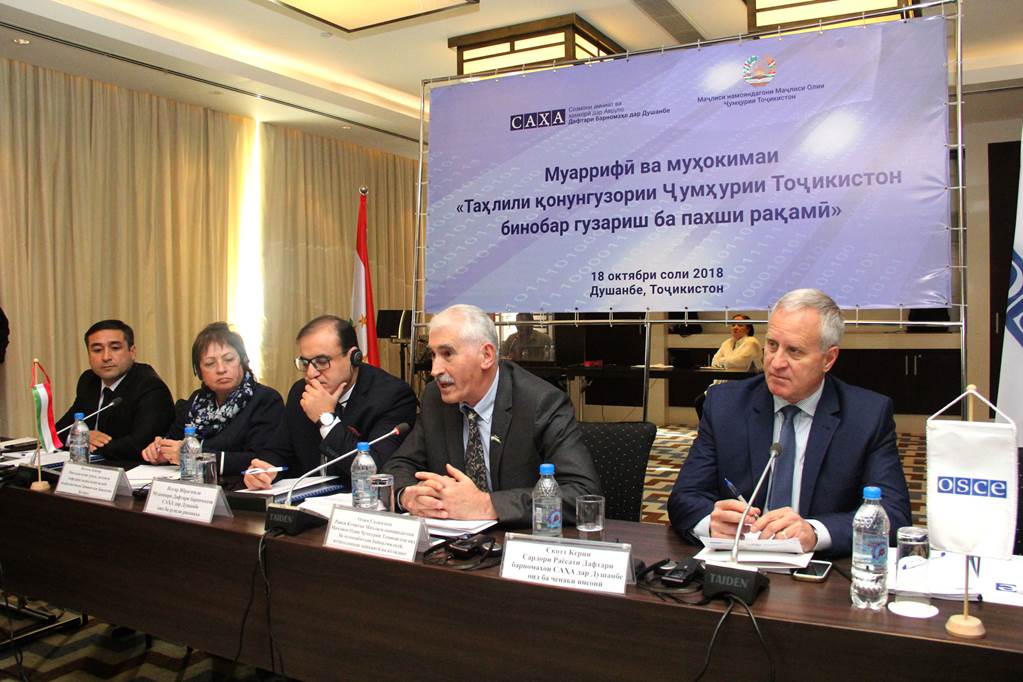
OSCE organizes roundtable discussion on Tajikistan’s legislation for transition to digital broadcasting

A roundtable discussion of Tajikistan’s legislation on the country’s transition to digital broadcasting was jointly organized by the OSCE Programme Office in Dushanbe and the Parliament of Tajikistan here on October 18.  According to the OSCE Programme Office, the discussion reportedly focused on a legal analysis of the existing relevant Tajik law conducted by legal […]

Asia-Plus

A roundtable discussion of Tajikistan’s legislation on the country’s transition to digital broadcasting was jointly organized by the OSCE Programme Office in Dushanbe and the Parliament of Tajikistan here on October 18. 

According to the OSCE Programme Office, the discussion reportedly focused on a legal analysis of the existing relevant Tajik law conducted by legal experts of the OSCE in the summer of 2018.

Some 50 representatives of the Parliament, civil society, media community and international organizations attended the discussion.

The legal analysis of Tajik law was conducted at the request of Tajikistan’s Parliament, in relation to the revision of existing legislation and preparation of the legal ground for the transition to digital broadcasting.

In his opening remarks, Scott Kearin, Head of the Human Dimension Department of the OSCE Programme Office in Dushanbe, underlined the importance of the transition to digital broadcasting.  “Transition to digital broadcasting is not a simple switch from an old to a new technology. It is an important opportunity to accelerate the convergence process, whereby information technology, broadcasting and telecommunications can interact and provide new opportunities to develop the economy, empower citizens, and provide the whole society with new tools of communication,” he said.

Olim Salimzoda, Chairperson of Tajikistan’s Parliamentary Committee on International Relations, Public Organizations and Information, thanked the OSCE for its continuous support in improving the country’s legislation and emphasized the importance of preparing a legal basis for the digital switchover.  He said: “Based on the analysis prepared by the OSCE experts, our Committee will develop a draft law on amendments and additions to legislation on media by the end of 2018, which will establish a good legal basis for the transition to digital broadcasting, in line with the OSCE standards and principles.”


Join us on social media!

Article translations:

Related Article

Оби зулол
Оби зулол

Most Read

Recent Articles

India’s blockchain push and lessons for the global south

The Indian Government has started pushing aggressively its agenda of embracing blockchain technology, and the same has received a new lease of life with...

India’s blockchain push and lessons for the global south

The Indian Government has started pushing aggressively its agenda...

25 Years in Touch: On Generation Change, “Digital” and “Invisible” Work

In its 25th anniversary year, "MegaFon Tajikistan" summarizes its...

The number of entrepreneurs in Tajikistan increases by 4.3%

The number of entrepreneurs operating under a patent is increasing the fastest.

Trump announces “very good” talks with Iran and the possibility of a quick agreement. Tehran did not comment on this

The President of the United States claims that Tehran has agreed to the US demand to abandon the development of nuclear weapons.

Police report the discovery of the remains of a man who had been missing since December 2025

A friend of the murdered person has been detained on suspicion of particularly brutal murder.

Residents of a settlement in Sughd: “Afghan refugees have disappeared from the Dehmoy jamoat”

Earlier, a citizen of Afghanistan was detained on charges of murdering a resident of Khujand.

In Russia, it was proposed to revoke residence permits and temporary residence permits from migrants who do not work for more than two months

During January-March 2026, 90% more residence permits were revoked from migrants in the country compared to the same period last year.

From reach to influence: why advertising no longer works by old rules discussed in Dushanbe

Market research forces a complete reconsideration of the advertising budget allocation strategy.