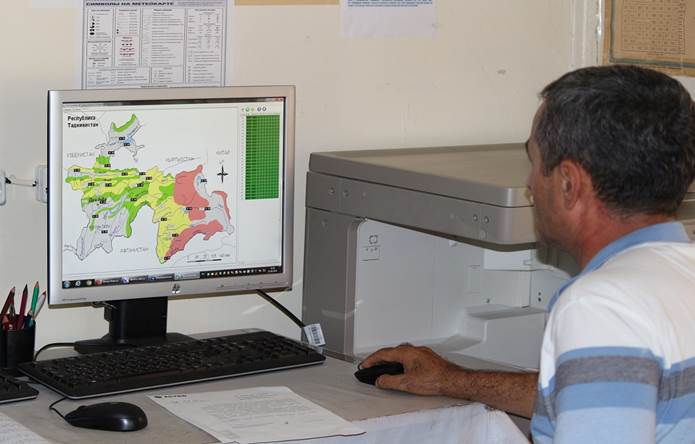
The national hydrometeorological services make a significant contribution to safety, security and well-being of population through observing, forecasting and warning of weather. The observation and timely collection of data and information from hydro-meteorological stations is the primary source of information for agricultural activities in the field.
On Wednesday February 27, the Food and Agriculture Organization of the United Nations (FAO) handed over 40 mobile phones to the Agency of Hydrometeorology (Hydromet) under the Committee for Environmental Protection of the Government of Tajikistan.
Equipped with mobile internet capabilities, the phones reportedly have improved durability and resistance to harsh climatic conditions and are simple and easy to use. The overall effort aims at improving the availability of quality information and data for weather forecasting and early warning.
This approach is expected to advance the timely and more frequent hydro-meteorological data collection, integration and dissemination of warnings and forecast in the country which is prone to severe and frequent hydro-meteorological disasters. The provided mobile phones will ensure regular and stable connections between the local meteorological stations and the data collection and processing center, in Dushanbe, the capital city of Tajikistan sending weather data every 3 hours, according to FAO Office in Tajikistan.
The handover ceremony took place at the Hydromet office and was attended by representatives of Hydromet and FAO. The distribution is one of a series of activities being carried out under the EU-funded FAO project, Strengthening Institutions and Capacity of the Ministry of Agriculture and State Veterinary Inspection Service for Policy Formulation.
“This technical support will help to strengthen the technical capacities of the Agency of Hydrometeorology to provide early warning services to beneficiaries to alert them to potential risks and to increase their resilience. It will enable farmers to make informed decisions, to better manage risks, to take advantage of favorable climate conditions and to adapt to climate change,” mentioned the FAO Representative in Tajikistan, Oleg Guchgeldiyev.
”Besides, we are in the process of providing the Agency with several agrometeorological stations, which will demonstrate how agrometeorology can help to forecast the situation with crop during growing season and provide the advice to farmers on what actions to take and when in regard to watering, or protecting from diseases.”
The mobile phone technology can be a useful tool to provide everyone, including farmers, with relevant and reliable information on weather and climate conditions for critical decisions.
Since 2016 the European Union and FAO are working together to support the agricultural policy reforms in the country, including the development of relevant strategies, designing institutional frameworks and strengthening the technical knowledge and skills of government and non-governmental institutions.