
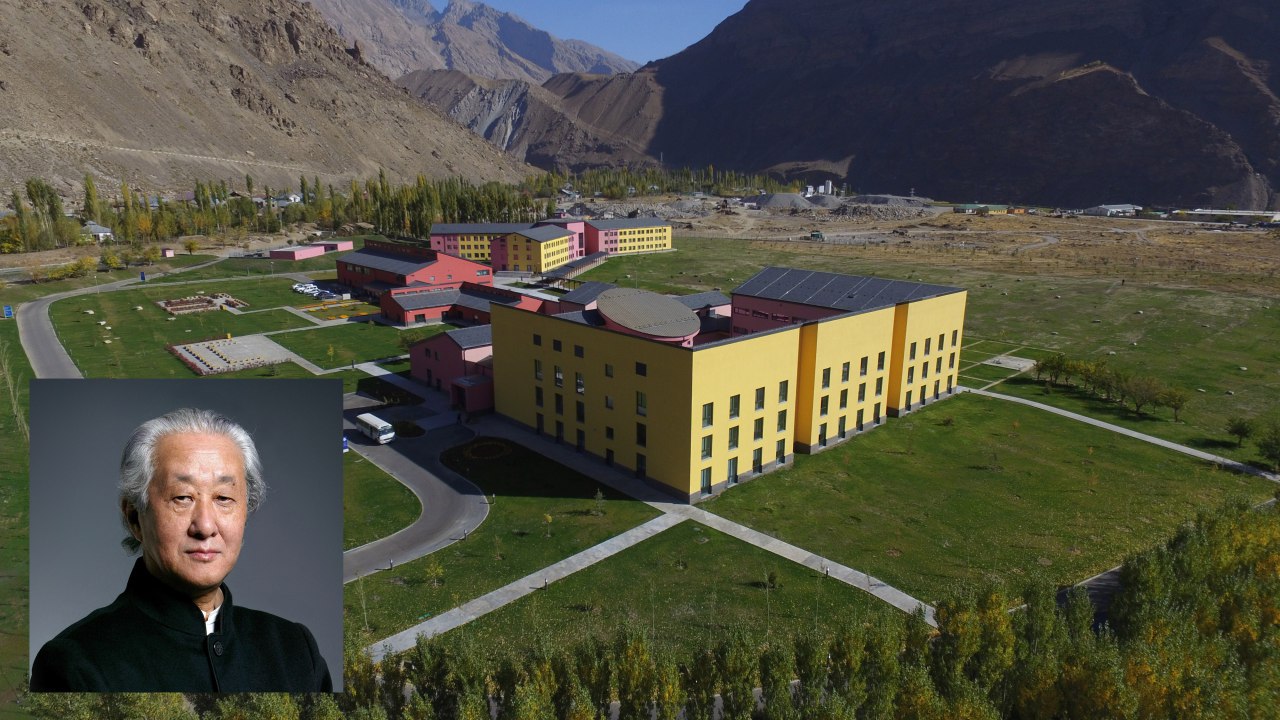
Arata Isozaki, the renowned Japanese architect, and designer of the master plan of the University of Central Asia (UCA), has won the coveted Pritzker Architecture Prize for 2019, according to UCA press center. He is the 46th Pritzker laureate, and the prize of $100,000 will be awarded at an official ceremony in May at the Chateau de Versailles in France.
Among Isozaki’s over 100 notable architectural designs are the Kyoto Concert Hall in Japan, the Museum of Contemporary Art in Los Angeles, and the Weill Cornell Medical College in Qatar.
He is also the designer of the master plan of the University of Central Asia, and its three campuses located in Khorog (Tajikistan), Naryn (Kyrgyzstan), and Tekeli (Kazakhstan), which has a set a new standard for university design in Central Asia. UCA’s design has received widespread attention for responsiveness to its mountain locations, and the environment it creates for study, contemplation, and play.
In 2001 Isozaki also served on the Master Jury of the Aga Khan Award for Architecture, where over $1,000,000 is awarded to winners every three years for projects that set new standards of excellence in architecture, planning practices, historic preservation, and landscape architecture.
Established by in 1979 by the Pritzker Family of Chicago, the Pritzker Architecture Prize is awarded annually “to honor a living architect or architects whose built work demonstrates a combination of those qualities of talent, vision and commitment, which has produced consistent and significant contributions to humanity and the built environment through the art of architecture.” The laureate is selected by an independent jury of five to nine professionals, and past winners include architects Philip Johnson, Frank Gehry, Rem Koolhaas, and Zaha Hadid.
The Pritzker Architecture Prize is considered to be one of the world's premier architecture prizes, and is often referred to as the Nobel Prize of architecture.
The prize is said to be awarded “irrespective of nationality, race, creed, or ideology.” The recipients receive US$100,000, a citation certificate, and since 1987, a bronze medallion. The designs on the medal are inspired by the work of architect Louis Sullivan, while the Latin inspired inscription on the reverse of the medallion—firmitas, utilitas, venustas (firmness, commodity and delight)—is from Ancient Roman architect Vitruvius. Before 1987, a limited edition Henry Moore sculpture accompanied the monetary prize.
