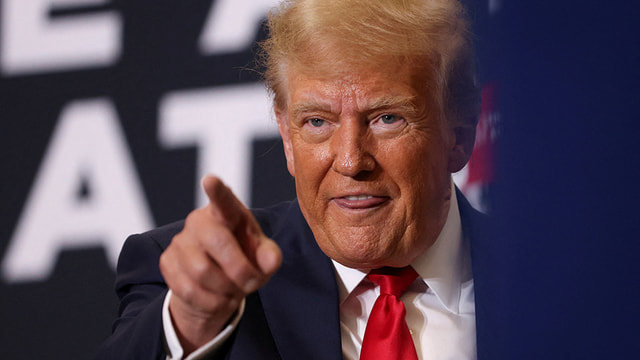
US President Donald Trump has faced growing criticism over his threats to attack Iran's cultural sites, therefore, he yesterday backed away from his threats to target Iranian cultural sites if Iran retaliates against the U.S. for assassination of one of its top generals.
After first tweeting the threat and later reiterating it to reporters as he flew back to Washington over the weekend, Trump retreated Tuesday, saying, “I like to obey the law,” according to AP.
But he still sounded offended by the idea that such sites would be off limits during armed conflict.
On Monday, Defense Secretary Mike Esper reportedly distanced the Pentagon from Trump’s threats to bomb Iranian cultural sites despite international prohibitions on such activity. Esper said the U.S. will “follow the laws of armed conflict.”
It all began over the weekend when Trump tweeted Saturday that if Iran attacked any American assets to avenge the killing of Iranian General Qasem Soleimani, the U.S. had 52 targets across Iran. He added that some are “important to Iran & Iranian culture.”
Anger spread quickly across Iran, and Trump repeated the threat to reporters traveling with him as he flew back to Washington on Sunday after spending two weeks at his Florida resort.
Targeting cultural sites is a war crime under the 1954 Hague Convention for their protection. Separately, in 2017, the U.N. Security Council unanimously passed a resolution condemning the destruction of heritage sites. Attacks by the Islamic State group and other armed factions in Syria and Iraq prompted that vote.
UNESCO, the United Nations’ cultural agency, has called on governments to remember that cultural sites are not targets.
U.N. Secretary-General Antonio Guterres stressed the importance of the world’s cultural heritage at Tuesday’s long-planned opening of an exhibition sponsored by Italy’s U.N. Mission of masterpieces that had been stolen and recovered. “It has been painful to see how much of mankind’s cultural heritage has been lost in recent years from Iraq and Syria to Yemen, Mali and Afghanistan,” Guterres said. “Indeed, we face an array of challenges that imperil efforts to protect our common heritage from the climate crisis to civil unrest, from armed conflict to terrorism.”
The U.N. chief made no mention of Trump but stressed that international cooperation must continue to preserve humanity’s treasures
Trump’s tweet also caused concern in Washington. According to AP, one U.S. national security official said the threat against Iranian cultural sites had caught many in his administration off-guard and prompted calls for others in his government, including Secretary of State Mike Pompeo, to clarify the matter. The official, who was not authorized to speak publicly to the issue, reportedly called such a clarification necessary to affirm that the U.S. military would not intentionally commit war crimes.
Iran is home to two dozen UNESCO World Heritage Sites, including Persepolis, with its ancient ruins that date to 518 B.C.; the 17th century grand mosque of Isfahan, located in a teeming bazaar; and the Golestan Palace in the heart of Tehran, where the last shah to rule Iran, Mohammad Reza Pahlavi, was crowned in 1967.