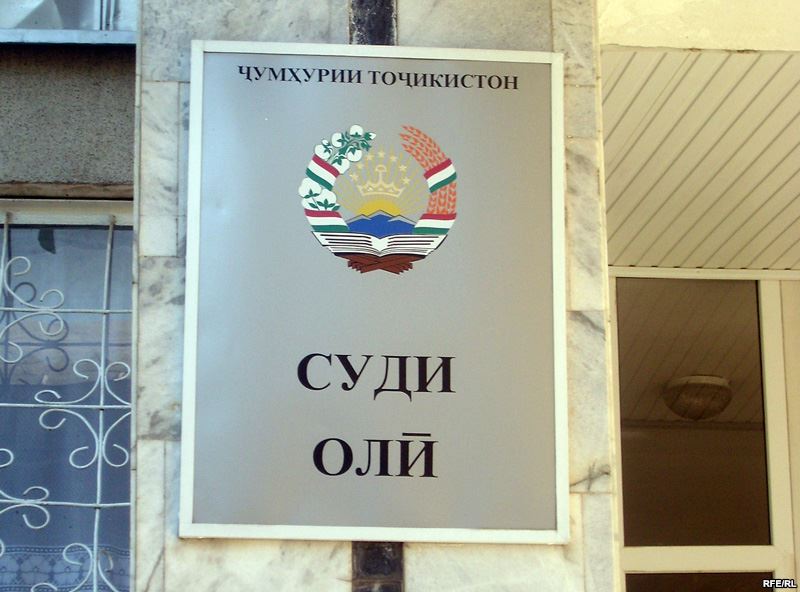
The Supreme Court of Tajikistan has completed consideration of criminal proceedings instituted against 119 suspected members of the banned Muslim Brotherhood group and sentenced 117 of them to various jail terms ranging from five to 23 years. Two others were fined for not reporting a crime.
The defendants reportedly included teachers and employees of various universities, two foreigners (both of them are nationals of Egypt), one official from the northern city of Isfara, and the nephew of the known Tajik religious figure Akbar Turajonzoda, Ismoil Qahhorov.
Ismoil Qahhorov was reportedly sentenced to 15 years in prison.
Mohammad Bayumi, the national of Egypt, who had worked with Tajik National University, was sentenced to 23 years in prison. A source aware of this criminal case says Mr. Bayumi was named as leader of the Muslim Brotherhood cell operating in Dushanbe.
Another Egypt citizen, who had also worked with Tajik National University, was sentenced to seven years in prison.
The remaining defendants reportedly got a jail term of five years each.
As it had been reportedly earlier, the trial of 119 suspected members of the banned Muslim Brotherhood group begun in Dushanbe in July last year. The case was classified as "top secret."
The arrests of suspected members of the Muslim Brotherhood group began in Tajikistan in January last year. The suspects were reportedly detained in dozens of raids as Tajik authorities uncovered an alleged Muslim Brotherhood cell operating in the capital, Dushanbe, as well as in the Sughd and Khatlon provinces.
Prosecutor-General Yusuf Rahmon told reporters in Dushanbe on January 28 that the suspects included 20 teachers and employees of various universities, two foreigners, and one official from the northern city of Isfara.
"The group's goal is to forcibly overthrow the government and establish an Islamic state, and it has been banned as a terrorist and extremist organization in many countries," Rahmon said.
The Muslim Brotherhood is a Sunni Islamist organization founded in Egypt in 1928 by the Islamic scholar Hassan al-Banna.
The group's teachings have spread internationally and have influenced various Islamic groups, movements, and parties around the world — some of which do not use the same name.
The group claims to be peaceful but has been banned in many countries as an extremist organization.
Tajik authorities banned the Muslim Brotherhood as an extremist group in 2006 and it faces a similar ban in Central Asian neighbors Kazakhstan, Turkmenistan, and Uzbekistan. It is not banned in Kyrgyzstan.
It is considered a terrorist organization in Tajikistan, Syria, Egypt, Libya, Saudi Arabia, Bahrain, the United Arab Emirates, and Russia but not in the United States or other Western countries.
In 2016, about 20 imams were arrested in the northern province of Sughd for allegedly being members of the movement. They were accused of receiving funds from abroad and of spreading Muslim Brotherhood ideology in Tajikistan, ultimately seeking to overthrow the secular government in Dushanbe.