In Tajikistan, one in four families has at least one family member working abroad. Representing about 10 percent of the total population, labor migrants from Tajikistan are predominantly men and mainly from rural areas. Families of labor migrants struggle to manage the farming work previously done by those who are away, they often face inequities and are considered a vulnerable and marginalized group with poor economic resilience.
The Food and Agriculture Organization of the United Nations (FAO) in its work to improve gender equality, increases the capacity of women and youth left behind to fill the gap in family farm work through farmer field schools, says press release issued by FAO Tajikistan.
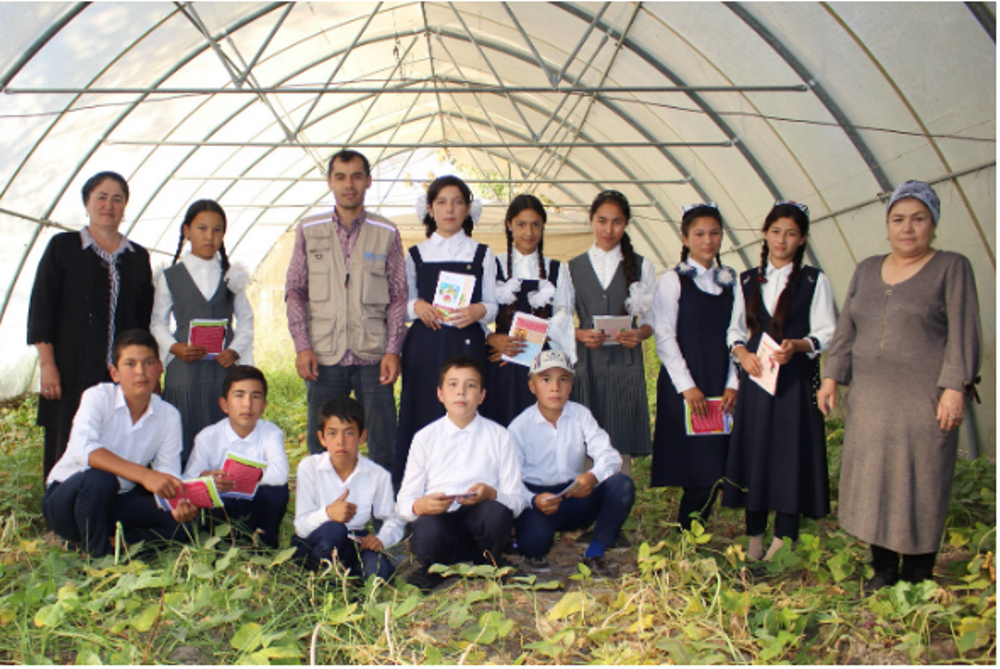
The FAO project "Empowerment of Families Left Behind for Improved Migration Outcomes in Khatlon, Tajikistan" is funded by the Migration Multi-Partner Trust Fund and implemented jointly with International Organization for Migration (IOM), United Nations International Children’s Emergency Fund (UNICEF) and United Nations Women (UN Women). Within the framework of this project, 50 junior farmer field schools were established to educate up to 1 000 children in Dousti and Kulob, Khatlon province. The first activities cover drip irrigation of crops, the cultivation of vegetables in greenhouses, organic farming methods, and technology to grow mushrooms in artificially controlled conditions.
Experts of FAO conducted a series of theoretical and practical “Training of Trainers” sessions for over 450 teachers, as well as instructors, students and junior farmers from 50 secondary schools in the two districts on the topics related to establishment of farmer field schools. The project will next monitor the junior farmer field schools and support them to ensure the benefits to family farmers are enduring and raise the livelihoods and well-being of farmers’ families.
The farmer field school (FFS) approach was developed by FAO and partners nearly 25 years ago as an alternative to the prevailing top-down extension method. It represents practical field exercises using direct observation, discussion, and decision-making to encourage active learning-by-doing. The FFS method is also an effective capacity building and extension approach for farmers.
Junior farmer field schools aim to increase awareness about healthy nutrition and sustainable use of natural resources among youth. The main goal of the schools is to create interest in agriculture, to coach youth in how to apply various advanced technologies to booster crops’ productivity and to promote sustainable agriculture.