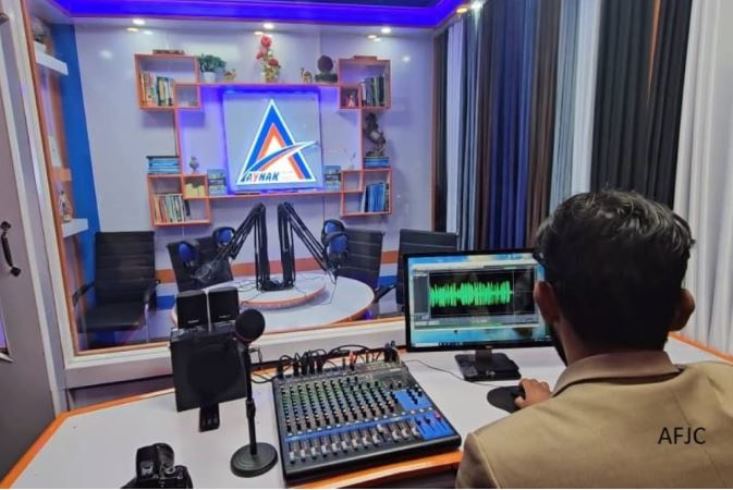
Media reports say the Afghanistan Journalists Center (AFJC) has reported that Taliban police authorities in the eastern Khost province have banned women and girls from contacting local radio and television channels and warned local media outlets not to accept phone calls from girls.
The Khaama Press News Agency reports that in the letter published by AFJC’s website on February 25, regional security head Abdul Rashid Omari alleged that some private media outlets were spreading corruption by way of “illegitimate contacts” with girls through their social and educational programs.
The letter alleged that such contacts led to “inappropriate behavior” that was in violation of the hardline Taliban's strict interpretation of Islamic law.
It said that local media, some of which allegedly lacked the required permission to broadcast educational content, had been warned they could be summoned and prosecuted for violating the order.
The Khaama Press News Agency notes that the Taliban’s official letter, signed on February 24, emphasizes that local radios and televisions do not have permission from the Ministry of Education to broadcast school curriculum programs. It warns that if media officials disobey this order, they will be summoned and face legal consequences.
According to the AFJC, 15 private radio stations and three private television outlets are broadcasting in Khost province, along with National Radio and Television under the control of the Taliban.
The Afghanistan Journalists Center reportedly strongly condemns the unprecedented written warning issued by the Taliban’s security command in Khost, urging the Taliban to retract their heightened interference in media operations. Additionally, the Center highlights the marginalization of the Commission for Addressing Media Complaints and Violations in Afghanistan, noting the direct and indirect threats posed by non-official authorities against the media.
The Afghanistan Journalists’ Center is an independent, non-governmental and non-partisan body operating across Afghanistan under the country’s Mass Media Law. The organization was established in June 2009 after getting operation license from the Ministry of Information and Culture under the name of Center to Support Journalists of Afghanistan (CSJA). Its name was modified in September 2011 on request from the Executive Board of the center which was approved by the ministry of Information and Culture by issuing a renewed license.
AFJC works to defend rights of Afghan journalists and ensure freedom of expression in Afghanistan.
Khost is one of the 34 provinces of Afghanistan located in the southeastern part of the country. Khost consists of thirteen districts and the city of Khost serves as the capital of the province. Historically, Khost used to be a part of Paktia and a larger region surrounding Khost is still referred to as Loya Paktia.
Throughout history, the province has been the site for numerous rebellions, leading to the local Pashtun populace to consider themselves the “traditional king-makers in Kabul”. The province was previously known as the Southern province and was united with the neighboring Paktia province. Khost is also home to numerous universities, including Shaikh Zayed University, which is the only university in Afghanistan with a faculty in computer science.