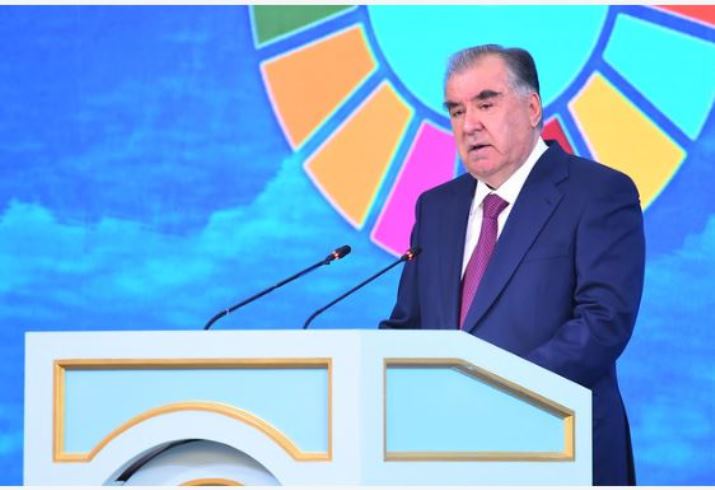
Inaugurating the 3rd Dushanbe Water Action Decade Conference “Water for Sustainable Development, 2018 – 2028”, Tajik President Emomali Rahmon noted on June 11 that modern risks and rising threats are becoming relatively fast and effective.
“Over the last five years, we have consistently been witnessing the hottest years and months on record on our planet,” Tajik leader said, noting that according to reports, 2023 was recorded as the hottest year as well.
There is a strong possibility that this is not all what has yet to come, and we will witness more record numbers in the next few years, Emomali Rahmon noted.
“It is worthy of noting that, year by year, the share of water-related emergencies within the total number of natural disasters and the amount of damages caused from said emergencies is also increasing,” said Tajik president. “Over the last 20 years, this share has increased from 80 to 90 percent and the amount of damages has increased considerably too.”
He further noted that a clear example of this is the current year's floods in various parts of the world, including Tajikistan, which caused hundreds of millions of dollars in financial damages to the countries' economies.
Tajikistan, despite having abundant fresh water resources, including glaciers, lakes, and rivers, reportedly pays particular attention to water-related problems.
Effective measures have been implemented at the national and regional levels to solve the water issues.
“In particular, we are implementing the "Water Sector Reform Program for 2016-2025" aimed at fully transition to the integrated management of water resources,” said Emomali Rahmon. “The development of the "National Water Strategy until 2040" and the "State Program for Drinking Water Supply and Wastewater Treatment until 2032", as well as the establishment of a unified information system in the water sector, are considered important steps by our country to this end.”
“Our programs and strategies in this direction also include the subjects related to the improvement of culture, rational and economical use of water, and the introduction of new irrigation technologies,” Tajik leader said.
According to him, Tajikistan is redoubling efforts to transition to "Green Economy", and water resources play a key role in achieving this goal.
“More than 98 percent of Tajikistan's electricity is produced from country's hydropower resources. We have decided to increase this indicator to 100 percent by 2032, that is, to produce electricity entirely by "Green Energy” resources,” Rahmon said noting that turning Tajikistan into a "Green Country" by 2037 is the Tajik government’s other aim.
In this context, along with the full use of renewable energy, Tajikistan has reportedly adopted the “Program for Greening the Country’s Nature until 2040” according to which more than two billion trees should be planted by then.
“At the same time, we pay special attention to cross-border cooperation on water issues,” said Tajik leader said, adding that Tajikistan is ready to further strengthening of regional cooperation in Central Asia and to solve the pressing water issues through a constructive dialogue.