
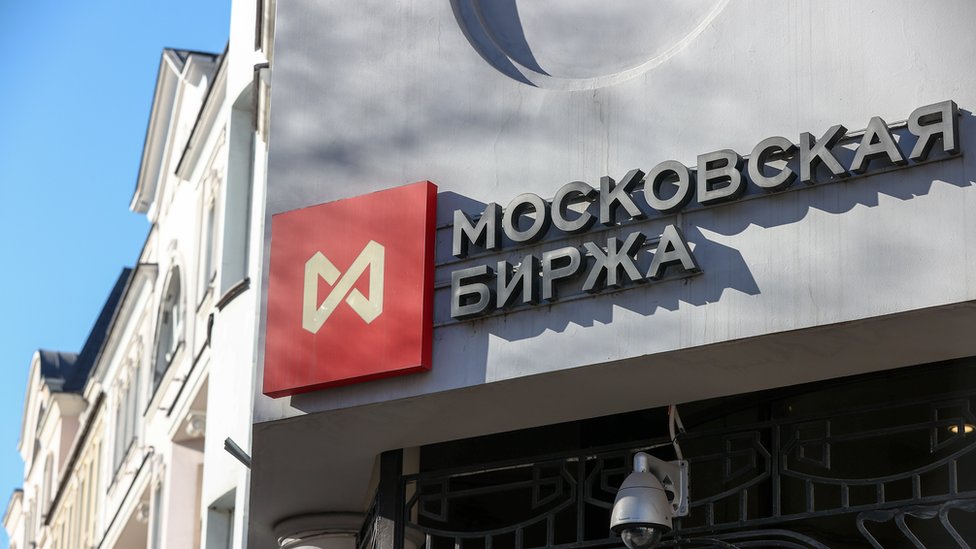
The US sanctions, imposed on the Moscow Exchange (MOEX) 20 days ago, have resulted in the cessation of trading in dollars and euros on this platform. Tajikistan's banking sector, heavily reliant on ruble remittances from migrants, initially experienced volatility but has since stabilized.
MOEX, which is Russia’s main exchange, has not carried out trading on foreign currency, precious metals, stock, money and futures markets in instruments with settlement in dollars and euros since June 13 due to new U.S. sanctions. The U.S. Department of the Treasury on June 12 included the Moscow Exchange, the National Clearing Center (NCC), and the National Settlement Depository (NSD) in its sanctions SDN (Specially Designated Nationals) list.
Being placed on this list means the company is isolated from the global dollar system. The exchange was immediately forced to suspend dollar trading.
The Moscow Exchange is the largest exchange in Russia, operating trading markets in equities, bonds, derivatives, the foreign exchange market, money markets, and precious metals. The Moscow Exchange also operates Russia's central securities depository, the National Settlement Depository (NSD), and the country's largest clearing service provider, the National Clearing Center. The exchange was formed in 2011 in a merger of the Moscow Interbank Currency Exchange and the Russian Trading System.
Fluctuations in ruble exchange rate
In the first few days, the sanctions imposed on MOEX have made the Russian currency volatile. The Russian ruble has lost nearly 5.0 percent of its value against the Tajik national currency, the somoni, in one day following the sanctions.
An official exchange rate of the somoni (TJS) against the Russian ruble (RR) set by the National bank of Tajikistan rose 4.8 percent in a day – from 0.1273:1 on June 10 to 0.1203:1 on June 13.
However, on that day, banks were hesitant to trade rubles, set exchange limits, and offered erratic rates, with some banks proposing 100 somonis for 1,000 rubles (0.1:1). In the subsequent days, the actual exchange rate differed significantly from the official exchange rate set by the country’s national financial regulator. Despite the official rate being just over 120 somonis for 1,000 rubles, banks were trading at rates between 115 and 118 somonis.
By June 20, the official exchange rate of the ruble against the somoni has increased to 1:0.1273, only to drop sharply to 1:0.1212 on June 21.
As of July 4, the official exchange rate of the ruble against the somoni was 1:0.1205.
The official exchange rates of TJS against the US dollar (USD) and the euro (EUR) have also slightly increased since the reporting period: the TJS/USD exchange rate increased from 10.7287:1 on June 13 to 10.6632:1 on July 4; and TJS/EUR exchange rate increased from 11.5441:1 on June 13 to 11.4736:1 on July 4.
The exchange rate of the somoni against the ruble is crucial for many Tajik families receiving remittances from labor migrants working in Russia. According to NBT regulations, ruble remittances are issued in somoni at the exchange rate at the time of receipt, and rubles are exchanged for dollars to meet foreign currency needs. An increase in the ruble's exchange rate benefits the families of labor migrants as they receive more somoni.
Alternative solutions
Meanwhile, the country’s national financial regulator notes that it conducts conversion operations mainly in freely convertible currencies and has minimal need for the Russian ruble/US dollar pair. “In addition to using the MOEX platform, the NBT has alternative channels for exchanging Russian rubles for freely convertible currencies, which continue to function successfully despite the recently imposed sanctions," an official source within the NBT told Asia-Plus in an interview.
Regarding the overall impact on the banking system, the NBT states that the country's credit and financial institutions also have additional options for converting Russian rubles into freely convertible currencies.
Avoiding sharp fluctuations?
The National Bank explained that currency pair trading is moving to the over-the-counter (OTC) market, which might result in additional transaction costs. "The OTC market provides alternative paths for transactions, which may entail additional expenses for market participants," the NBT explained. The NBT emphasized that the USD/TJS exchange rate depends on various factors, including the volume of foreign currency inflows into the country and the dynamics of the dollar to ruble exchange rate. "Factors influencing the USD/RR exchange rate are external and highly volatile, making their changes unpredictable and requiring close monitoring," the NBT source added.
Banks adapt
Several banks in the country confirmed to Asia-Plus that it took half a day to quickly reorient and resume operations. One bank noted that the US sanctions imposed on MOEX have certain negative consequences, but nothing the Tajik banking system cannot handle. "Tajikistan's economy is diverse, and the risk of sanctions against MOEX had long existed. The country has economic ties with Europe, China, and other countries, facilitating settlements in other directions," the bank representative added. He also noted that severe negative consequences for the US dollar and euro exchange rates on the market are not expected.
Another major bank confirmed this, indicating that the sanctions have lengthened and increased the cost of currency exchange processes. "Banks across Central Asia have found a way to convert rubles to yuan, then yuan to dollars. However, indirect interaction with the exchange complicates and increases the cost of transactions," the bank representative commented.
Indeed, the US sanctions imposed on MOEX caused short-term fluctuations in the Russian ruble exchange rate in Tajikistan. However, due to the flexibility of commercial banks and the availability of alternative channels, the negative consequences have been minimal.
