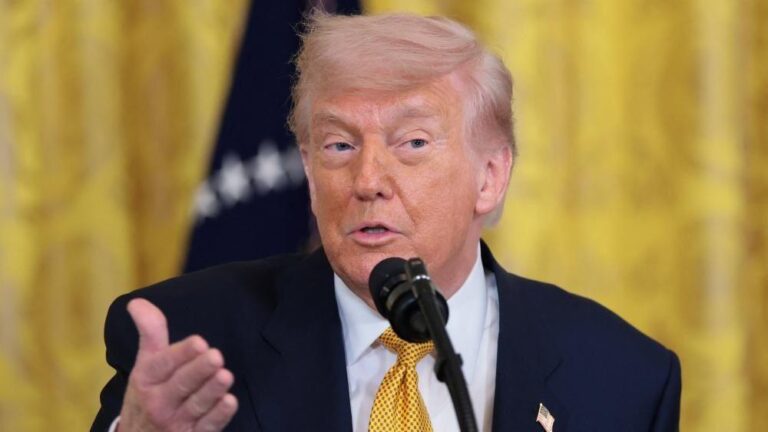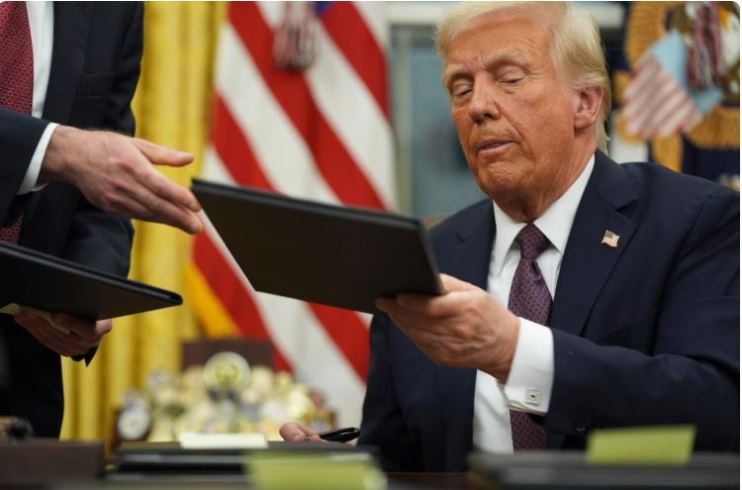
Media reports say US President Donald Trump on January 20 signed an executive order temporarily suspending all U.S. foreign assistance programs for 90 days pending reviews to determine whether they are aligned with his policy goals. It was not immediately clear how much assistance would initially be affected by the order as funding for many programs has already been appropriated by Congress and is obligated to be spent, if not already spent.
ABC News reports that the order, among many Trump signed on his first day back in office, said the “foreign aid industry and bureaucracy are not aligned with American interests and in many cases antithetical to American values” and “serve to destabilize world peace by promoting ideas in foreign countries that are directly inverse to harmonious and stable relations internal to and among countries.”
Consequently, Trump reportedly declared that “no further United States foreign assistance shall be disbursed in a manner that is not fully aligned with the foreign policy of the President of the United States.”
The Associated Press (AP) says the order signed by Trump leaves it up to Secretary of State Marco Rubio or his designee to make such determinations, in consultation with the Office of Management and Budget. The State Department and the U.S. Agency for International Development (USAID) are the main agencies that oversee foreign assistance.
According to AP, Trump has long railed against foreign aid despite the fact that such assistance typically amounts to roughly 1% of the federal budget, except under unusual circumstances such as the billions in weaponry provided to Ukraine. Trump has reportedly been critical of the amount shipped to Ukraine to help bolster its defenses against Russia's invasion.
Some of the biggest recipients of U.S. assistance, Israel ($3.3 billion per year), Egypt ($1.5 billion per year) and Jordan ($1.7 billion per year) are unlikely to see dramatic reductions, as those amounts are included in long-term packages that date back decades and are in some cases governed by treaty obligations.
Reuters says the executive order echoes a return to the approach Trump took during his first term in office between 2017 and 2021.
He reportedly first came to power proposing to cut about a third off U.S. diplomacy and aid budgets, which included steep reductions in funding for U.N. peacekeeping and international organizations. But Congress pushed back on Trump's proposals. Then at the annual gathering of world leaders at the United Nations in 2018, Trump complained that the U.S. was the largest foreign aid donor, "but few give anything to us." "That is why we are taking a hard look at U.S. foreign assistance," he said. "Moving forward, we are only going to give foreign aid to those who respect us and, frankly, are our friends."