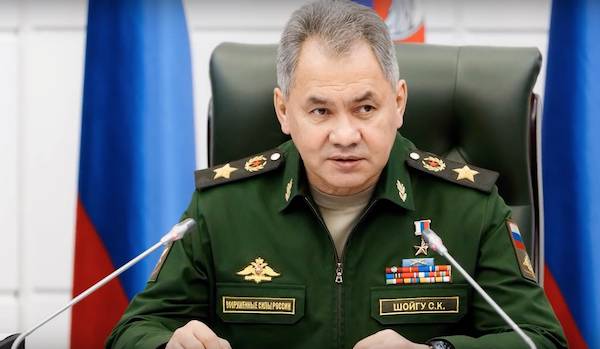
The risk of a clash between nuclear powers is growing, states Russia’s Security Council Secretary

Geopolitical rivalry between major powers on the international stage is intensifying, and the risks of a military confrontation between nuclear-armed states are increasing, the Secretary of the Security Council of the Russian Federation, Sergei Shoigu, stated in an interview with TASS on January 24. “Against the backdrop of rising tensions and the intensification of geopolitical […]

Asia-Plus

Geopolitical rivalry between major powers on the international stage is intensifying, and the risks of a military confrontation between nuclear-armed states are increasing, the Secretary of the Security Council of the Russian Federation, Sergei Shoigu, stated in an interview with TASS on January 24.

“Against the backdrop of rising tensions and the intensification of geopolitical rivalry worldwide, the risks of military confrontation between major powers, including those involving nuclear states, are increasing,” Shoigu noted.

According to him, Western countries have launched an “ideological and value-based aggression” against Russia and Belarus.  They are reportedly not only trying to harm these nations through economic sanctions but are also attempting to destabilize their internal political situations.

"There are ongoing attempts to destabilize the domestic situation, undermine societal foundations, and impose an alien neoliberal ideology," the Secretary of the Security Council of the Russian Federation emphasized.


Political interests at the expense of global security

Shoigu also stressed that such actions by the West affect not only Russia and Belarus but also negatively impact the global situation as a whole.

"There is an active devaluation of international organizations such as the WTO, WHO, OPCW, etc., which are increasingly becoming political tools," he pointed out.

Attempts are being made to undermine international efforts to prevent an arms race in space and to turn outer space into a new arena for armed confrontation, he added.

"These actions are directly aimed at weakening our countries and are driven by the desire to deprive us of sovereignty, the right to freely choose our own development path, and to pursue our strategic interests," Shoigu concluded.

 

Join us on social media!

Article translations:

Related Article

Оби зулол
Оби зулол

Most Read

Recent Articles

25 Years in Touch: On Generation Change, “Digital” and “Invisible” Work

In its 25th anniversary year, "MegaFon Tajikistan" summarizes its technological development and outlines future directions. On the key stages of network evolution, prospects for...

The number of entrepreneurs in Tajikistan increases by 4.3%

The number of entrepreneurs operating under a patent is increasing the fastest.

Trump announces “very good” talks with Iran and the possibility of a quick agreement. Tehran did not comment on this

The President of the United States claims that Tehran has agreed to the US demand to abandon the development of nuclear weapons.

Police report the discovery of the remains of a man who had been missing since December 2025

A friend of the murdered person has been detained on suspicion of particularly brutal murder.

Residents of a settlement in Sughd: “Afghan refugees have disappeared from the Dehmoy jamoat”

Earlier, a citizen of Afghanistan was detained on charges of murdering a resident of Khujand.

In Russia, it was proposed to revoke residence permits and temporary residence permits from migrants who do not work for more than two months

During January-March 2026, 90% more residence permits were revoked from migrants in the country compared to the same period last year.

From reach to influence: why advertising no longer works by old rules discussed in Dushanbe

Market research forces a complete reconsideration of the advertising budget allocation strategy.

Facial recognition cameras are being tested in Tashkent schools

Biometric control over children is being implemented without their explicit consent.