
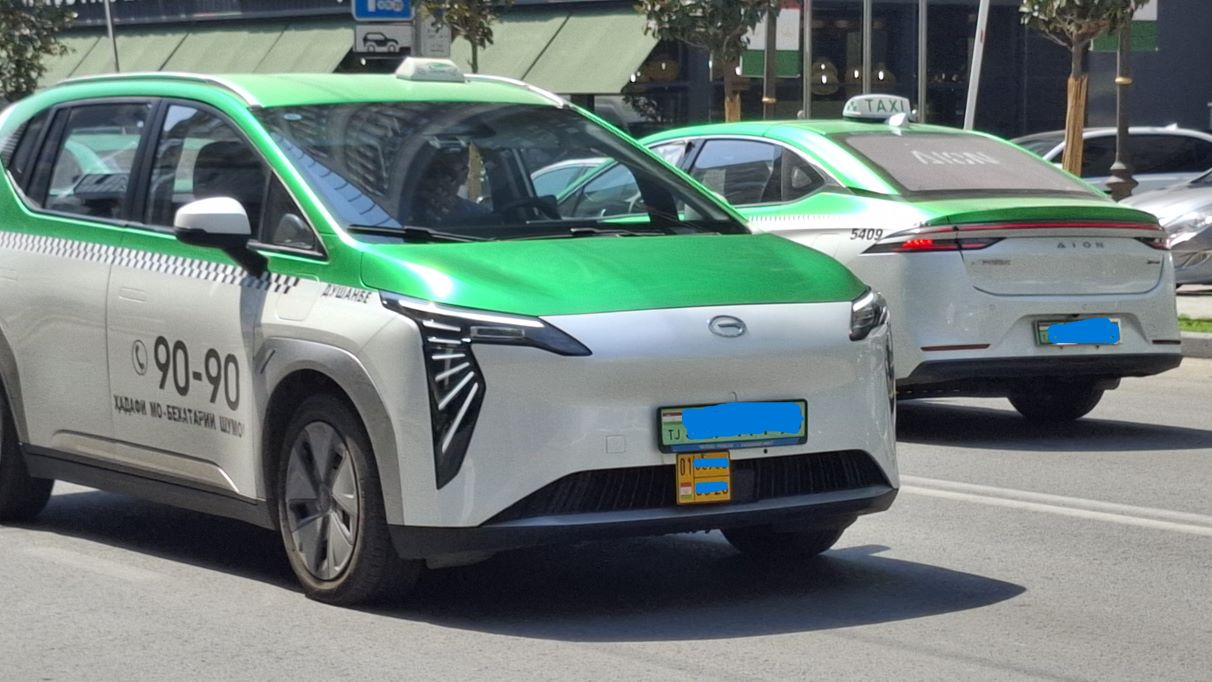
The authorities ordered taxi drivers in the capital to install, in addition to the green license plate, also a yellow number. The Department of State Automobile Supervision of the Ministry of Internal Affairs claims that the yellow number is provided to companies for free, and they must also transmit it to their drivers for free. However, some taxi drivers claim that they got yellow plates for money.
The correspondent of Asia–Plus spoke with the drivers of four companies, the responsible person of one of them and representatives of government agencies.
Mirali Abdurakhmonzoda, head of the Traffic Police Department of the Interior Ministry, told Asia–Plus that the yellow number is being introduced to identify illegal taxi drivers arriving from the districts, but it is free.
"The company submits an application, the traffic police produces numbers in accordance with its needs, a representative of the company signs and receives them. The numbers are distributed by the companies themselves," Sodik Sobirzoda, Deputy head of the Traffic police Department, shared the details.
He added that of the four operating companies, only one charges for yellow vehicle registration plates, but declined to name it.
"We checked that only one company charged a fee. They explained this by deducting it from membership fees.
Otherwise, vehicle registration plates are free," he explained. However, he noted that the traffic police does not control the collection of fees by companies.
According to the decision of the mayor's office, only four companies have the right to provide taxi services in Dushanbe, each of which can have up to 3,000 cars. Previously, there were 12 companies with a total fleet of about 4,300 vehicles.
Who takes money from their drivers?
The drivers of three companies — Eco–Taxi, Covion and Safo Taxi – confirmed that they had received yellow plates for free.
"In Eco–Taxi, they give out yellow plates for free and in turn," says one of the drivers. "I haven't received the yellow number yet, but my colleagues said they were given it for free," said a taxi driver from Covion.
Several drivers from Safo Taxi also confirmed the free issue of license plates.
But the drivers of the Oluch–Avto company claim that their company charges a fee for a yellow number.
"The 70 00 company gave us yellow numbers for money — 260 somoni. I recently received a permit and it has not expired yet, but I had to pay anew for a new number," said one driver of the company (he did not give his name).
Another employee who has been working for this company for more than a year noted that the fee was explained by the need to preserve the numbers and prevent cars from being taken off the line.
"We were told that we needed to pay small expenses," he added.
Asia–Plus received payment receipts stating that the money was taken for the "iron license permit", with the company's seal.
"The company explained that the yellow number is an official work permit that all taxi drivers must have. When I said that I had already bought a permit, but they were selling it again, I received no response. I had to buy a yellow license plate, otherwise I couldn't work," says another driver of this company.
What do they say in Olucha–Avto?
The Olucha–Avto company confirmed that the yellow number costs 260 somoni and this money is used to pay for the permit.
"260 somoni is the price of the yellow number, as it is established. In other companies, this money is deducted from membership fees. We also deduct contributions," the company representative said briefly. For a more detailed answer, he demanded to apply in writing.
Who makes the yellow numbers?
According to the deputy head of Traffic police Department, Sodik Sobirzoda, 50 yellow numbers are produced daily, in total, about 2500 pieces have been produced since the beginning of the issue. The numbers are official permits issued on the letterhead of the State Service for Control and Regulation in the Field of Transport.
"The numbers have the national flag, the region code (01), the license number and the validity period. After the end of the period, the numbers are changed for free," he said.
However, he added that if companies continue to manufacture and sell plates on their own, "that's their business, but the numbers from the traffic police are free."
Earlier, Jahonbin Hakimzoda, head of the PR department of the Traffic police Department, said that the production and issuance of yellow numbers is not the task of the traffic police, they are printed and distributed by the companies themselves.
"Therefore, although the license plates are free, the paid distribution is not controlled by the traffic police. The State Service for Control and Regulation of Transport is responsible for this," he said.
An employee of this service in Dushanbe, Zafarkhon Boboev, told Asia–Plus that they only issue permits according to quotas for four companies.
"We don't print yellow license plates — the traffic police prints them and passes them on to the company, which sends them to the drivers. We are only preparing permits for the lists of companies," Boboev said.
The statements of government agencies contradict each other, but they all claim that yellow plates are free and companies should issue them to drivers for free, but Oluch–Avto drivers found themselves in a situation where they either had to pay money or stop operating.
They note that they have invested heavily in buying cars and membership in the company, and demanding additional payments, especially if denied by government agencies, creates serious difficulties for them.
