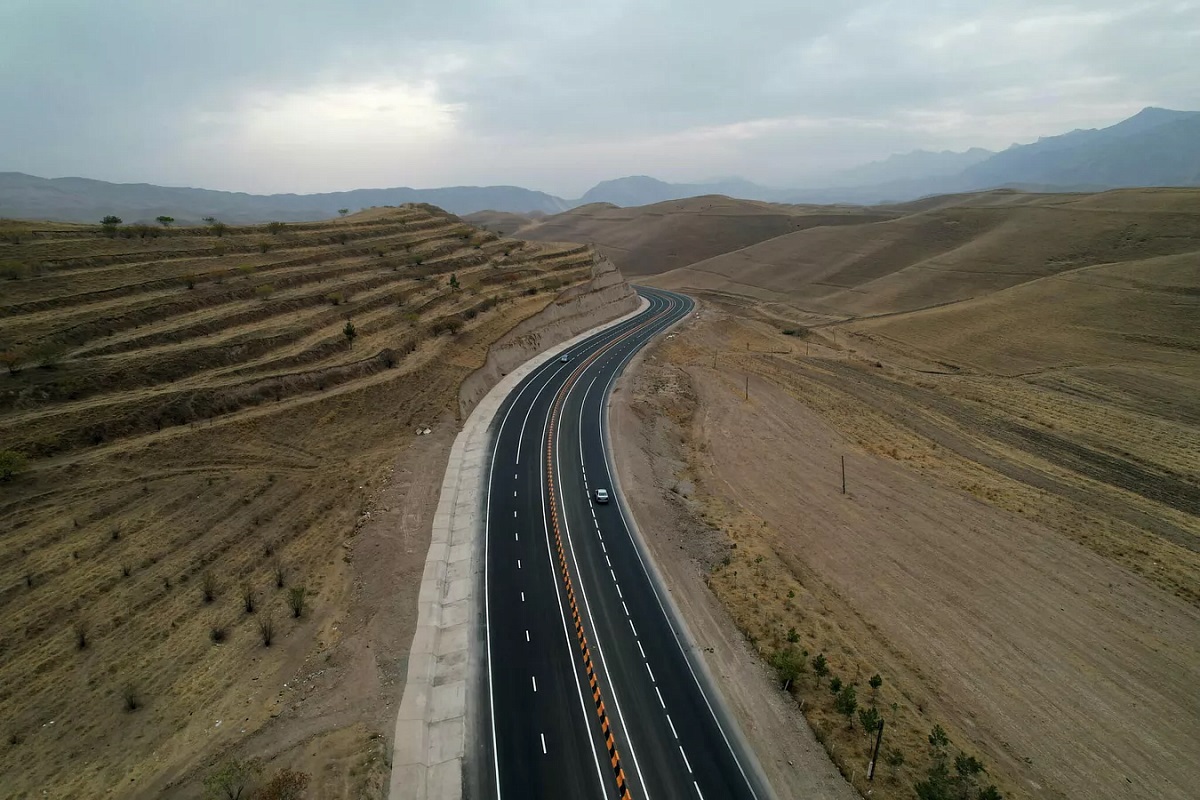
Tajikistan’s road infrastructure was ranked the highest quality in Central Asia in 2024, according to the World Economic Forum’s road quality index. The country placed 50th out of 141 nations, ahead of Kazakhstan at 93rd, Kyrgyzstan at 113th, and with Uzbekistan and Turkmenistan absent from the list. This impressive ranking reflects ongoing efforts to construct, rehabilitate, and modernize Tajikistan’s road infrastructure, according to the Ministry of Transport of Tajikistan.
What has been built?
The government has focused on overcoming the country's communication isolation. Over the past 32 years, more than 2,400 kilometers of roads have been reconstructed, along with 274 bridges, 2 three-level and 2 two-level intersections, and 7 transport tunnels.
To date, 58 projects worth more than $2.2 billion have been implemented in the country’s transport sector.
Murgab-Kulma road
One of the first major road projects post-independence was the construction of a 32.3-kilometer stretch connecting the Khorog-Osh highway with China via the Kulma Pass. Before this, there was no direct road link between Tajikistan and China. The project was funded with a loan of over $9.7 million from the Islamic Development Bank (IsDB), with the Tajik government contributing around $4.3 million. The Kulma checkpoint was opened in May 2004, enabling the launch of road traffic between the two countries.
Major road projects and ongoing developments
Dushanbe – Khujand – Chanak
One of the largest road projects completed in Tajikistan since independence was the reconstruction of the Dushanbe-Khujand-Chanak road, which stretches 336 kilometers to the Uzbekistan border. This project cost approximately $300 million, with around $290 million from a Chinese loan and $15 million from the Tajik government. The road was completed in 2008 and was later handed over to Innovative Road Solutions Ltd. in 2010 under a concession agreement. This company now operates toll on this highway and manages its infrastructure.
The Dushanbe-Khujand-Chanak road includes three tunnels, the longest being the 5-kilometer Istiqlol Tunnel under the Anzob Pass, built with $39 million — $21.2 million from a Chinese loan and $10 million from Iran’s government grant. Additionally, the Shahriston and Dousti tunnels were constructed with Chinese loans totaling $88.4 million and $13.7 million, respectively.
Dushanbe – Khorog – Kulma
Another key road project is the construction of a year-round route linking Dushanbe to the Gorno-Badakhshan Autonomous Region (GBAO) via the Khatlon province. Previously, the only access was through the Rasht Valley (eastern districts subordinate to the center), and the road to the GBAO was closed during winter due to heavy snow at the Khoburubot Pass (3,252 meters) in GBAO’s Darvoz district. The new road is nearly 100 kilometers longer but remains open year-round.
New and ongoing projects
Currently, there are 12 state investment projects in the transport sector worth over 9.6 billion somonis, which will involve the construction of more than 1,500 kilometers of roads. The government has allocated over $723 million for these projects, with $331 million in grants, more than $334 million in loans from development partners, and about $58 million from the national budget.
Among the major ongoing works is the restoration of the Qala-i-Khumb-Vanj-Rushan border road in GBAO, valued at over $200 million. Additionally, roads in the Khatlon province, such as Bokhtar-Levakant-Lolazor-Danghara and Hulbuk-Temurmalik-Kongurt, are being built, with a combined value of over $138 million.
Future priorities
Looking ahead, the government plans to launch and develop 36 priority road projects, including the construction of international and national economic corridors. These projects are set to begin once financing sources are secured. The key projects include roads connecting Tajikistan to neighboring countries such as Uzbekistan, Afghanistan, and Iran, which will position Tajikistan as a central transit corridor between China and Europe.
In his latest address to both chambers of parliament, President Emomali Rahmon emphasized that these roads will serve as vital transit routes for economic corridors linking China, Tajikistan, Afghanistan, Uzbekistan, Turkmenistan, Iran, Turkey, and Europe, further integrating the region into the global trade network.