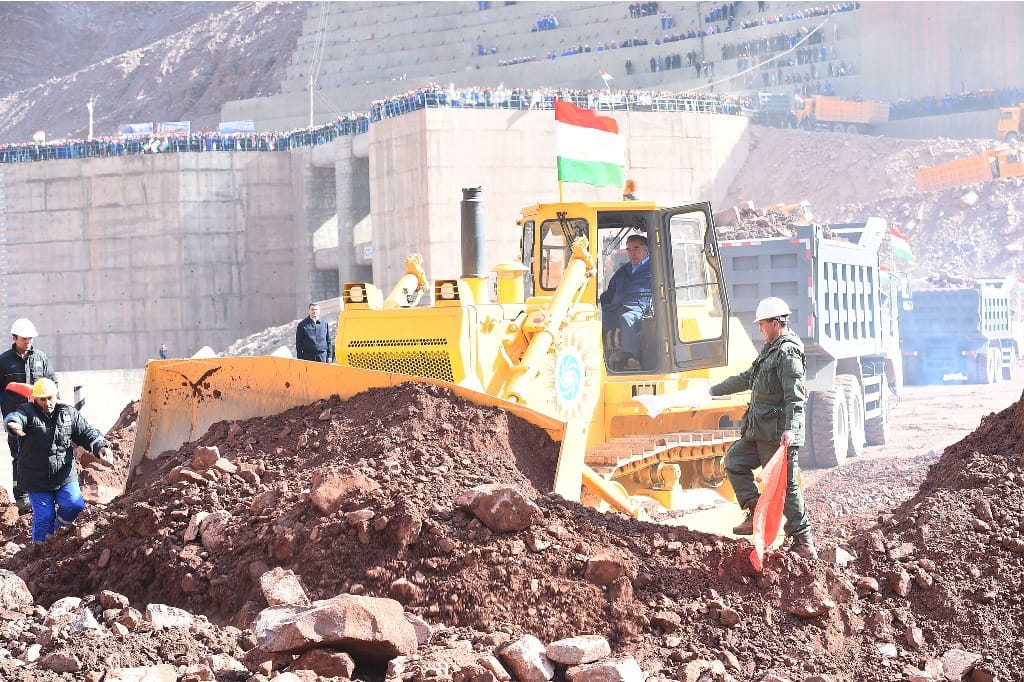
The government of Tajikistan will need 60.4 billion somoni (approximately $6.5 billion) to implement its Electricity Sector Development Program for 2026–2030.
Funding is expected to come from a mix of development partners, private investors, and annual allocations from the state budget — primarily for the ongoing construction of the Roghun Hydropower Plant (HPP).
The main funding sources for the program are as follows:
· Development partners: 36.57 billion somoni;
· Private sector investment: 23.79 billion somoni;
· State budget contributions for the Roghun HPP, which are allocated annually in specific amounts.
This year alone, the government has allocated over 9 billion somonis from the state budget for the Roghun hydropower development project — accounting for about 20% of total budgeted expenditures.
In the 2026 state budget, funding for the fuel and energy sector is projected at 15 billion somoni (more than $1.6 billion), which represents 22.4% of total government spending for that year.
What’s planned under the Electricity Sector Development Program?
The program will primarily focus on completing the construction of the Roghun HPP, as well as building the Shu rob and Chart hem hydropower plants. There are also plans to modernize and reconstruct existing energy infrastructure. By 2030, the government aims to commission the remaining four units of the Roghun hydropower plant and replace two worn turbine runners to boost generation capacity and recover lost energy output.
In addition, the development of solar and wind energy remains a priority. Plans include the construction of 1.5 GW of solar power capacity in Sighed and Khatlon provinces, alongside further exploration of the country’s wind energy potential.
Tajikistan is also working to expand electricity exports and sees providing frequency regulation services to regional power grids as a key strategy for strengthening its role in Central Asia. This will require modernization and expansion of the national transmission infrastructure. Planned projects include the construction of high-voltage power transmission lines, such as the 500 kV “Roghun–Shayon” power transmission line, and upgrades to existing substations.
To improve the reliability of the national power supply, the program also envisions modernization of distribution networks, equipment replacement, and the installation of smart metering systems.
Expected results
By the end of the program period, Tajikistan expects to achieve the following:
· 2,680 MW of new hydropower capacity;
· 253 MW of additional capacity from upgrades to existing stations, plus the restoration of 440 MW lost due to equipment wear and tear;
· 1,500 MW of solar energy capacity;
· Reduction of power transmission losses to 3%;
· Reduction of distribution losses to 9%;
· Up to 5 billion kilowatt-hours of electricity exported annually.
In his latest address to the parliament, President Emmalee Rahman emphasized that domestic demand for electricity is growing each year and is expected to rise by 31% by 2030 compared to 2025.
He noted that over the past decade, around 60 billion somoni have been invested into the country’s energy sector, resulting in a total increase of 1,017 MW in electricity generation capacity.