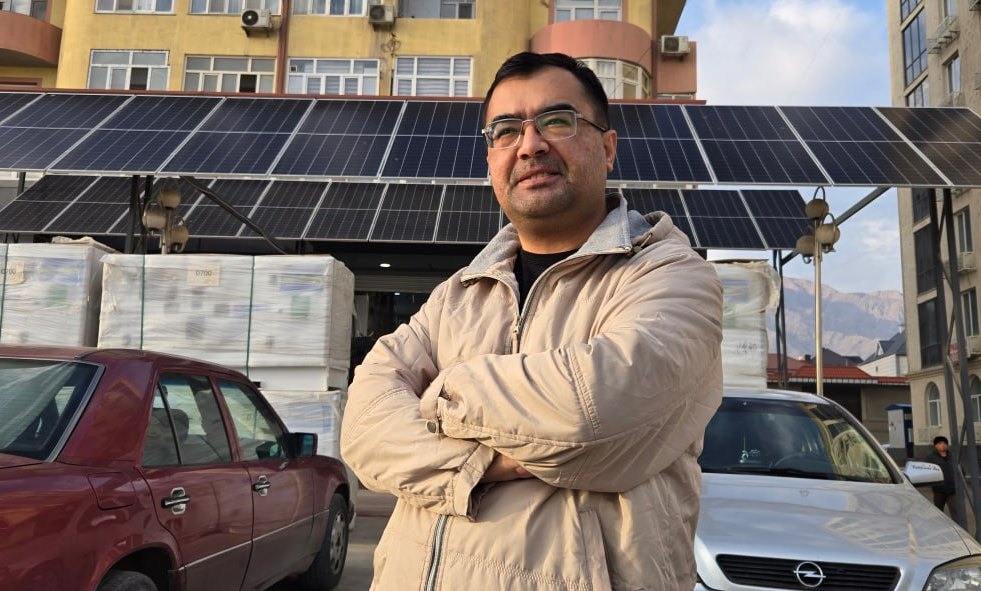
This is the story of Mashhour Pochoyev, an enthusiast from Khujand who, tired of constant power outages and needing stable internet access for remote work, decided to install a solar power system in his home.
Meet Mashhour
Mashhour is 36 years old and considers himself a fan of solar energy. Born in a remote town in northern Tajikistan, he moved to Khujand in 2007 to study and ended up staying there. His career has been diverse, including roles as a radio host, program coordinator at an environmental organization, graphic designer, and even a production specialist.
In his free time, Mashhour is passionate about electronics and physics. He currently lives in a small one-story house, which he is gradually making his own. His greatest support and inspiration come from his family.
"My wonderful wife was the driving force behind the installation of the solar system. Without her, I wouldn't have dared to take the leap. We have a son now, and he's very happy that there's always electricity at home. For me, it's a huge victory – peace and comfort in our home."
From childhood memories to an adult decision
Mashhour's idea of energy independence has deep roots. During his childhood in a remote village, electricity was available only for two hours a day from September to May, and there was one instance when it was completely out for 14 days.
"Life seemed to stop. I read every book in our home library by candlelight, and out of boredom, I even delved into technical literature like geodesy," Mashhour recalls. "The inability to do simple household tasks like ironing or cleaning frustrated me."
His interest in using solar energy at home first sparked in 2005 while volunteering at an environmental organization, but the turning point came in 2020 during the COVID-19 pandemic.
"I worked as a designer, and switching to remote work left me with no choice: electricity and internet had to be constant. It was no longer just a household issue but a matter of stable income. The goal wasn't to save money, but to ensure an uninterrupted power supply," he explains.
After considering various options, including purchasing a diesel generator, Mashhour ultimately decided on a solar power system.
Doubts, calculations, and installation
Mashhour strengthened his theoretical knowledge by completing a course on alternative energy at the Kazakhstan-German University. However, despite this, he still had natural doubts before starting the installation.
"Even after seeing firsthand in Almaty how a solar system powers an entire floor of a university, questions remained. But they disappeared after the first month of stable operation of my system."
Mashhour took on the key preparatory work, including the critical calculations. Using open data on solar insolation and specialized software, he determined the optimal angle and orientation of the panels, as well as the required power and capacity.
"I needed to avoid making the system overpowered, but also to ensure it wasn't lacking. I spent a week doing calculations and observing the sun and shadows on the site. But the installation itself only took one day for professional electricians," he explains.
The choice of components was practical: cost, claimed power, and guarantees on key components.
"It all came down to finding the right balance between price, power, and warranty. I didn't rely on just one contractor. I ordered part of the equipment, bought some locally, and then hired specialists to assemble and connect the system."
"A reserve for the future": how to build a smarter and cheaper solar system
Mashhour's system is a balance between current needs, future plans, and budget. The core of the system is four 500W solar panels (nominal power each).
"I deliberately chose a hybrid inverter with 10 kW capacity, even though a 5 kW inverter would have been enough for today's needs and would have been cheaper. But I have plans to install additional equipment. I wanted a reserve for the future."
Energy storage is provided by a modern lithium iron phosphate battery with a capacity of 5 kWh, allowing the family to comfortably endure dark hours or cloudy days.
Since Mashhour took on the logistics, calculations, and selection of components himself, he was able to significantly save on the overall cost of the project.
"A year ago, the package with installation was quoted at 50-70 thousand somoni. But since I did most of the work myself, my system cost me much less. This isn't a story of big investments, but of a reasonable and smart approach," he says.
The first malfunction – a warranty case
The road to energy independence is rarely smooth, and Mashhour faced his first serious test of the system’s reliability. During a network failure, a voltage surge damaged the battery management controller.
"It was an unpleasant setback—the battery management system failed after a power line accident. But this highlights the importance of choosing equipment with an official warranty," he notes.
This incident, however, confirmed the correctness of his approach to selecting components. The manufacturer quickly replaced the faulty battery block under warranty.
Not payback, but quality of life: lights in the windows and bills on a "diet"
For Mashhour, financial payback calculations were secondary. His main argument is both philosophical and practical: "Initially, I didn’t consider payback as a criterion. Electricity doesn’t get cheaper, but solar systems are getting cheaper—that’s a fact. But for me, the question was never about that; it was about the quality of life here and now."
In practice, this approach fully paid off. The system operates reliably, although its performance is highly seasonal.
"On an ideal winter day, the peak output reaches 2100 W per hour, but on cloudy days, it can drop to 500 W per hour. However, the hybrid inverter and the battery smooth out these fluctuations, ensuring uninterrupted power supply."
"When I temporarily didn’t have the battery (it was being replaced under warranty), I really felt the difference. I had to constantly monitor the output and live in energy-saving mode. This proved once again that a battery is not a luxury, but a necessity."
The most significant measurable result isn’t kilowatts, but peace at home and… reduced bills.
"My electricity bills have shrunk by an average of 30%. In summer, during the day, we often don’t take any energy from the grid. I use the sun for almost everything except the water heater. And now I’m sure that if the electricity is cut off for 10-12 hours, my house won’t even notice it."
But the most striking, almost anecdotal, proof of success was the reaction of his neighbors. During scheduled blackouts, his house stood out like a beacon on the dark street.
"At first, my neighbors thought I had somehow hooked up a ‘secret’ line," laughs Mashhour.
Energy Independence as a Hobby: Mashhour's Main Advice
Mashhour believes that installing a solar system was one of the most important decisions of his life. But his main advice is not about the equipment, but about the right mindset.
"This will be the most useful purchase of your life. Children doing homework by the light, the ability to calmly boil the kettle or work—that’s priceless. We don’t appreciate these simple things until they’re gone."
He advises future owners to dive into the subject as if it were a hobby.
"My advice is simple: make sure to study and understand the details. But if you don’t have the time or interest in physics, look for trusted specialists. Visit completed projects and see how everything works."
Mashhour has turned his experience into a local educational mission. He is increasingly being approached for advice.
"I always help with consultations, showing my system as an example. It proves that even with a minimal budget, peace of mind is achievable. And one more practical tip: always build in a 15-20% power reserve. Real life is far from ideal lab conditions."