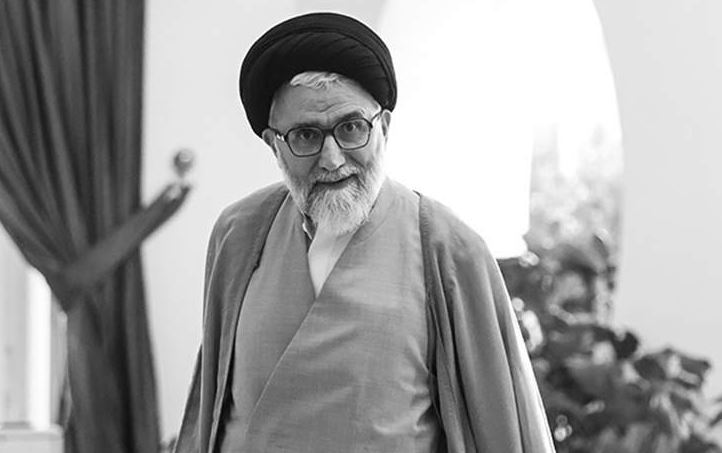
Iranian President Masoud Pezeshkian confirmed the death of intelligence chief Esmail Khatib, following an Israeli airstrike in Tehran on March 18. The Israeli military had earlier reported Khatib’s death as a result of the attack, as noted by the BBC’s Russian Service.
Pezeshkian expressed his grief on social media, saying, "The cowardly killing of my dear colleagues Esmail Khatib, Ali Larijani, Aziz Nasirzadeh, as well as some of their family members and accompanying team members, has plunged us into mourning." He extended his condolences to the people of the Islamic Republic of Iran.
Esmail Khatib (1961 – 18 March 2026) had served as Iran's Minister of Intelligence since August 2021. He was the eighth official to hold the prestigious post.
Born in Qaen, South Khorasan, Khatib studied Islamic jurisprudence in Qom, a major center of religious scholarship in Iran. Over the years, he became a trusted ally of Iran's Supreme Leader, Ayatollah Ali Khamenei, and a strong supporter of the Islamic Republic's founder, Ayatollah Ruhollah Khomeini. Khatib was deeply connected to influential religious figures, particularly his teachers, which helped cement his position in Iran's political and religious spheres.
Khatib held the title of Hujjat al-Islam, a high-ranking religious status in Iran that translates to "proof of Islam" or "authority on Islam."
Before his appointment as Minister of Intelligence, he held several key positions, including head of the Information Protection Center of the Judiciary and head of Astan Quds Razavi Security. Additionally, Khatib worked in the Office of the Supreme Leader as the chief warden, and served in both the Islamic Revolutionary Guard Corps (IRGC) intelligence division and Iran's Ministry of Intelligence.
Israeli Prime Minister Benjamin Netanyahu and Defense Minister Yoav Gallant confirmed the death of Khatib in an Israeli airstrike on the night of March 18. Gallant authorized actions by the Israeli Defense Forces (IDF) that allow for the elimination of senior Iranian officials without additional approvals, according to DW.
Gallant also warned of potential escalation in the coming days. He emphasized that the Israeli military's operation could result in "significant surprises" and usher in a new phase in the ongoing confrontation with Iran and its allied Lebanese group, Hezbollah. He stated that the intensity of strikes on Iranian targets would increase.
Since the onset of tensions between Israel, the United States, and Iran, numerous high-ranking Iranian officials have been killed, including Iran's Supreme Leader Ayatollah Ali Khamenei. On March 18, funerals were held in Tehran for former Supreme National Security Council Secretary Ali Larijani and the leader of the Basij militia, Gholamreza Suleimani, both killed in the airstrikes. Also commemorated were 84 sailors from the IRIS Dena ship, which was sunk by a torpedo in the Indian Ocean.
Alongside Larijani, his son Morteza, his bodyguard deputy Alireza Beyat, and Gholamreza Suleimani were killed in the attacks.
On March 18, the Iranian Revolutionary Guard Corps (IRGC) issued an “urgent warning” about planned strikes on five energy facilities in the Persian Gulf. According to Iran’s Tasnim news agency, the IRGC warned civilians living near these facilities to evacuate immediately. These include the Samref oil refinery, the Al-Jubail petrochemical complex, the Mosaid holding company, the Al-Hosn gas field, and the Ras Laffan refinery.
The statement urged: "These facilities have become direct and legitimate targets and will be subjected to attacks in the coming hours. Therefore, all citizens, residents, and workers are strongly advised to leave these areas and move to a safe distance without delay."
In retaliation for the Israeli airstrike on Iran’s largest gas field in the Persian Gulf, Iran threatened to bomb oil and gas facilities. U.S. President Donald Trump took to his Truth Social platform to warn that the U.S. would "destroy" the South Pars gas field if Iran attacks Qatar. Trump asserted that the United States had not been informed in advance of Israel’s strike on the field, which he said affected only a small part of the reserve, and was carried out "out of anger."
Trump also criticized Iran for its response to the Israeli attack, which he described as "unjustified and unfair." He emphasized that Israel would not strike South Pars again, as the field is "extremely important and valuable."
However, Trump warned that if Iran attacked Qatar again, the United States could strike the South Pars field with unprecedented force. He clarified that he was not seeking further escalation due to the potential long-term consequences for Iran, but underscored that any future attack on Qatari LNG infrastructure would prompt an immediate response from the U.S.