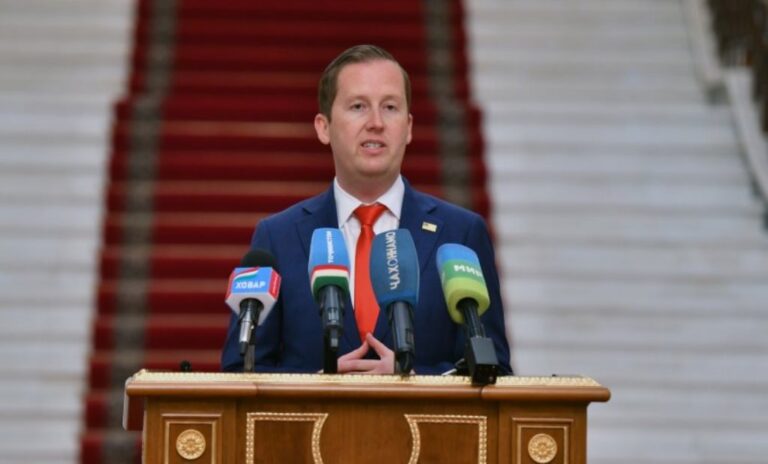
DUSHANBE, March 5, 2011, Asia-Plus – The U.S. Embassy in Dushanbe on March 4 released statement on freedom of religion in OSCE delivered by Ambassador Ian Kelly to the OSCE Permanent Council in Vienna on March 3
Mr. Kelly, in particular, noted that today, throughout the world, governments and societies are struggling with rising religious diversity even as they are called upon to protect the fundamental rights of individuals in all communities who seek to practice their own religious beliefs.
“The most severe abuses of religious freedom take place under authoritarian governments; those that seek to control all religious thought and expression as part of a more comprehensive determination to control all aspects of political and civic life. Some governments cite concerns about political security as a basis to repress peaceful religious practice. We see this today in the OSCE especially in Uzbekistan, Turkmenistan, and Tajikistan.”
“In Tajikistan a proposed “draft law on the responsibilities of parents” would prohibit anyone under the age of 18 from participation in religious communities. We encourage the government of Tajikistan to remove this draft provision, which would constitute a serious violation of religious freedom. We note with concern that a de facto ban on women attending mosques is already in effect in Tajikistan.”
According to him, another concern is state hostility toward members of nontraditional and minority religious groups. Ambassador Kelly noted that some governments intimidated and harassed members of religious communities and tolerated societal abuses against them. “Religious minorities in many participating States face numerous legal restrictions or administrative obstacles to practicing their faiths.”
“We are also concerned by discriminatory legislation or concrete action that favors one or more religions over others. These circumstances often result from historical dominance by a particular religious group, and can result in institutionalized bias against new or historically repressed religious communities.”
Some participating States discriminate against specific groups asserting they are illegitimate and dangerous to individuals or societal order, Mr. Kelly said. “Government officials describe such groups as “cults” or “sects,” thereby perpetuating the stigmatization of the members of these groups and encouraging or implicitly condoning acts of violence against them. This practice is relatively common even in countries where religious freedom is otherwise respected.”
“We also believe that participating States have a responsibility to promote tolerance and respect at a societal level.”
“Finally, a number of participating States have worked during OSCE meetings to advance the concept of “defamation of religions.” While the United States deplores actions that exhibit disrespect for deeply held religious beliefs, we do not agree with the “defamation of religions” concept because it can be used to undermine the fundamental freedoms of religion and expression.”
“The United States believes that the best way for governments to address these issues is to develop robust legal regimes to address acts of discrimination and bias-inspired crime; to condemn hateful ideology and proactively reach out to all religious communities, especially minority groups; and to defend vigorously the rights of individuals to practice their religion freely and to exercise their freedom of expression.”
“For this reason we are currently working to find an alternative to the current defamation of religions resolution at the UN Human Rights Council that would garner widespread support and would redirect energies from a polarizing debate to an action-oriented approach, based on shared principles, which would address the increasing concerns of individuals targeted because of their religion. We were impressed by the call for action in OIC Secretary Ihsanoglu’s speech delivered at the 15th session of the Human Rights Council, to address discrimination, violence, and hostility without seeking to limit freedoms of expression or of religion. We hope that the eight action points from this speech can form the basis of a new, broadly supported, action oriented approach.”