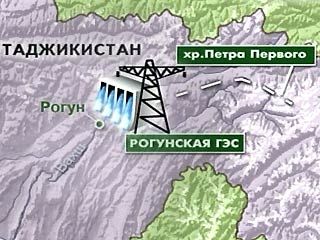
DUSHANBE, May 31, 2011, Asia-Plus — President Emomali Rahmon, accompanied by Mr. Struan Stevenson, a Member of the European Parliament and President of the European Parliament Intergroup on Climate Change, Biodiversity and Sustainable Development (EP/ ICCBSD), is visiting the site for construction of the Roghun hydroelectric power plant (HPP) today.
The source at the government says the main purpose of the visit is for the president to get acquainted with the pace of rehabilitation work at the site as well as living and working conditions of workers.
It is not the first visit of the EP/ICCBSD head to Tajikistan. Mr. Stevenson visited Tajikistan in September 2010 and met with a number of senior Tajik state officials.
In the article written after his visit to Tajikistan (the article was posted on the website of the Permanent Mission of Tajikistan to the OSCE in March 2011), Mr. Stevenson, who was also Personal Representative of the OSCE for the Ecology and Environment of Central Asia, noted that “…the mountainous landscape of Tajikistan means that scarce water resources and limited water availability are not a concern. However, as an upstream country, I acknowledge that Tajikistan has responsibilities towards its downstream neighbors. I concluded that Tajikistan takes this responsibility very seriously and indeed I was assured by senior government officials in Dushanbe that it never has and never will withhold water from its neighbors.”
“In terms of water policies my report notes that the Tajik government has a key objective to increase hydropower capacity and this is the main concern for other states in Central Asia. The Tajik government is currently trying to finish the Roghun and Sangtuda dam projects on the Vakhsh River. The Roghun project began in the 1980s but was halted during the Tajik Civil War in 1993.”
“Uzbekistan has vehemently objected to the Roghun project, claiming it would give control of the river’s flow to Tajikistan and could cause devastation if breached by an earthquake, but I have noted that such negative reactions are premature. In my report I suggest that Uzbekistan and other downstream nations in Central Asia should await the outcome of a critical analysis of the project by World Bank experts which is due to be published later this year.”
“I note in my report that it is common for tensions to arise between the upstream and downstream users of large dams… I am not surprised therefore, that tension has arisen over Tajikistan’s plans for Roghun. However, I clarify in the report that the upstream countries in Central Asia, (Tajikistan /Kyrgyzstan) possess nearly 90% of the region’s water resources and control the heads of Central Asia’s major rivers. However, the majority of water in Central Asia is consumed by the downstream countries – Kazakhstan, Turkmenistan and Uzbekistan – with the latter consuming the most. This upstream-downstream dichotomy has often been a source of tension and it has been suggested that conflict could ensue if a solution is not agreed upon soon. The key issue is the downstream states’ growing consumption of water for summer irrigation mirrored against the upstream states’ withholding of water to generate power for winter heating needs. I conclude in the report that the proper management of water by both the upstream and downstream nations is an essential prerequisite to avoiding future tension and conflict. I therefore seek assurances that the upstream countries will continue to provide a full flow of water during the summer months to enable irrigation to be carried out downstream. But I also call for proper water management in the downstream nations, insisting on concrete lined reservoirs and irrigation channels to prevent water loss and the introduction of droplet irrigation rather than wasteful flooding systems.”
“I note that President Rahmon’s laudable objectives can be realized through the Roghun project which can play an essential role in restoring economic prosperity to Tajikistan through the export of electricity to Pakistan and Afghanistan, while at the same time helping to stabilize economically these volatile neighboring countries.”