Annual OSCE preparatory human dimension implementation meeting held in Dushanbe

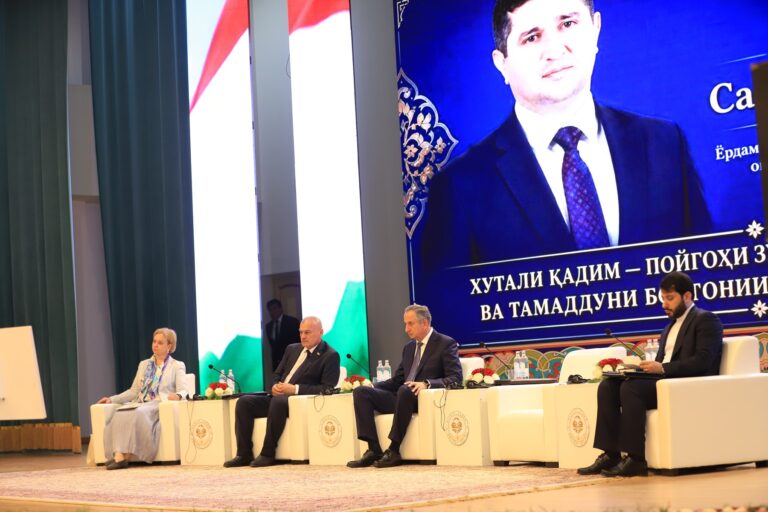
DUSHANBE, July 4, 2012, Asia-Plus  — The sixth annual OSCE Preparatory Human Dimension Implementation Meeting for government and civil society representatives to discuss human rights issues took place in Dushanbe on July 2-3.  Organized by the OSCE Office in Tajikistan and the Department on Constitutional Guarantees of Citizen Rights within President’s Executive Office in cooperation […]

Payrav Chorshanbiyev

DUSHANBE, July 4, 2012, Asia-Plus  — The sixth annual OSCE Preparatory Human Dimension Implementation Meeting for government and civil society representatives to discuss human rights issues took place in Dushanbe on July 2-3. 

Organized by the OSCE Office in Tajikistan and the Department on Constitutional Guarantees of Citizen Rights within President’s Executive Office in cooperation with civil society organizations from across the country, this year’s meeting brought together more than 120 participants, including representatives of the Office of the General Prosecutor, the Central Commission for Election and Referenda, Parliament, the Supreme Court and the Ministries of Interior, Health, Justice and Labor and Social Protection.  This year saw the participation of more than 30 representatives of non-governmental organizations and political parties from the regions alongside their national-level counterparts.

The meeting, held ahead of the OSCE-wide annual Human Dimension Implementation Meeting, which takes place in Warsaw in autumn, serves as an open forum to examine topical issues in human rights and the rule of law.

The agenda of this year’s meeting in Tajikistan was developed jointly by government and civil society representatives, with the OSCE Office facilitating the process. Sessions focused on freedom of expression and new media, freedom from torture, freedom of expression, freedom of religion, access to justice, human rights and counter-terrorism, property rights and forced resettlement, democratic standards of elections and political participation of youth.

“The intensity of this year’s discussion reflects the shared will of government and civil society to take measures to improve both the legal framework for human rights protection as well as the practical implementation of legislation,” said Ambassador Ivar Vikki, the Head of the OSCE Office in Tajikistan.

Muzaffar Ashourov, the Head of the Department of Constitutional Guarantees of Citizen Rights within President’s Executive, said: “Recommendations on key human rights issues resulting from this meeting will not be left without attention. They help us to develop effective policies for improving the framework for human rights protection.”

Join us on social media!

Article translations:

Related Article

Оби зулол
Оби зулол

Most Read

Акика Алиф

Recent Articles

The ministry of health states that hantavirus does not threaten Tajikistan

Cases of infection with this virus were detected on board the cruise liner Hondius near the Canary Islands.

Tajikistan lags behind other Central Asian countries in number of chain hotels – study

The Republic remains a niche market with a limited number of quality hotels.

Climate risks threaten food security in Central Asia – FAO

Land degradation reduces agricultural productivity. The loss of biodiversity weakens the ecosystems that farmers, livestock breeders, and rural communities depend on.

Potential or illusion? Why the world overlooks Tajikistan’s mineral wealth

The republic may indeed possess significant reserves of rare metals, but there is a catch...

The case of ousted Kyrgyz security boss classified and moves to court

The former head of the GKNB is charged with violent seizure of power and abuse of official position.

Trump states that Iran’s nuclear program is a higher priority than U.S. citizens’ economic issues

Fluctuations in energy prices led to record inflation in the United States in April, the highest in the past three years.

Foot-and-mouth disease, plague, and flu: Central Asia threatened by transboundary animal diseases

FAO urges Central Asian countries to strengthen coordination and epidemiological surveillance.

Tajikistan approves the second phase of the Electric Transport Development Program; $95 million will be allocated for its implementation.

At this stage, the authorities are focusing on charging infrastructure, services for electric vehicles, and the expansion of the electric bus fleet.

Tajikistan and Kazakhstan to sign roadmap for cooperation in the agrarian sector

The parties are interested in expanding investment cooperation and establishing joint ventures.