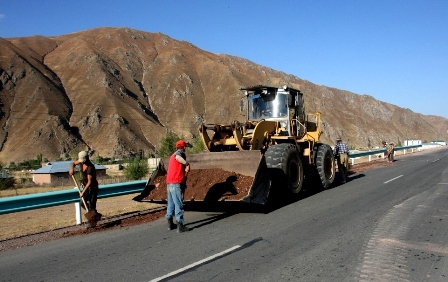
DUSHANBE, September 13, 2012, Asia-Plus — The Asian Development Bank (ADB) is providing a $100 million grant to help Tajikistan upgrade a vital road between Ayni-Panjakent and the Uzbek border in northern Tajikistan, press release issued by the ADB Tajikistan Resident Mission (TJRM) on September 13 said.
The road is part of the Central Asia Regional Economic Cooperation (CAREC) Corridor 6 that spans about 10,000 km linking Europe and the Russian Federation to the Middle East and South Asia.
The 113-kilometer road — part of the historic Silk Road — runs along the Zarafshon River through the Zarafshon Valley, crossing the Ayni and Panjakent districts before ending at the border with Uzbekistan.
“Improvements to this road will increase regional connectivity, reduce transport costs, and strengthen competitiveness,” said Zheng Wu, Transport Specialist at ADB’s Central and West Asia Department. “This will also improve access to markets and social services for impoverished local communities; stimulate development of agriculture, tourism and mining industries that in return create job opportunities; and improve the region’s living standards.”
The grant will finance road upgrading and improvements to drainage structures and bridges, improve of road safety, upgrade the Sarazm border post infrastructure, and bolster community development, including improving feeder roads, public facilities and training local communities.
The grant will be sourced from the Asian Development Fund.
Tajikistan joined ADB in 1998, and to date the institution has cumulatively approved a total assistance of more than $966 million in concessional loans, grants and technical assistance to the country. ADB’s operations benefit the population by reducing isolation, increasing communication, broadening access to electricity, improving social services, and creating more income-generating opportunities.
CAREC promotes project-based cooperation in transport, energy, trade facilitation, and trade policy. The CAREC partnership comprises 10 countries — Afghanistan, Azerbaijan, China, Kazakhstan, Kyrgyzstan, Mongolia, Pakistan, Tajikistan, Turkmenistan, and Uzbekistan — and six multilateral institutions: ADB, the European Bank for Reconstruction and Development, the International Monetary Fund, the Islamic Development Bank, the United Nations Development Programme, and the World Bank. ADB has served as the CAREC Secretariat since 2001.
ADB, based in Manila, is dedicated to reducing poverty in Asia and the Pacific through inclusive economic growth, environmentally sustainable growth and regional integration. Established in 1966, it is owned by 67 members – 48 from the region. In 2011, ADB approvals including cofinancing totaled $21.7 billion.