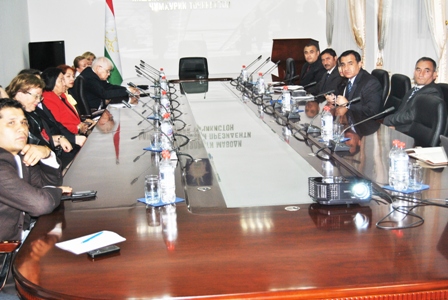
DUSHANBE, October 31, 2012, Asia-Plus — A two-day conference formally “Effective Legal Remedies for Migrant Workers: Role of Ombudsmen of Russian Federation and Central Asia” concluded in Dushanbe today.
Organized by Tajik Ombudsman’s Office in cooperation with the Tajik NGAO Human Rights Center, the conference was held in the framework of the Regional Migration Programme in Central Asia and Russia implemented by UN Women, IOM and WB with a financial support of UK Government and the Project “Strengthening Capacity of the Human Rights Ombudsman of Tajikistan to Protect and Promote Rights of Tajik Migrant Workers” funded by the Human Rights Programme of Switzerland.
The aim of the conference was to strengthen cooperation between Ombudsmen of CA and Russia and NGOs providing services for migrants, to increase the level of their accountability on fulfillment of international obligations by UN member-states in the area of the protection of rights of migrant workers, and to agree on practical mechanisms for cooperation to protect rights of migrants and members of their families.
Within the CIA area, Tajikistan, Kyrgyzstan and Uzbekistan are the major providers of migrant workers predominantly to the Russian Federation and Kazakhstan. The key challenge reportedly lies in the fact that the majority of them do not have sufficient vocational skills, and the level of their education is, in general, low. The problem is exacerbated by legal illiteracy and lack of knowledge of languages of countries of destination of migrants, in particular Russian. These factors contribute to their vulnerability and discrimination and may also lead to labor exploitation and slavery.
In order to respond to these challenges ombudsmen of countries of origin and countries of destination, in particular Tajikistan, Kyrgyzstan, Kazakhstan and Russia – initiated establishment of joint cooperation in this area, in order to develop mechanisms and define practical measures that will be directed to ensuring adequate legal counseling to migrant workers in case of violation of their rights.
The conference reportedly brought together the Ombudsmen and civil society organizations, as well as Government and international representatives. Concurrently, it is the first occasion, where Swiss Ambassador to Tajikistan based in Astana, a representative from the Swiss Embassy in Moscow as well as the Swiss Cooperation Office in Tajikistan jointly attended, which underlines the significance Swiss Government attaches to the migration issues.
UN Resident Coordinator for Tajikistan supports this initiative and on behalf of UN agencies working in the area of labor migration has highlighted importance to follow the international human rights and gender quality commitments and standards for development, implementation and monitoring of the national policy and interstate agreements regulating labor migration.
The agenda of the conference also included panel discussions and follow-up of results of the working visit paid by the Ombudsman of Tajikistan to Sverdlovsk region in September 2012 as well as follow-up to discussions organized by Ombudsman of Tajikistan, Ombudsman of Sverdlovsk region and UN Women in Dushanbe on December 5, 2011. The meeting was reportedly attended by a member of UN committee on migrants’ rights.