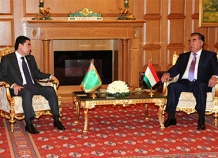
DUSHANBE, December 14, 2015, Asia-Plus – Tajik President Emomali Rahmon held talks with his Turkmen counterpart Gurbanguly Berdymukhammedov in the Turkmen capital, Ashgabat, on December 11.
According to the Tajik president’s official website, Rahmon, heading a high-ranking delegation, arrived in Ashgabat last Friday to participate on events dedicated to the 20th anniversary of Turkmenistan neutrality.
The two leaders reportedly discussed a broad range of issues related to trade, economic, transport, energy and cultural cooperation between their countries.
Rahmon and Berdymukhammedov also exchanged views on of the issues of providing regional security and addressing modern challenges and threats.
On the same day, President Rahmon attended an international conference entitled “The Politics of Neutrality: International Cooperation for the Sake of Peace, Stability and Development.”
The conference reportedly brought together senior representatives of international and regional organizations, statesmen, chiefs of diplomatic missions active in Turkmenistan, Turkmen parliamentarians, chief editors and rectors of Turkmen universities to discuss the significance o Turkmenistan neutrality for providing regional and global peace, security and sustainable development.
Meanwhile, some media outlets report Turkmenistan celebrated 20th anniversary of Permanent Neutrality in the presence of delegates from around 70 countries, including Tajikistan, in Ashgabat on December 12.
For the first time in the history of the UNGA the adoption of the Special Resolution on December 12, 1995, entitled “On the Permanent Neutrality of Turkmenistan” became a recognition of the peaceful foreign policy of this country and an approval of the authoritative role of Turkmenistan as a state that can make a worthy contribution to the peaceful development of international relations and ensuring universal security and steady progress.
Turkmen neutrality model assumes that contemporary international law is the law of peace and that constantly a neutral state must adhere to its status not only in wartime, but also in peacetime.
The international legal status of permanent neutrality of Turkmenistan is enshrined in its current Constitution and the special resolution 50/80 of the General Assembly of December 12, 1995 “A Permanent Neutrality of Turkmenistan”, and is supported by a number of documents of international organizations and bilateral agreements, statements, declarations, as well as communiqués signed with other countries.
This year, Turkmenistan adopted one more document. That was according to the UN News Centre, on June 3, 2015, 193 states at the 69th session of the UN General Assembly unanimously adopted a resolution titled as “Permanent Neutrality of Turkmenistan.” 47 states became the co-authors of the document.
The document, welcomed the government’s decision to declare the 2015 as the Year of Neutrality and Peace as well as to host the international conference on topic “The policy of neutrality: international cooperation for peace, security and development” in December, 2015.
In the adopted resolution, the General Assembly reiterated its support for the status of permanent Neutrality of Turkmenistan and called on the States – members of the United Nations to respect and support this status as well as to respect the independence, sovereignty and territorial integrity of Turkmenistan.
Resolution says that status of permanent Neutrality of Turkmenistan contributes to the strengthening of peace and security in the region. The active and positive role which Turkmenistan plays in the development of peaceful, friendly and mutually beneficial relations with the countries of the region and other countries of the world was noted in the resolution.