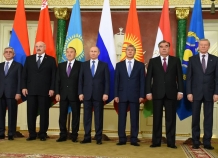
DUSHANBE, December 22, 2015, Asia-Plus – Russian media outlets report that the leaders of the Collective Security Treaty Organization (CSTO) member countries call for forming a broad coalition on the basis of UN Charter, norms and principles of international law without politicizing and preconditions.
Tass
news agency reports that a joint statement signed after the CSTO summit in Moscow said on December 21 that CSTO member countries consider fighting against the Islamic State (IS) terrorist organization as top priority and note growing security threats in Central Asia.
“We see as a priority task the decisive fight against the ISIL (Islamic State of Iraq and the Levant — former name of IS) terrorist group that has unleashed cruel bloodshed in many countries and presents a threat to the entire humanity,” the document said.
“We note the growth of security threats in Central Asia connected with activities of IS, the Taliban movement, Al-Qaeda and other terrorist organizations on the territory of Afghanistan which leads to escalation of tensions on CSTO’s southern borders, directly threatening with destabilization of the situation in the area of its (CSTO’s) responsibility,” the statement added.
The document noted that CSTO member states call on all countries to strictly comply with requirements of anti-terrorist resolutions of UN Security Council and General Assembly. The leaders of CSTO member countries also called for forming a broad coalition on the basis of UN Charter, norms and principles of international law without politicizing and preconditions.
“We pay much attention to further strengthening the package of measures aimed at fighting against the ideology of international terrorism and religious extremism. We are confident that in order to strengthen civil immunity to distribution of radical ideas, it is necessary to add to efforts of relevant state authorities the potential of public structures, media and religious confessions,” the statement said.
The regional security organization was initially formed in 1992 for a five-year period by the members of the CIS Collective Security Treaty (CST) — Armenia, Kazakhstan, Kyrgyzstan, Russia, Tajikistan, and Uzbekistan, which were joined by Azerbaijan, Georgia, and Belarus the following year. A 1994 treaty reaffirmed the desire of all participating states to abstain from the use or threat of force, and prevented signatories from joining any “other military alliances or other groups of states” directed against members states. The CST was then extended for another five-year term in April 1999, and was signed by the presidents of Armenia, Belarus, Kazakhstan, Kyrgyzstan, Russia, and Tajikistan. In October 2002, the group was renamed as the CSTO. Uzbekistan that suspended its membership in 1999 returned to the CSTO again in 2006 after it came under international criticism for its brutal crackdown of antigovernment demonstrations in the eastern city of Andijon in May 2005. On June 28, 2012, Uzbekistan announced that it has suspended its membership of the CSTO, saying the organization ignores Uzbekistan and does not consider its views. The CSTO is currently an observer organization at the United Nations General Assembly.