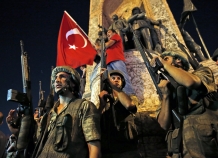
DUSHANBE, July 18, 2016, Asia-Plus — Since its founding, the Turkish Republic has endured its share of military intervention in politics, and seen four coups – two of them forced a change of government without taking over.
They have all had grave consequences, and shattered many lives. But nothing compares to what happened on the night of July 15, 2016.
Even though there was talk of the mid-ranks of the military being unhappy with President Recep Tayyip Erdogan”s illiberal policies, a coup was highly unlikely, many reckoned,
BBC
said, noting that there are several reasons for this.
Firstly, restraining the military”s presence in politics was one of the governing AK party”s main pledges, since its second term of office.
In 2007, the then chief of the armed forces, Gen Yasar Buyukanit, opposed Abdullah Gul – an AKP founder and long-time comrade of Mr. Erodgan”s – becoming president.
The AKP and parliament ignored Gen Buyukanit”s intervention and elected Mr Gul anyway.
But the general”s attempt to shape government affairs suggested a conflict between the AKP and the military, and it increased support for the AKP.
A month after Gen Buyukanit”s intervention, the long-running and high-profile criminal investigation into Ergenekon began.
Ergenekon, according to the indictment, was a terrorist organization consisting of secular nationalists in the “deep state” – within the political system.
They had allegedly plotted assassinations and bomb attacks to oust the government and had been influencing the Turkish political sphere for decades.
Among those accused was a former armed forces chief, Gen Ilker Basbug.
In 2010, another high profile case called Sledgehammer (Balyoz) started, which led to the incarceration of 300 army officials.
They were accused of plotting a 2003 coup against the AKP government, but the majority of the evidence was found to have been fabricated.
All defendants in both trials were acquitted.
It is now acknowledged the trials were orchestrated by followers of Fethullah Gulen in the military, intelligence, police and judiciary. Gulen is an influential Islamic cleric who has been in exile in Pennsylvania since 1999.
The AK party relied on the Gulen movement to eliminate the secularist establishment in the state and the military,
BBC
reports.
President Erdogan vowed to cleanse the country of what he called a “terrorist parallel state”, staging arrests. But he has admitted that it is taking time.
Still, Mr Erdogan seemed to be in control with top-ranking officials on his side.
It looks as if the coup attempt of July 15 was staged mainly by the gendarmerie and air force personnel, according to
BBC
.
Key parts of the military fiercely condemned the coup attempt.
BBC
reports that one theory suggests it was a “false flag” event staged by President Erdogan to gain more power, but common sense dictates the event went too far to be a false flag.
Another theory embraced by the Kurdish movement is that Kemalists – secular followers of the founder of modern Turkey, Mustafa Kemal Ataturk – in the army tricked the Gulenists into staging a coup. They knew it would fail and that it would lead to a long-awaited cleansing of Gulenists from the military.
Another theory stems from a police source, who said that the AKP government had been planning to arrest Gulen-supporting army officials on July 16. The source claims that when the coup-plotters learned about this, they went ahead and initiated the coup earlier than planned – hence the sloppiness.
President Erdogan and his ministers blame the Gulen movement for the coup, and say that this attempt is the group”s last gasp.
The Guardian
reports that cleric who leads global Hizmet movement from exile in Pennyslvania, US, is a critic of Recep Tayyip Erdoğan and remains influential in Turkish affairs.
Fethulla Gulen, a cleric living in reclusive exile in Pennsylvania, leads a popular movement called Hizmet. It is a hodge-podge that at times has appeared cultish – spawning think tanks, businesses, schools and publications across the globe, while building up substantial wealth and influence in the process.
The Guardian
says that according to some reports, 10% of the Turkish population is estimated to support Hizmet.
Meanwhile, a statement released by the Turkish Embassy in Dushanbe says that the situation unfolded in Turkey was a coup attempt to overthrow the democratically-elected government. This attempt was foiled by the Turkish people in unity and solidarity.
“Our President and Government are in charge. Turkish Armed Forces was not involved in the coup attempt in its entirety.
“It was conducted by a clique within the Armed Forces and received a well-deserved response from our nation,” the statement says.