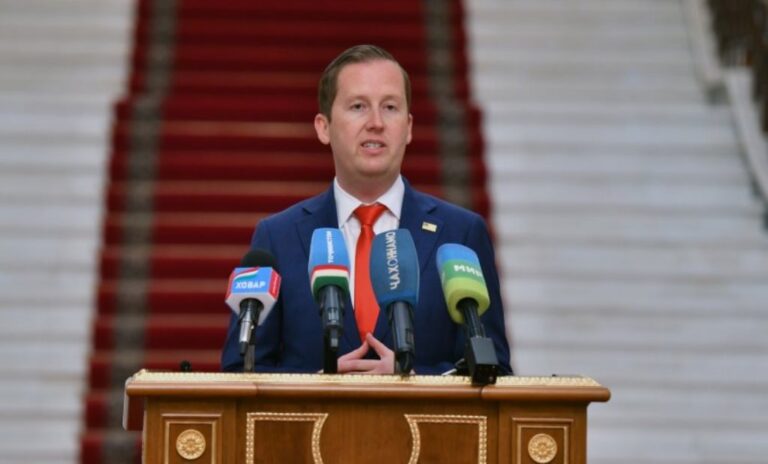
DUSHANBE, August 17, 2016, Asia-Plus – Tajik Foreign Minister Sirojiddin Aslov yesterday received U.S. Ambassador to Tajikistan Elizabeth I. Millard.
According to the Tajik MFA information department, the two discussed state and prospects of further expansion of bilateral cooperation between Tajikistan and the United States.
Aslov and Millard also discussed the results of the second ministerial level meeting in the C5+1 format that took place in Washington on August 3 and a number of other issues being of mutual interest.
Recall that the U.S. Secretary of State and the foreign ministers of Kazakhstan, Kyrgyzstan, Tajikistan, Turkmenistan, and Uzbekistan, following the second ministerial level meeting together issued the Second Joint Declaration of Partnership and Cooperation.
The six foreign ministers declare the intention of their countries to:
– Enhance the C5+1 diplomatic platform further as a mechanism for dialogue and joint action through future ministerial meetings devoted to the exchange of views on issues of common interest, through implementation of mutually-agreed projects, and future C5+1 events;
– Implement trade facilitation measures and advance development of transportation corridors across the region to increase access to markets, improve productivity and efficiency of transport, and strengthen competitiveness in the region and in international markets;
– Strengthen logistics sectors across Central Asia to facilitate regional trade and promote investment potential;
– Enhance the region’s favorable business climate to attract foreign direct investment and facilitate local entrepreneurship, and broaden and strengthen business and investment contacts among the Central Asian countries and the United States;
– Contribute to the development of the region’s renewable energy resources;
– Support regional, national, and local-level planning and implementation of the measures to prepare for and adapt to the impact of climate change;
– Enhance cooperation to prevent and counter transboundary threats and challenges such as terrorism, and the trafficking of weapons of mass destruction, illicit drugs and human beings;
– Contribute to global and regional efforts on nonproliferation of weapons of mass destruction, including by respecting the provisions of the Treaty on a Nuclear-Weapons-Free Zone in Central Asia and pursuing entry into force of the Treaty’s Protocol;
– Increase dialogue on threats from foreign terrorist fighters, and exchange best practices on countering terrorism and preventing radicalization to violence;
– Continue support to Afghanistan and its development as an independent, peaceful, thriving state, recognizing that the situation in Afghanistan remains an important factor in security and stability of the entire region;
– Further develop cooperation in the humanitarian sphere and more extensive people-to-people ties and encourage wider educational, cultural, and business exchanges;
– Protect human rights, develop democratic institutions and practices, and strengthen civil society through respect for recognized norms, and principles of international law, including the United Nations Charter, the Universal Declaration of Human Rights, the Declaration on Principles of International Law, the Helsinki Final Act of the Conference on Security and Co-operation in Europe;
– Align the projects and dialogues with other international partner C5 formats on issues of common interest.